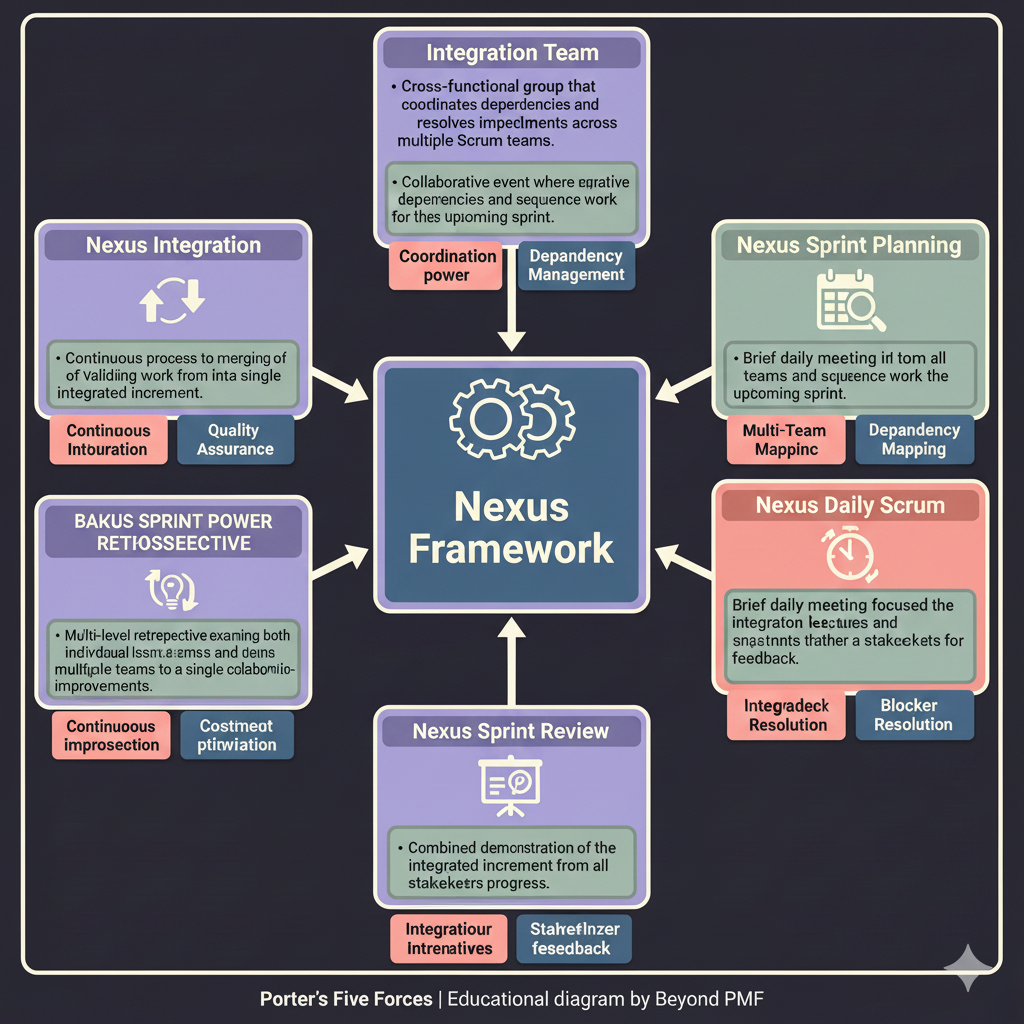
Nexus Framework

https://ik.imagekit.io/beyondpmf/frameworks/nexus-framework.png
The Nexus Framework primarily addresses the friction of coordinating and orchestrating multiple Scrum teams working on the same product. It focuses on processes, handovers, and governance at scale, ensuring smooth workflows across teams.

The Nexus Framework is designed to help organizations scale Scrum by coordinating the work of multiple Scrum teams working on a single product. It provides a structured approach to overcoming challenges such as integration, dependency management, and shared responsibility. The framework emphasizes transparency, accountability, and regular inspection and adaptation to optimize the productivity and effectiveness of large-scale projects.

Steps / Detailed Description

Form the Nexus Integration Team (NIT) to oversee and coordinate the work of all Scrum teams. | Define a single Product Backlog for clear prioritization and vision. | Conduct synchronized Sprint Planning across teams to align efforts and objectives. | Hold daily Nexus Scrum meetings to address integration issues and dependencies. | Implement Nexus Sprint Review and Retrospective to inspect progress and adapt processes.

Best Practices

Ensure strong leadership and commitment from the Nexus Integration Team | Maintain clear and constant communication across all teams | Regularly review and adapt the framework to fit the organization's evolving needs

Pros

Enhances coordination and integration among multiple Scrum teams | Improves scalability of agile practices in larger organizations | Facilitates consistent delivery of high-quality products

Cons

Can be complex to implement and manage | Requires high levels of commitment and collaboration from all team members | May lead to bureaucratic overhead if not implemented carefully

When to Use

When scaling Scrum across multiple teams working on the same product | In large projects requiring frequent integration and coordination

When Not to Use

For small projects that can be managed with a single Scrum team | When the organization is not ready to adopt rigorous agile practices

Related Frameworks

Categories

Lifecycle

Scope

Scope not defined

Maturity Level

Maturity level not specified

Time to Implement

2–4 Weeks
3–6 Months
1–2 Weeks
3–6 Months
1–2 Months
3–6 Months
1–2 Weeks
Less Than 1 Day
1–2 Weeks
Longer Than 6 Months
1–2 Weeks
Longer Than 6 Months
1–2 Weeks
3–6 Months
1–2 Weeks
1–2 Weeks
1–2 Weeks
1–2 Weeks
1–2 Days
1–2 Weeks
1–2 Weeks
1–2 Weeks
1–2 Weeks
1–2 Weeks
1–2 Weeks
3–6 Months
1–2 Weeks
1–2 Weeks
1–2 Weeks
3–6 Months
1–2 Weeks
1–2 Weeks
2–4 Weeks
1–2 Weeks
1–2 Days
1–2 Weeks
Longer Than 6 Months
3–6 Months
Longer Than 6 Months
1–2 Weeks
Longer Than 6 Months
3–6 Months
Less Than 1 Day
3–6 Months
1–2 Months
3–6 Months
Longer Than 6 Months
3–6 Months
Less Than 1 Day
1–2 Weeks
3–6 Months
3–6 Months
1–2 Weeks
3–6 Months
1–2 Weeks
1–2 Weeks
1–2 Days
1–2 Weeks
1–2 Months
Longer Than 6 Months
1–2 Weeks
Longer Than 6 Months
1–2 Weeks
3–6 Months
1–2 Weeks
Less Than 1 Day
1–2 Weeks
3–6 Months
1–2 Weeks
3–6 Months
1–2 Weeks
1–2 Weeks
Longer Than 6 Months
Less Than 1 Day
3–6 Months
Longer Than 6 Months
1–2 Months
1–2 Weeks
Longer Than 6 Months
1–2 Weeks
3–6 Months
1–2 Weeks
1–2 Weeks
3–6 Months
Less Than 1 Day
1–2 Weeks
1–2 Weeks
3–6 Months
3–6 Months
Less Than 1 Day
1–2 Weeks
Longer Than 6 Months
1–2 Months
1–2 Weeks
1–2 Weeks
1–2 Weeks
Longer Than 6 Months

Copyright Information

Autor:
Ken Schwaber
2015
Publication:
Scrum.org