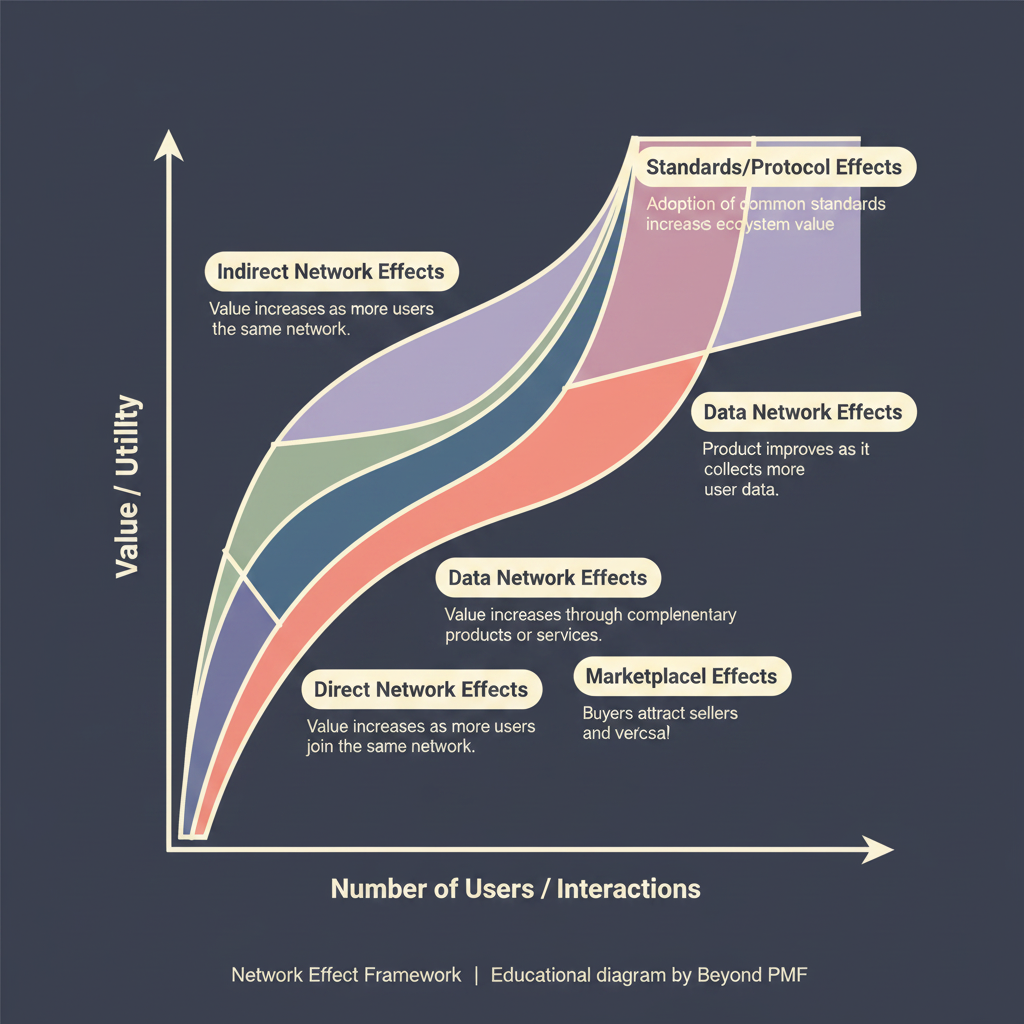
Network Effect Framework

https://ik.imagekit.io/beyondpmf/frameworks/network-effect-framework.png
The Network Effect Framework primarily addresses the strategic friction of understanding how a product or service gains value from its user base. It helps in formulating a strategy around user acquisition, market positioning, and potentially business model decisions that exploit network effects.

The Network Effect Framework is a strategic tool used to evaluate and enhance the value of a product or service based on its user base. It emphasizes the importance of each additional user increasing the value of a service to others. This framework is crucial for businesses aiming to leverage user growth to create competitive advantages and ensure sustainability.

Steps / Detailed Description

Identify potential network effects in the product or service. | Analyze current user interactions and how they contribute to the network's value. | Develop strategies to maximize user engagement and attract new users. | Implement features that enhance connectivity and interaction among users. | Measure the impact of network effects on product adoption and user retention.

Best Practices

Focus on early user acquisition and retention | Encourage user interaction to strengthen network effects | Regularly analyze network performance and user feedback

Pros

Enhances product value with increased user base | Creates barriers to entry for competitors | Facilitates faster growth and scalability

Cons

Difficult to initiate without a critical mass of users | High dependency on continuous user growth | Potential for negative effects if user base declines

When to Use

When launching a new platform or service | In markets where user interaction adds significant value

When Not to Use

For niche products with limited user interaction | In highly regulated markets where rapid scaling is restricted

Related Frameworks

Lifecycle

Not tied to a specific lifecycle stage

Scope

Scope not defined

Maturity Level

Maturity level not specified

Time to Implement

2–4 Weeks
3–6 Months
1–2 Weeks
3–6 Months
1–2 Months
3–6 Months
1–2 Weeks
Less Than 1 Day
1–2 Weeks
Longer Than 6 Months
1–2 Weeks
Longer Than 6 Months
1–2 Weeks
3–6 Months
1–2 Weeks
1–2 Weeks
1–2 Weeks
1–2 Weeks
1–2 Days
1–2 Weeks
1–2 Weeks
1–2 Weeks
1–2 Weeks
1–2 Weeks
1–2 Weeks
3–6 Months
1–2 Weeks
1–2 Weeks
1–2 Weeks
3–6 Months
1–2 Weeks
1–2 Weeks
2–4 Weeks
1–2 Weeks
1–2 Days
1–2 Weeks
Longer Than 6 Months
3–6 Months
Longer Than 6 Months
1–2 Weeks
Longer Than 6 Months
3–6 Months
Less Than 1 Day
3–6 Months
1–2 Months
3–6 Months
Longer Than 6 Months
3–6 Months
Less Than 1 Day
1–2 Weeks
3–6 Months
3–6 Months
1–2 Weeks
3–6 Months
1–2 Weeks
1–2 Weeks
1–2 Days
1–2 Weeks
1–2 Months
Longer Than 6 Months
1–2 Weeks
Longer Than 6 Months
1–2 Weeks
3–6 Months
1–2 Weeks
Less Than 1 Day
1–2 Weeks
3–6 Months
1–2 Weeks
3–6 Months
1–2 Weeks
1–2 Weeks
Longer Than 6 Months
Less Than 1 Day
3–6 Months
Longer Than 6 Months
1–2 Months
1–2 Weeks
Longer Than 6 Months
1–2 Weeks
3–6 Months
1–2 Weeks
1–2 Weeks
3–6 Months
Less Than 1 Day
1–2 Weeks
1–2 Weeks
3–6 Months
3–6 Months
Less Than 1 Day
1–2 Weeks
Longer Than 6 Months
1–2 Months
1–2 Weeks
1–2 Weeks
1–2 Weeks
Longer Than 6 Months

Copyright Information

Autor:
Public Domain
N/A
Publication:
Generic Business Tool