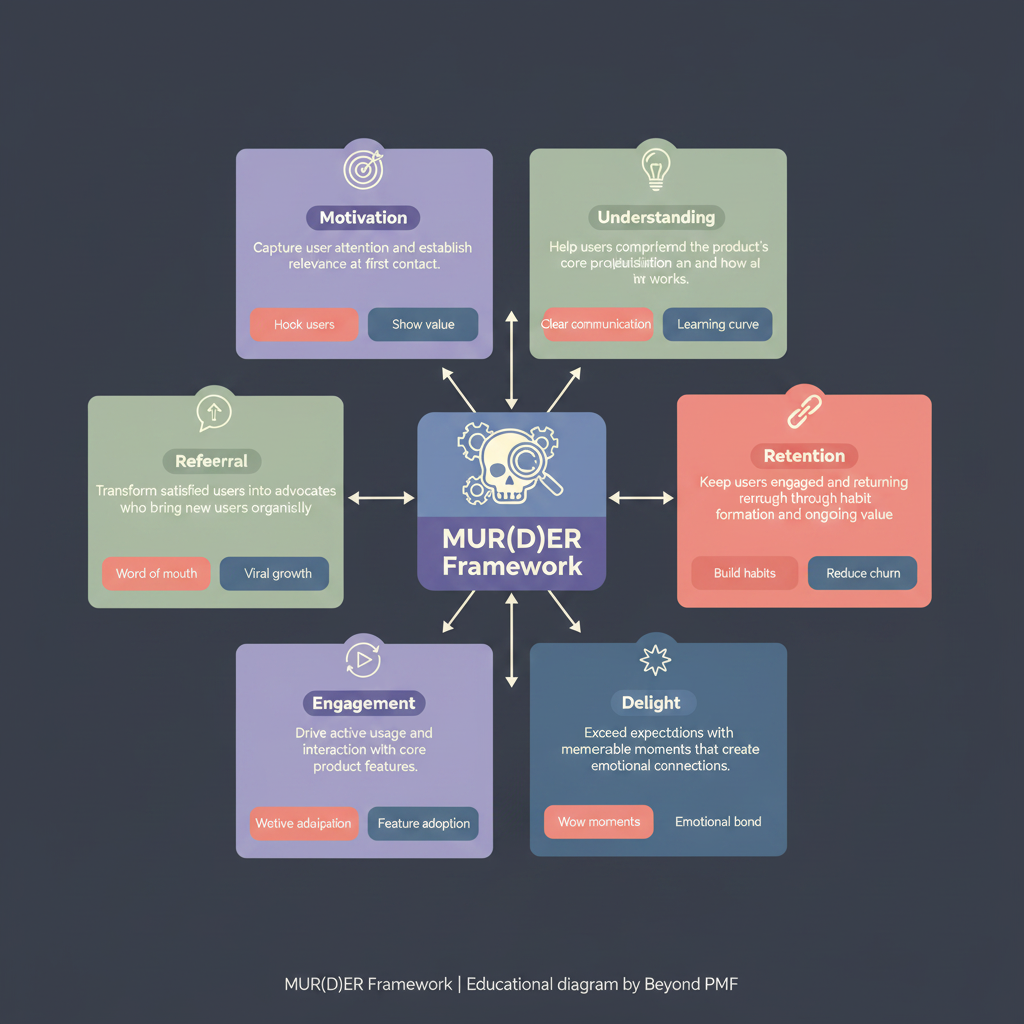
MUR(D)ER Framework

https://ik.imagekit.io/beyondpmf/frameworks/mur-d-er-framework.png
The MUR(D)ER Framework, being a strategic tool for problem-solving and decision-making, primarily addresses friction related to unclear direction and conflicting priorities within a complex business environment. It helps guide the process of defining the 'what' and 'why' of business decisions.

The MUR(D)ER Framework is a structured approach designed to tackle complex problems by breaking them down into manageable components. It emphasizes a systematic examination of each aspect of a problem or decision, ensuring thorough analysis and effective solutions. This framework is particularly beneficial for its ability to provide clear guidance and structure in ambiguous situations, making it a valuable tool for managers and leaders.

Steps / Detailed Description

Define the problem clearly to understand its nature and implications. | Gather relevant data and insights to inform the decision-making process. | Generate potential solutions by brainstorming and leveraging diverse perspectives. | Evaluate the solutions based on criteria such as feasibility, impact, and resources required. | Decide on the best solution and plan for its implementation. | Review the results post-implementation to assess effectiveness and learn for future applications.

Best Practices

Clearly define all terms and criteria before starting the process | Ensure diverse input and perspectives in the brainstorming phase | Regularly review and refine the process based on past outcomes

Pros

Provides a structured approach to problem-solving | Facilitates thorough analysis and informed decision-making | Encourages continuous improvement through post-implementation reviews

Cons

Can be time-consuming | May require significant resources to implement effectively | Risk of over-complication in simpler scenarios

When to Use

When facing complex, multi-faceted business problems | In strategic planning and major decision-making scenarios

When Not to Use

For simple or straightforward decisions | When quick action is required without the need for detailed analysis

Related Frameworks

Lifecycle

Not tied to a specific lifecycle stage

Scope

Scope not defined

Maturity Level

Maturity level not specified

Time to Implement

2–4 Weeks
3–6 Months
1–2 Weeks
3–6 Months
1–2 Months
3–6 Months
1–2 Weeks
Less Than 1 Day
1–2 Weeks
Longer Than 6 Months
1–2 Weeks
Longer Than 6 Months
1–2 Weeks
3–6 Months
1–2 Weeks
1–2 Weeks
1–2 Weeks
1–2 Weeks
1–2 Days
1–2 Weeks
1–2 Weeks
1–2 Weeks
1–2 Weeks
1–2 Weeks
1–2 Weeks
3–6 Months
1–2 Weeks
1–2 Weeks
1–2 Weeks
3–6 Months
1–2 Weeks
1–2 Weeks
2–4 Weeks
1–2 Weeks
1–2 Days
1–2 Weeks
Longer Than 6 Months
3–6 Months
Longer Than 6 Months
1–2 Weeks
Longer Than 6 Months
3–6 Months
Less Than 1 Day
3–6 Months
1–2 Months
3–6 Months
Longer Than 6 Months
3–6 Months
Less Than 1 Day
1–2 Weeks
3–6 Months
3–6 Months
1–2 Weeks
3–6 Months
1–2 Weeks
1–2 Weeks
1–2 Days
1–2 Weeks
1–2 Months
Longer Than 6 Months
1–2 Weeks
Longer Than 6 Months
1–2 Weeks
3–6 Months
1–2 Weeks
Less Than 1 Day
1–2 Weeks
3–6 Months
1–2 Weeks
3–6 Months
1–2 Weeks
1–2 Weeks
Longer Than 6 Months
Less Than 1 Day
3–6 Months
Longer Than 6 Months
1–2 Months
1–2 Weeks
Longer Than 6 Months
1–2 Weeks
3–6 Months
1–2 Weeks
1–2 Weeks
3–6 Months
Less Than 1 Day
1–2 Weeks
1–2 Weeks
3–6 Months
3–6 Months
Less Than 1 Day
1–2 Weeks
Longer Than 6 Months
1–2 Months
1–2 Weeks
1–2 Weeks
1–2 Weeks
Longer Than 6 Months

Copyright Information

Autor:
Unknown
N/A
Publication:
Unknown