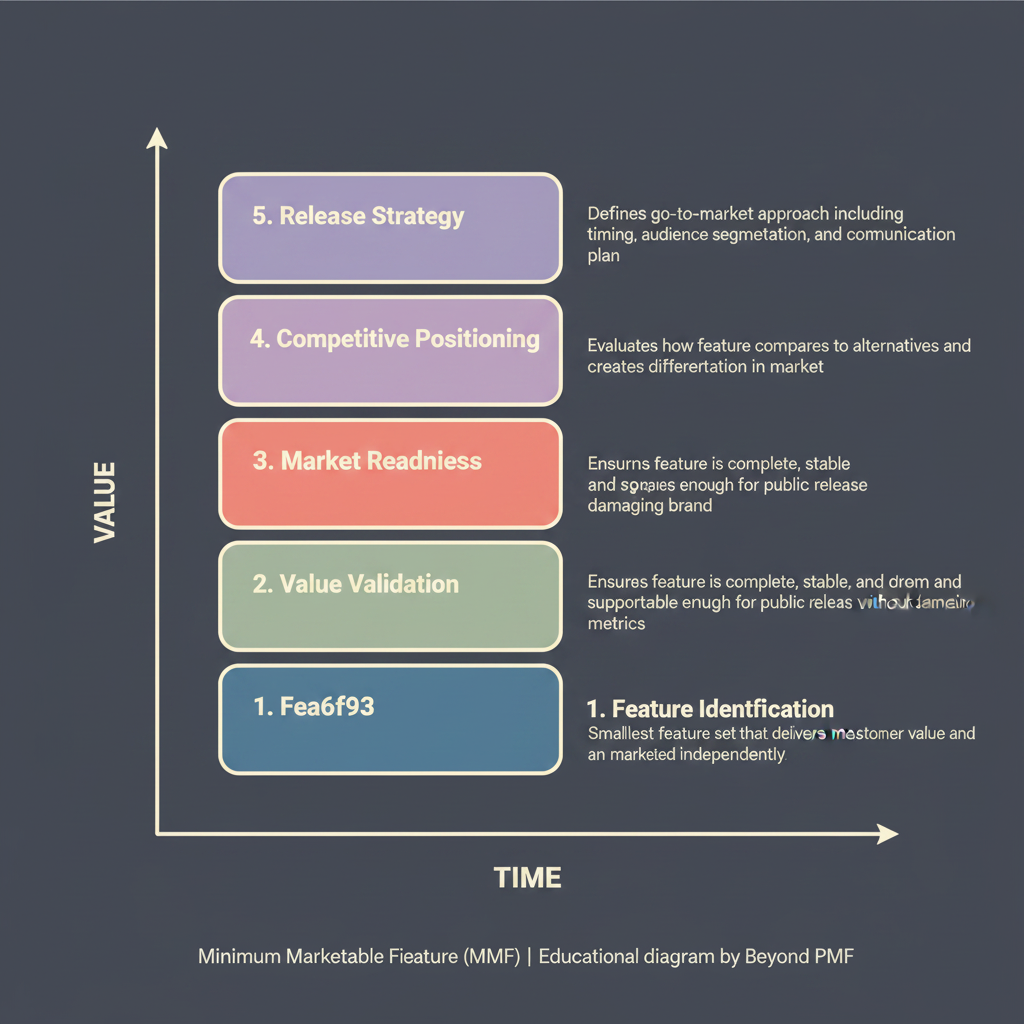
Minimum Marketable Feature (MMF)

MMF primarily addresses execution friction by focusing on delivering a valuable product to users quickly. It helps prioritize features for implementation and minimizes the risk of over-engineering, ultimately improving the customer experience.

The Minimum Marketable Feature (MMF) framework is used to determine the smallest subset of functionality that can be delivered to customers and still provide value. This approach helps in prioritizing development efforts, reducing time to market, and focusing on core functionalities that meet customer needs. By implementing MMFs, organizations can ensure that they are not overbuilding their products and are efficiently utilizing their resources.

Steps / Detailed Description

Identify the core value proposition of the product. | Break down the product features into smaller components. | Evaluate each component based on its potential impact and value to the customer. | Select the feature set that represents the minimum viable increment that can be marketed. | Develop, test, and refine the selected features. | Release the MMF to the market. | Gather feedback and iterate on the product.

Best Practices

Regularly review customer feedback | Prioritize features based on value and impact | Iterate quickly based on market response

Pros

Faster time to market | Reduced development costs | Focused product development on core value

Cons

Risk of underestimating customer needs | Potential for frequent iterations | May overlook long-term product vision

When to Use

When launching a new product | When entering a competitive market quickly is crucial

When Not to Use

For products requiring comprehensive features at launch | When the market demands a highly polished product

Related Frameworks

Categories

Lifecycle

Scope

Scope not defined

Maturity Level

Maturity level not specified

Time to Implement

2–4 Weeks
3–6 Months
1–2 Weeks
3–6 Months
1–2 Months
3–6 Months
1–2 Weeks
Less Than 1 Day
1–2 Weeks
Longer Than 6 Months
1–2 Weeks
Longer Than 6 Months
1–2 Weeks
3–6 Months
1–2 Weeks
1–2 Weeks
1–2 Weeks
1–2 Weeks
1–2 Days
1–2 Weeks
1–2 Weeks
1–2 Weeks
1–2 Weeks
1–2 Weeks
1–2 Weeks
3–6 Months
1–2 Weeks
1–2 Weeks
1–2 Weeks
3–6 Months
1–2 Weeks
1–2 Weeks
2–4 Weeks
1–2 Weeks
1–2 Days
1–2 Weeks
Longer Than 6 Months
3–6 Months
Longer Than 6 Months
1–2 Weeks
Longer Than 6 Months
3–6 Months
Less Than 1 Day
3–6 Months
1–2 Months
3–6 Months
Longer Than 6 Months
3–6 Months
Less Than 1 Day
1–2 Weeks
3–6 Months
3–6 Months
1–2 Weeks
3–6 Months
1–2 Weeks
1–2 Weeks
1–2 Days
1–2 Weeks
1–2 Months
Longer Than 6 Months
1–2 Weeks
Longer Than 6 Months
1–2 Weeks
3–6 Months
1–2 Weeks
Less Than 1 Day
1–2 Weeks
3–6 Months
1–2 Weeks
3–6 Months
1–2 Weeks
1–2 Weeks
Longer Than 6 Months
Less Than 1 Day
3–6 Months
Longer Than 6 Months
1–2 Months
1–2 Weeks
Longer Than 6 Months
1–2 Weeks
3–6 Months
1–2 Weeks
1–2 Weeks
3–6 Months
Less Than 1 Day
1–2 Weeks
1–2 Weeks
3–6 Months
3–6 Months
Less Than 1 Day
1–2 Weeks
Longer Than 6 Months
1–2 Months
1–2 Weeks
1–2 Weeks
1–2 Weeks
Longer Than 6 Months

Copyright Information

Autor:
Unknown
N/A
Publication:
Generic Business Tool