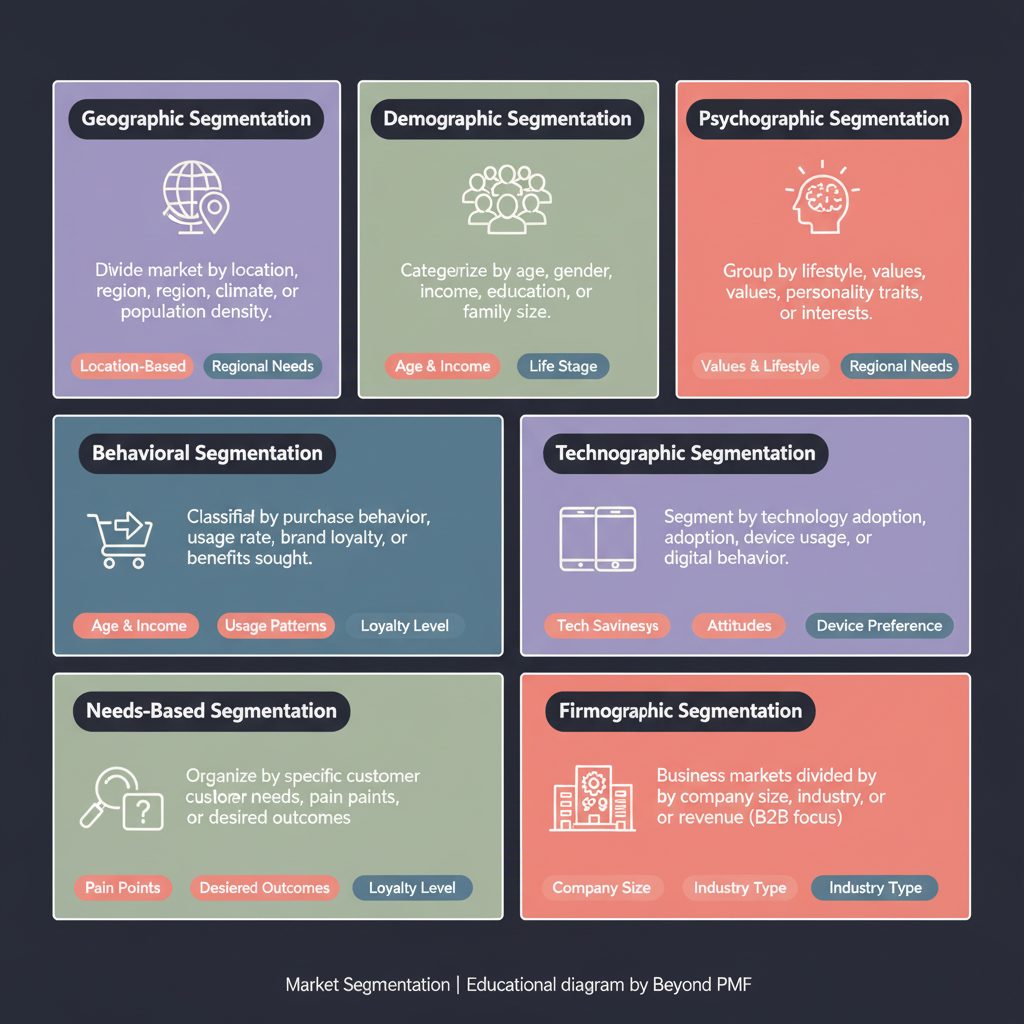
Market Segmentation

https://ik.imagekit.io/beyondpmf/frameworks/market-segmentation.png
Market segmentation directly addresses strategic friction by providing a framework to align business activities with specific consumer needs and preferences. It helps clarify market positioning and ensures the business model is targeted effectively.

Market Segmentation is a fundamental marketing strategy that involves dividing a broad target market into subsets of consumers, businesses, or countries that have, or are perceived to have, common needs, interests, and priorities. This approach helps companies tailor their marketing efforts and products to meet the specific needs of each segment more effectively. The benefits of market segmentation include enhanced competitiveness, increased market share, and improved customer retention.

Steps / Detailed Description

Identify the basis for segmenting the market, such as demographic, psychographic, geographic, or behavioral characteristics. | Conduct market research to gather data about potential market segments. | Analyze the data to identify distinct segments within the market. | Evaluate the attractiveness of each segment based on factors like size, growth potential, and compatibility with the company's objectives. | Select target segments to focus marketing efforts on. | Develop tailored marketing strategies for each chosen segment.

Best Practices

Regularly update segmentation data to reflect market changes. | Use a combination of segmentation bases for more accuracy. | Align segment strategies with overall business objectives.

Pros

Enhanced targeting precision | Improved product fit and customer satisfaction | Increased efficiency in marketing resources

Cons

Higher marketing costs | Risk of overlooking potential customers | Complexity in managing multiple segments

When to Use

Launching a new product | Entering a new market

When Not to Use

Limited resources for detailed market analysis | Uniform market with little variation in consumer preferences

Related Frameworks

Scope

Scope not defined

Maturity Level

Maturity level not specified

Time to Implement

2–4 Weeks
3–6 Months
1–2 Weeks
3–6 Months
1–2 Months
3–6 Months
1–2 Weeks
Less Than 1 Day
1–2 Weeks
Longer Than 6 Months
1–2 Weeks
Longer Than 6 Months
1–2 Weeks
3–6 Months
1–2 Weeks
1–2 Weeks
1–2 Weeks
1–2 Weeks
1–2 Days
1–2 Weeks
1–2 Weeks
1–2 Weeks
1–2 Weeks
1–2 Weeks
1–2 Weeks
3–6 Months
1–2 Weeks
1–2 Weeks
1–2 Weeks
3–6 Months
1–2 Weeks
1–2 Weeks
2–4 Weeks
1–2 Weeks
1–2 Days
1–2 Weeks
Longer Than 6 Months
3–6 Months
Longer Than 6 Months
1–2 Weeks
Longer Than 6 Months
3–6 Months
Less Than 1 Day
3–6 Months
1–2 Months
3–6 Months
Longer Than 6 Months
3–6 Months
Less Than 1 Day
1–2 Weeks
3–6 Months
3–6 Months
1–2 Weeks
3–6 Months
1–2 Weeks
1–2 Weeks
1–2 Days
1–2 Weeks
1–2 Months
Longer Than 6 Months
1–2 Weeks
Longer Than 6 Months
1–2 Weeks
3–6 Months
1–2 Weeks
Less Than 1 Day
1–2 Weeks
3–6 Months
1–2 Weeks
3–6 Months
1–2 Weeks
1–2 Weeks
Longer Than 6 Months
Less Than 1 Day
3–6 Months
Longer Than 6 Months
1–2 Months
1–2 Weeks
Longer Than 6 Months
1–2 Weeks
3–6 Months
1–2 Weeks
1–2 Weeks
3–6 Months
Less Than 1 Day
1–2 Weeks
1–2 Weeks
3–6 Months
3–6 Months
Less Than 1 Day
1–2 Weeks
Longer Than 6 Months
1–2 Months
1–2 Weeks
1–2 Weeks
1–2 Weeks
Longer Than 6 Months

Copyright Information

Autor:
Public Domain
N/A
Publication:
Generic Business Tool