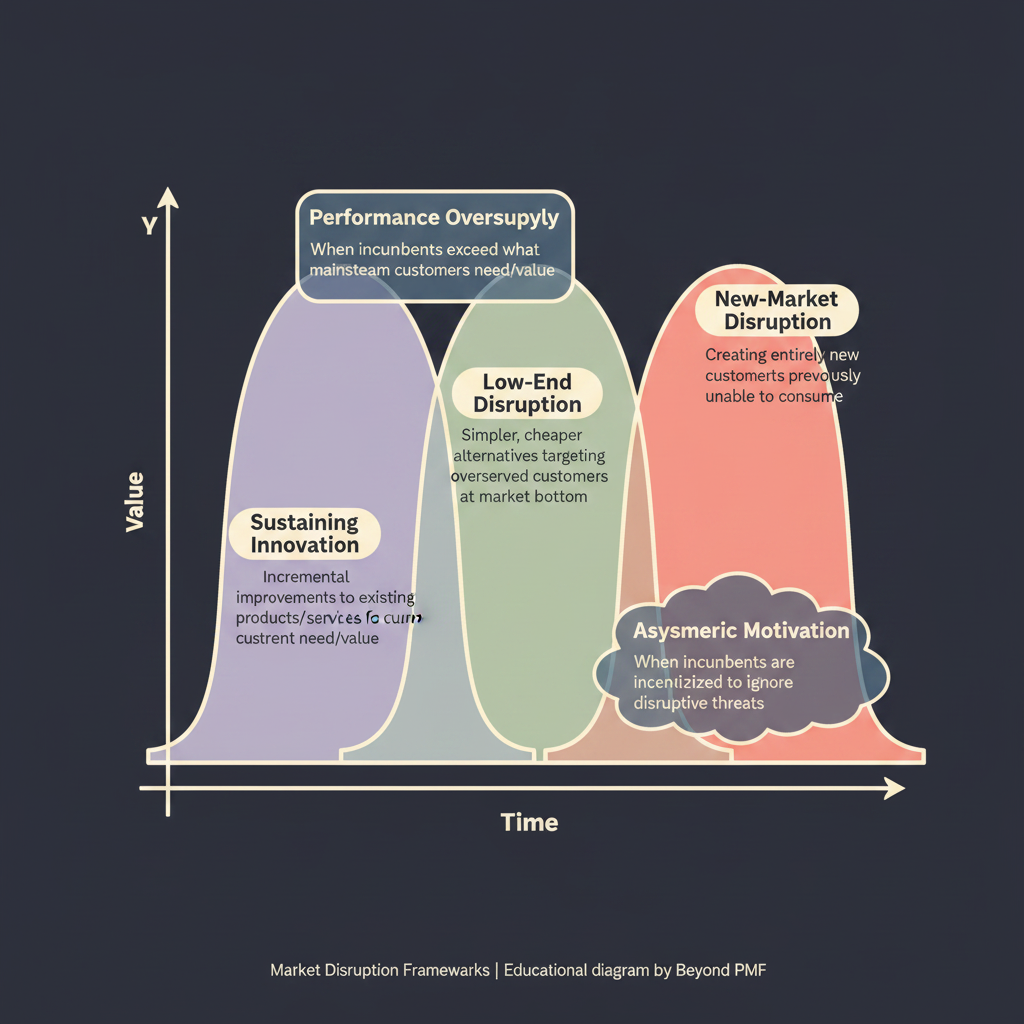
Market Disruption Frameworks

https://ik.imagekit.io/beyondpmf/frameworks/market-disruption-frameworks.png
Market Disruption Frameworks directly address the friction of unclear direction and market alignment by providing tools to analyze market dynamics and develop innovative business models. They help businesses define a clear strategic direction for disruptive innovation and competitive advantage.

Market Disruption Frameworks guide organizations in identifying and exploiting opportunities to disrupt established markets. These frameworks focus on understanding market dynamics, customer needs, and technological advancements to introduce groundbreaking products or services. They are used to strategically position companies in a way that challenges and alters the status quo, often leading to significant market share gains and long-term profitability.

Steps / Detailed Description

Identify underserved or overlooked market segments. | Analyze current market offerings and pinpoint gaps or inefficiencies. | Develop innovative solutions that significantly differ from existing ones. | Create a go-to-market strategy that emphasizes the unique value of the new solution. | Scale the solution while continuously adapting to market feedback and changes.

Best Practices

Thorough market research to validate the need for disruption. | Continuous iteration based on feedback and market trends. | Strategic partnerships to enhance market entry and scaling.

Pros

Facilitates entry into or creation of new markets. | Can lead to substantial competitive advantage and market share. | Encourages innovation and differentiation from competitors.

Cons

High risk of failure due to market unpredictability. | Requires significant investment in research and development. | Potential to alienate existing customers if not managed carefully.

When to Use

When entering a saturated market with little differentiation. | When technological advancements create new possibilities.

When Not to Use

In highly regulated industries where changes are slow. | When the company lacks resources to sustain prolonged R&D and market education.

Related Frameworks

Scope

Scope not defined

Maturity Level

Maturity level not specified

Time to Implement

2–4 Weeks
3–6 Months
1–2 Weeks
3–6 Months
1–2 Months
3–6 Months
1–2 Weeks
Less Than 1 Day
1–2 Weeks
Longer Than 6 Months
1–2 Weeks
Longer Than 6 Months
1–2 Weeks
3–6 Months
1–2 Weeks
1–2 Weeks
1–2 Weeks
1–2 Weeks
1–2 Days
1–2 Weeks
1–2 Weeks
1–2 Weeks
1–2 Weeks
1–2 Weeks
1–2 Weeks
3–6 Months
1–2 Weeks
1–2 Weeks
1–2 Weeks
3–6 Months
1–2 Weeks
1–2 Weeks
2–4 Weeks
1–2 Weeks
1–2 Days
1–2 Weeks
Longer Than 6 Months
3–6 Months
Longer Than 6 Months
1–2 Weeks
Longer Than 6 Months
3–6 Months
Less Than 1 Day
3–6 Months
1–2 Months
3–6 Months
Longer Than 6 Months
3–6 Months
Less Than 1 Day
1–2 Weeks
3–6 Months
3–6 Months
1–2 Weeks
3–6 Months
1–2 Weeks
1–2 Weeks
1–2 Days
1–2 Weeks
1–2 Months
Longer Than 6 Months
1–2 Weeks
Longer Than 6 Months
1–2 Weeks
3–6 Months
1–2 Weeks
Less Than 1 Day
1–2 Weeks
3–6 Months
1–2 Weeks
3–6 Months
1–2 Weeks
1–2 Weeks
Longer Than 6 Months
Less Than 1 Day
3–6 Months
Longer Than 6 Months
1–2 Months
1–2 Weeks
Longer Than 6 Months
1–2 Weeks
3–6 Months
1–2 Weeks
1–2 Weeks
3–6 Months
Less Than 1 Day
1–2 Weeks
1–2 Weeks
3–6 Months
3–6 Months
Less Than 1 Day
1–2 Weeks
Longer Than 6 Months
1–2 Months
1–2 Weeks
1–2 Weeks
1–2 Weeks
Longer Than 6 Months

Copyright Information

Autor:
Public Domain
N/A
Publication:
Generic Business Tool