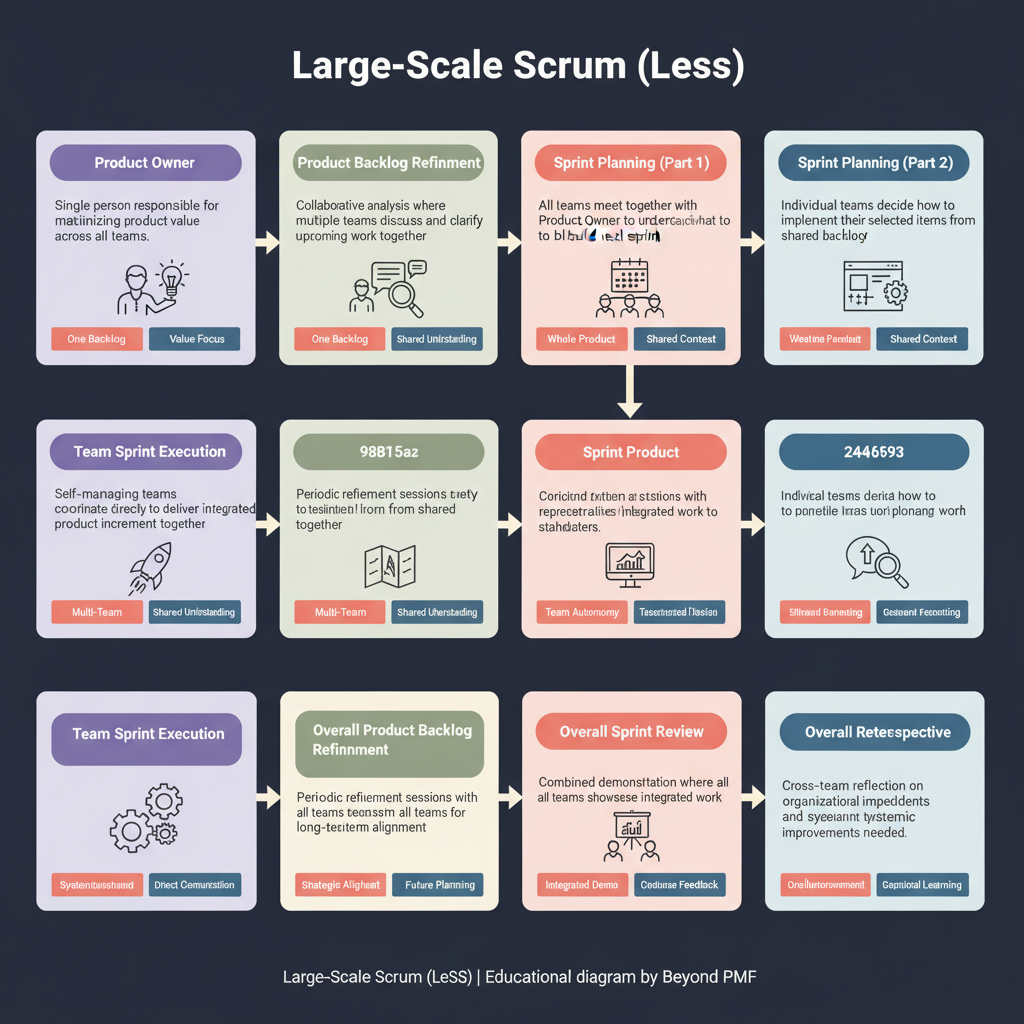
Large-Scale Scrum (LeSS)

https://ik.imagekit.io/beyondpmf/frameworks/large-scale-scrum-less.png
LeSS addresses the organizational design challenges of scaling agile. It tackles issues like team structure, role definition, and cross-functional alignment in large organizations, aiming to improve coordination and reduce friction between teams.

Large-Scale Scrum (LeSS) is an extension of Scrum that focuses on scaling Scrum to bigger organizations and coordinating multiple teams working on the same product. It aims to simplify the structure and rules of Scrum in a large-scale context, reducing complexity by descaling rather than adding roles and artifacts. LeSS promotes transparency, customer focus, and continuous improvement, making it suitable for large projects requiring agility and adaptability.

Steps / Detailed Description

Define the product and identify the Product Owner. | Create a single Product Backlog for clarity and transparency. | Organize teams into feature teams rather than component teams. | Conduct overall product backlog refinement sessions. | Plan for a single Sprint for all teams with one Sprint Planning. | Perform synchronized Sprint Reviews and Retrospectives.

Best Practices

Ensure strong leadership and support from management | Train all members thoroughly in Scrum principles | Focus on building feature teams rather than component teams

Pros

Improves coordination and integration across multiple teams | Maintains simplicity and transparency of Scrum at scale | Enhances adaptability and responsiveness to market changes

Cons

Requires significant organizational changes and commitment | Can be challenging to implement in very large or distributed teams | Depends heavily on the maturity of teams and their understanding of Scrum

When to Use

When scaling Scrum across multiple teams working on the same product | In organizations looking to maintain agility while growing in size

When Not to Use

In very small projects or teams where basic Scrum is sufficient | Where organizational culture resists change or agile methodologies

Related Frameworks

Categories

Lifecycle

Scope

Scope not defined

Maturity Level

Maturity level not specified

Time to Implement

2–4 Weeks
3–6 Months
1–2 Weeks
3–6 Months
1–2 Months
3–6 Months
1–2 Weeks
Less Than 1 Day
1–2 Weeks
Longer Than 6 Months
1–2 Weeks
Longer Than 6 Months
1–2 Weeks
3–6 Months
1–2 Weeks
1–2 Weeks
1–2 Weeks
1–2 Weeks
1–2 Days
1–2 Weeks
1–2 Weeks
1–2 Weeks
1–2 Weeks
1–2 Weeks
1–2 Weeks
3–6 Months
1–2 Weeks
1–2 Weeks
1–2 Weeks
3–6 Months
1–2 Weeks
1–2 Weeks
2–4 Weeks
1–2 Weeks
1–2 Days
1–2 Weeks
Longer Than 6 Months
3–6 Months
Longer Than 6 Months
1–2 Weeks
Longer Than 6 Months
3–6 Months
Less Than 1 Day
3–6 Months
1–2 Months
3–6 Months
Longer Than 6 Months
3–6 Months
Less Than 1 Day
1–2 Weeks
3–6 Months
3–6 Months
1–2 Weeks
3–6 Months
1–2 Weeks
1–2 Weeks
1–2 Days
1–2 Weeks
1–2 Months
Longer Than 6 Months
1–2 Weeks
Longer Than 6 Months
1–2 Weeks
3–6 Months
1–2 Weeks
Less Than 1 Day
1–2 Weeks
3–6 Months
1–2 Weeks
3–6 Months
1–2 Weeks
1–2 Weeks
Longer Than 6 Months
Less Than 1 Day
3–6 Months
Longer Than 6 Months
1–2 Months
1–2 Weeks
Longer Than 6 Months
1–2 Weeks
3–6 Months
1–2 Weeks
1–2 Weeks
3–6 Months
Less Than 1 Day
1–2 Weeks
1–2 Weeks
3–6 Months
3–6 Months
Less Than 1 Day
1–2 Weeks
Longer Than 6 Months
1–2 Months
1–2 Weeks
1–2 Weeks
1–2 Weeks
Longer Than 6 Months

Copyright Information

Autor:
Craig Larman and Bas Vodde
2008
Publication:
LeSS Company