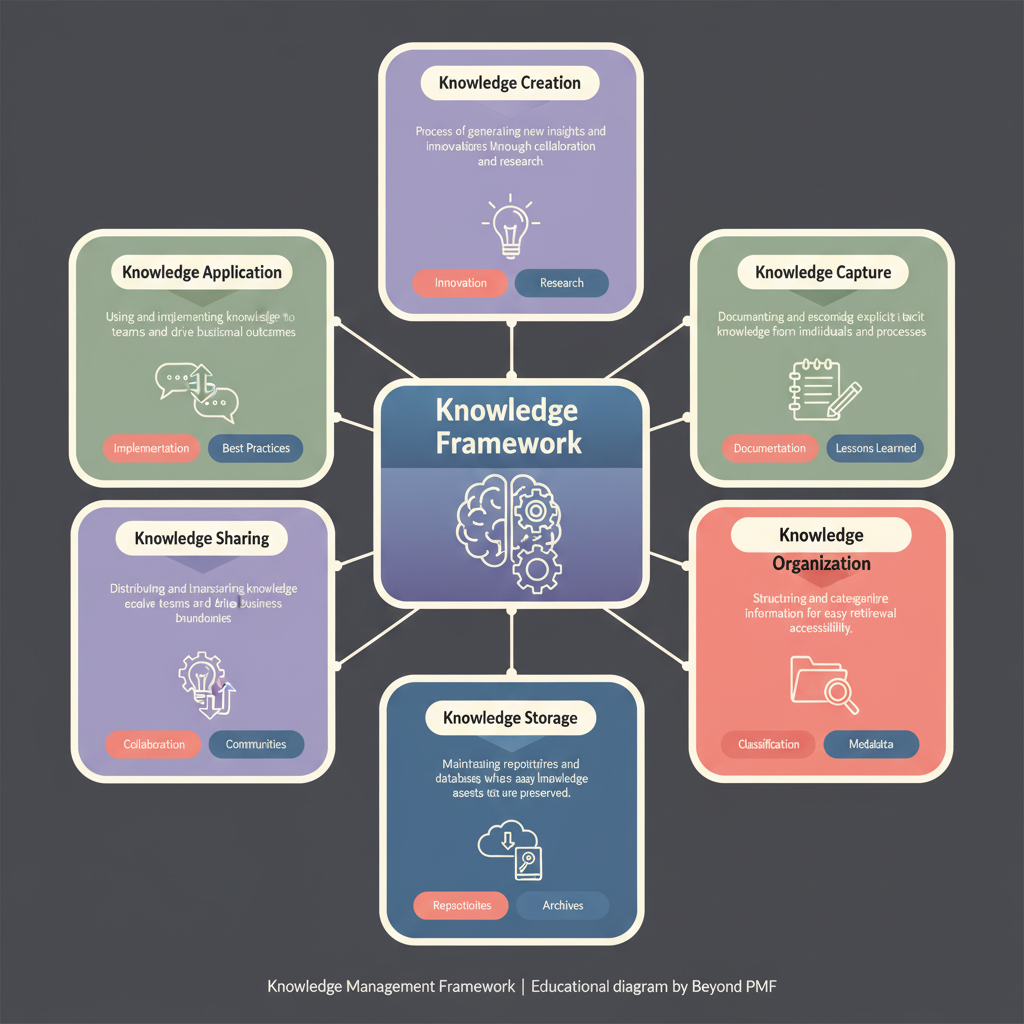
The Knowledge Management Framework is a systematic approach designed to help organizations manage their knowledge effectively. It involves processes and tools that facilitate the capture, distribution, and effective use of knowledge to enhance organizational performance. The framework supports continuous learning and knowledge sharing, leading to improved innovation, competitive advantage, and customer satisfaction.
Identify knowledge needs: Determine the critical knowledge areas that drive value for the organization. | Capture knowledge: Implement processes to collect valuable information from both internal and external sources. | Organize knowledge: Categorize and store knowledge in accessible formats and databases. | Share knowledge: Facilitate the dissemination of knowledge across the organization through various communication channels. | Apply knowledge: Ensure that knowledge is actively used to improve decision-making and problem-solving. | Review and update knowledge: Regularly evaluate the relevance of knowledge and update it to reflect new insights and feedback.
Establish a clear knowledge management strategy | Leverage technology for knowledge sharing | Promote a culture of continuous learning and collaboration
Enhances decision-making capabilities | Boosts productivity and efficiency | Fosters innovation and continuous improvement
Can be time-consuming to implement | Risk of information overload | Potential resistance to sharing knowledge
When aiming to improve organizational learning | When needing to preserve critical organizational knowledge
When there is limited time for implementation | When organizational culture resists sharing and collaboration