IT4IT Framework

https://ik.imagekit.io/beyondpmf/frameworks/it4it-framework.png
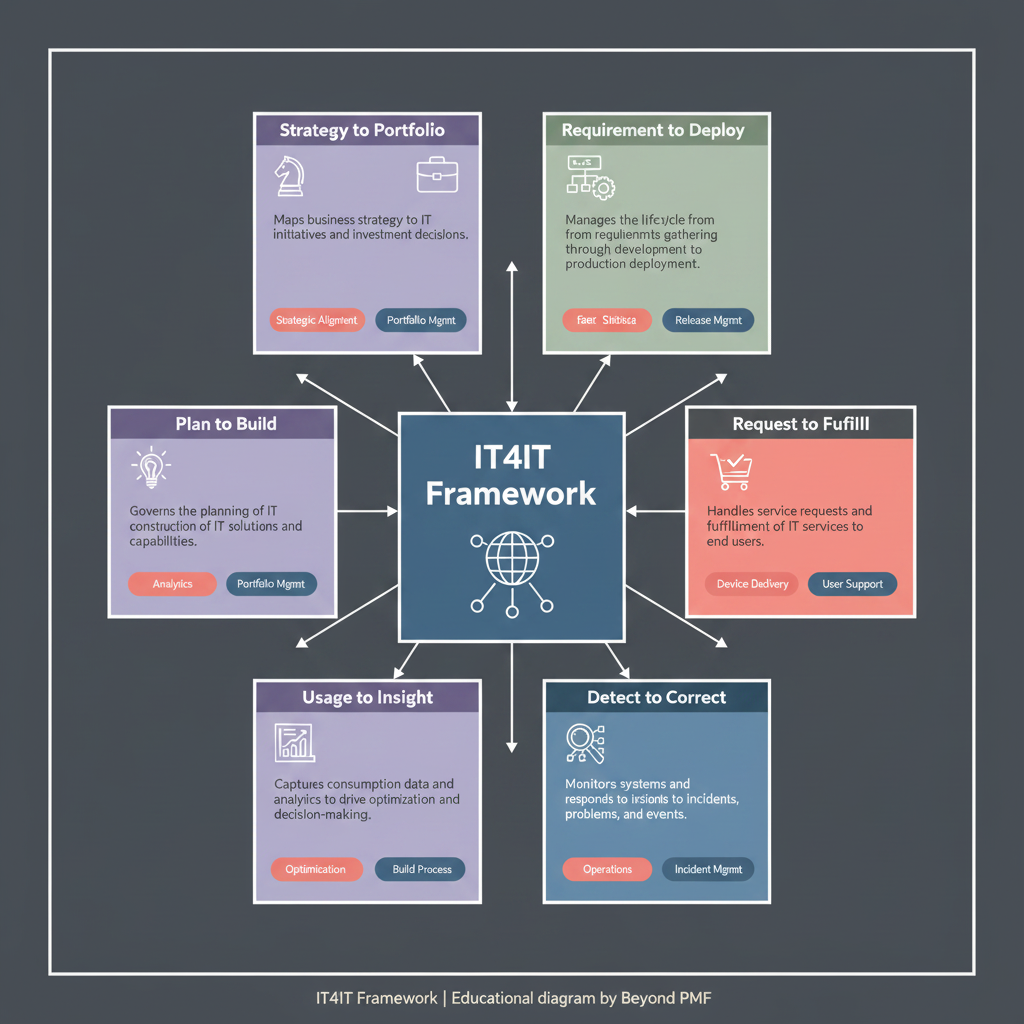
The IT4IT framework focuses on value stream-based guidance to manage the business of IT, implying a focus on improving processes and workflows within the IT organization. This suggests it primarily addresses frictions related to operational efficiency and coordination.

The IT4IT Framework, developed by The Open Group, is a reference architecture designed to help organizations manage their IT operations more effectively. It is structured around a value chain-based approach that emphasizes managing IT as a business. The framework aids in the standardization of IT management practices, offering a holistic view of the entire IT lifecycle. This approach helps organizations optimize their IT resources, improve service management, and align IT processes with overall business goals, thereby enhancing efficiency and reducing costs.

Steps / Detailed Description

Define the Strategy to Portfolio (S2P) value stream: Align IT investments with business goals. | Manage the Requirement to Deploy (R2D) value stream: Standardize and streamline the way new services are developed. | Operate the Request to Fulfill (R2F) value stream: Manage the services catalog and handle service requests efficiently. | Oversee the Detect to Correct (D2C) value stream: Focus on proactive problem management and incident resolution.

Best Practices

Start with a thorough assessment of current IT capabilities and needs. | Engage stakeholders across the organization to ensure alignment and support. | Implement incrementally, prioritizing areas with the highest business impact.

Pros

Provides a clear, structured approach to managing IT services. | Enhances alignment between IT operations and business objectives. | Improves efficiency through standardized processes.

Cons

Can be complex to implement and require significant change management. | May necessitate substantial upfront investment in training and tools. | Could be overly prescriptive, limiting flexibility in rapidly changing environments.

When to Use

When standardizing IT operations across large organizations. | When seeking to align IT services with business strategies.

When Not to Use

In very small organizations where the complexity might outweigh benefits. | When rapid, flexible adaptation is more critical than standardized processes.

Related Frameworks

Lifecycle

Not tied to a specific lifecycle stage

Scope

Scope not defined

Maturity Level

Maturity level not specified

Time to Implement

2–4 Weeks
3–6 Months
1–2 Weeks
3–6 Months
1–2 Months
3–6 Months
1–2 Weeks
Less Than 1 Day
1–2 Weeks
Longer Than 6 Months
1–2 Weeks
Longer Than 6 Months
1–2 Weeks
3–6 Months
1–2 Weeks
1–2 Weeks
1–2 Weeks
1–2 Weeks
1–2 Days
1–2 Weeks
1–2 Weeks
1–2 Weeks
1–2 Weeks
1–2 Weeks
1–2 Weeks
3–6 Months
1–2 Weeks
1–2 Weeks
1–2 Weeks
3–6 Months
1–2 Weeks
1–2 Weeks
2–4 Weeks
1–2 Weeks
1–2 Days
1–2 Weeks
Longer Than 6 Months
3–6 Months
Longer Than 6 Months
1–2 Weeks
Longer Than 6 Months
3–6 Months
Less Than 1 Day
3–6 Months
1–2 Months
3–6 Months
Longer Than 6 Months
3–6 Months
Less Than 1 Day
1–2 Weeks
3–6 Months
3–6 Months
1–2 Weeks
3–6 Months
1–2 Weeks
1–2 Weeks
1–2 Days
1–2 Weeks
1–2 Months
Longer Than 6 Months
1–2 Weeks
Longer Than 6 Months
1–2 Weeks
3–6 Months
1–2 Weeks
Less Than 1 Day
1–2 Weeks
3–6 Months
1–2 Weeks
3–6 Months
1–2 Weeks
1–2 Weeks
Longer Than 6 Months
Less Than 1 Day
3–6 Months
Longer Than 6 Months
1–2 Months
1–2 Weeks
Longer Than 6 Months
1–2 Weeks
3–6 Months
1–2 Weeks
1–2 Weeks
3–6 Months
Less Than 1 Day
1–2 Weeks
1–2 Weeks
3–6 Months
3–6 Months
Less Than 1 Day
1–2 Weeks
Longer Than 6 Months
1–2 Months
1–2 Weeks
1–2 Weeks
1–2 Weeks
Longer Than 6 Months

Copyright Information

Autor:
The Open Group
2015
Publication:
The Open Group