INVEST Criteria

https://ik.imagekit.io/beyondpmf/frameworks/invest-criteria.png
The INVEST criteria directly addresses the quality and clarity of user stories, which impacts the speed, quality, and overall effectiveness of software delivery. It helps reduce technical friction and potential customer UX issues arising from poorly defined requirements.

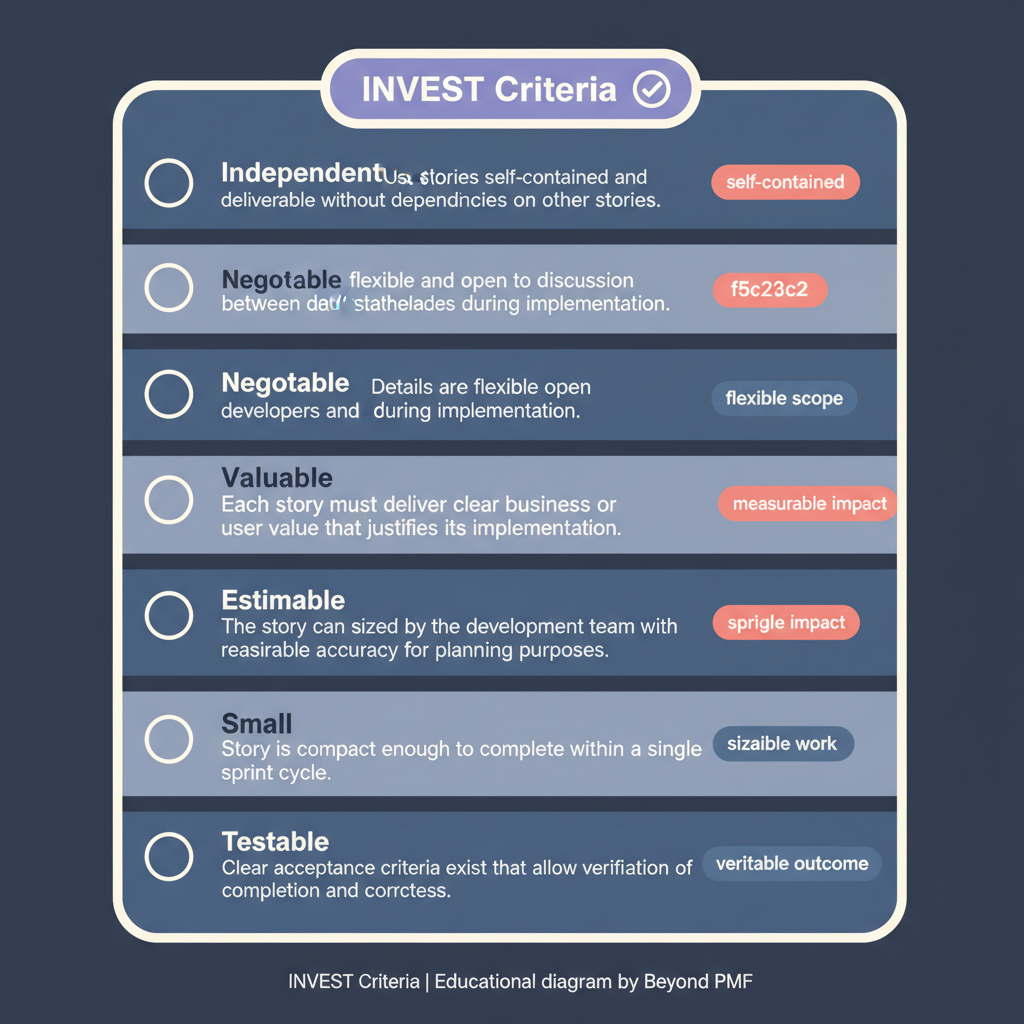
The INVEST Criteria is a mnemonic that stands for Independent, Negotiable, Valuable, Estimable, Small, and Testable. It is used primarily in Agile and Scrum methodologies to create clear and effective user stories. This framework helps teams deliver better products by ensuring that each user story is well-defined and structured to facilitate efficient planning, execution, and testing. The criteria promote transparency, predictability, and adaptability in the development process.

Steps / Detailed Description

Independent: Ensure each user story is self-contained, with no inherent dependency on another user story. | Negotiable: User stories should be flexible and open to negotiation and discussion. | Valuable: Each user story must deliver a clear value to the customer or user. | Estimable: The team must be able to estimate the size and complexity of the user story. | Small: User stories should be small enough to be easily manageable and testable but large enough to provide significant value. | Testable: There should be clear acceptance criteria to test and verify that the story meets the requirements.

Best Practices

Regularly review and refine user stories with stakeholders | Train and educate the team on the INVEST criteria | Use the criteria as a checklist during backlog grooming sessions

Pros

Improves clarity and focus of user stories | Facilitates better planning and estimation | Enhances product quality and customer satisfaction

Cons

Can be overly rigid in dynamic development environments | May not be suitable for very complex features | Requires thorough understanding and discipline to implement effectively

When to Use

When defining user stories in Agile project management | During backlog refinement and sprint planning sessions

When Not to Use

In non-Agile, highly structured or waterfall projects | When quick, ad-hoc development is needed without detailed planning

Related Frameworks

Categories

Lifecycle

Scope

Scope not defined

Maturity Level

Maturity level not specified

Time to Implement

2–4 Weeks
3–6 Months
1–2 Weeks
3–6 Months
1–2 Months
3–6 Months
1–2 Weeks
Less Than 1 Day
1–2 Weeks
Longer Than 6 Months
1–2 Weeks
Longer Than 6 Months
1–2 Weeks
3–6 Months
1–2 Weeks
1–2 Weeks
1–2 Weeks
1–2 Weeks
1–2 Days
1–2 Weeks
1–2 Weeks
1–2 Weeks
1–2 Weeks
1–2 Weeks
1–2 Weeks
3–6 Months
1–2 Weeks
1–2 Weeks
1–2 Weeks
3–6 Months
1–2 Weeks
1–2 Weeks
2–4 Weeks
1–2 Weeks
1–2 Days
1–2 Weeks
Longer Than 6 Months
3–6 Months
Longer Than 6 Months
1–2 Weeks
Longer Than 6 Months
3–6 Months
Less Than 1 Day
3–6 Months
1–2 Months
3–6 Months
Longer Than 6 Months
3–6 Months
Less Than 1 Day
1–2 Weeks
3–6 Months
3–6 Months
1–2 Weeks
3–6 Months
1–2 Weeks
1–2 Weeks
1–2 Days
1–2 Weeks
1–2 Months
Longer Than 6 Months
1–2 Weeks
Longer Than 6 Months
1–2 Weeks
3–6 Months
1–2 Weeks
Less Than 1 Day
1–2 Weeks
3–6 Months
1–2 Weeks
3–6 Months
1–2 Weeks
1–2 Weeks
Longer Than 6 Months
Less Than 1 Day
3–6 Months
Longer Than 6 Months
1–2 Months
1–2 Weeks
Longer Than 6 Months
1–2 Weeks
3–6 Months
1–2 Weeks
1–2 Weeks
3–6 Months
Less Than 1 Day
1–2 Weeks
1–2 Weeks
3–6 Months
3–6 Months
Less Than 1 Day
1–2 Weeks
Longer Than 6 Months
1–2 Months
1–2 Weeks
1–2 Weeks
1–2 Weeks
Longer Than 6 Months

Copyright Information

Autor:
Bill Wake
2003
Publication:
Unknown