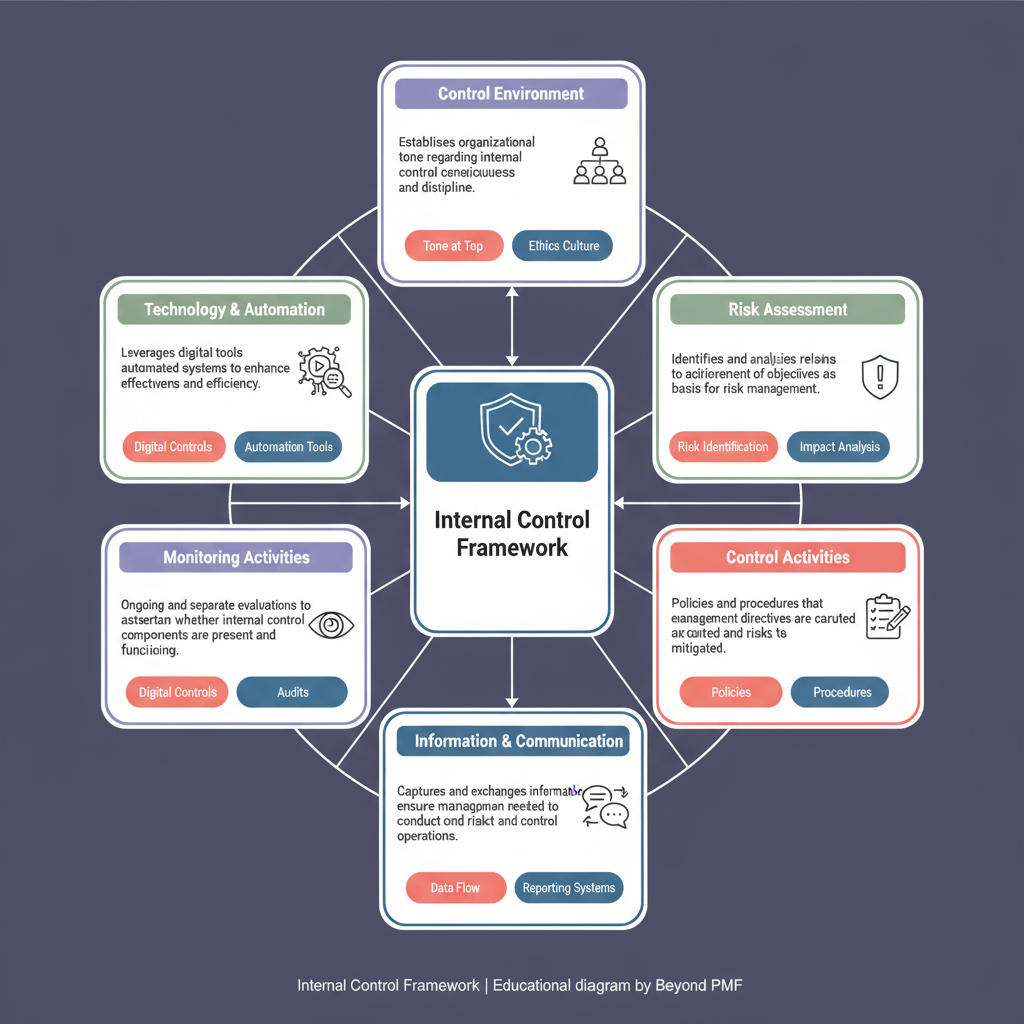
An Internal Control Framework (ICF) is a set of policies, procedures, and technologies designed to provide reasonable assurance regarding the achievement of an organization's objectives related to operations, reporting, and compliance. It helps organizations identify and mitigate risks, ensure the reliability of financial reporting, and comply with laws and regulations. The framework is crucial for fostering transparency, accountability, and efficiency in business operations.
Define objectives: Clearly articulate what the organization aims to achieve in terms of financial reporting, compliance, and operations. | Identify risks: Systematically identify the risks that could prevent the organization from achieving its objectives. | Assess risks: Evaluate the identified risks in terms of likelihood and impact, prioritizing them accordingly. | Design controls: Develop appropriate controls to manage or mitigate the prioritized risks. | Implement controls: Put the designed controls into action within the organization's processes. | Monitor and review: Regularly assess the effectiveness of the controls and make necessary adjustments.
Regularly update the risk assessment to reflect changes in the business environment | Train employees on the importance of internal controls and their specific roles | Use technology to automate controls and monitoring where possible
Enhances reliability of financial reporting | Improves compliance with laws and regulations | Reduces the risk of asset loss
Can be costly to implement and maintain | May slow down organizational processes | Requires continuous monitoring and updating
When establishing or reviewing governance structures | In preparation for audit activities
In very small organizations where informal controls are sufficient | When the cost of implementing controls outweighs the potential risks