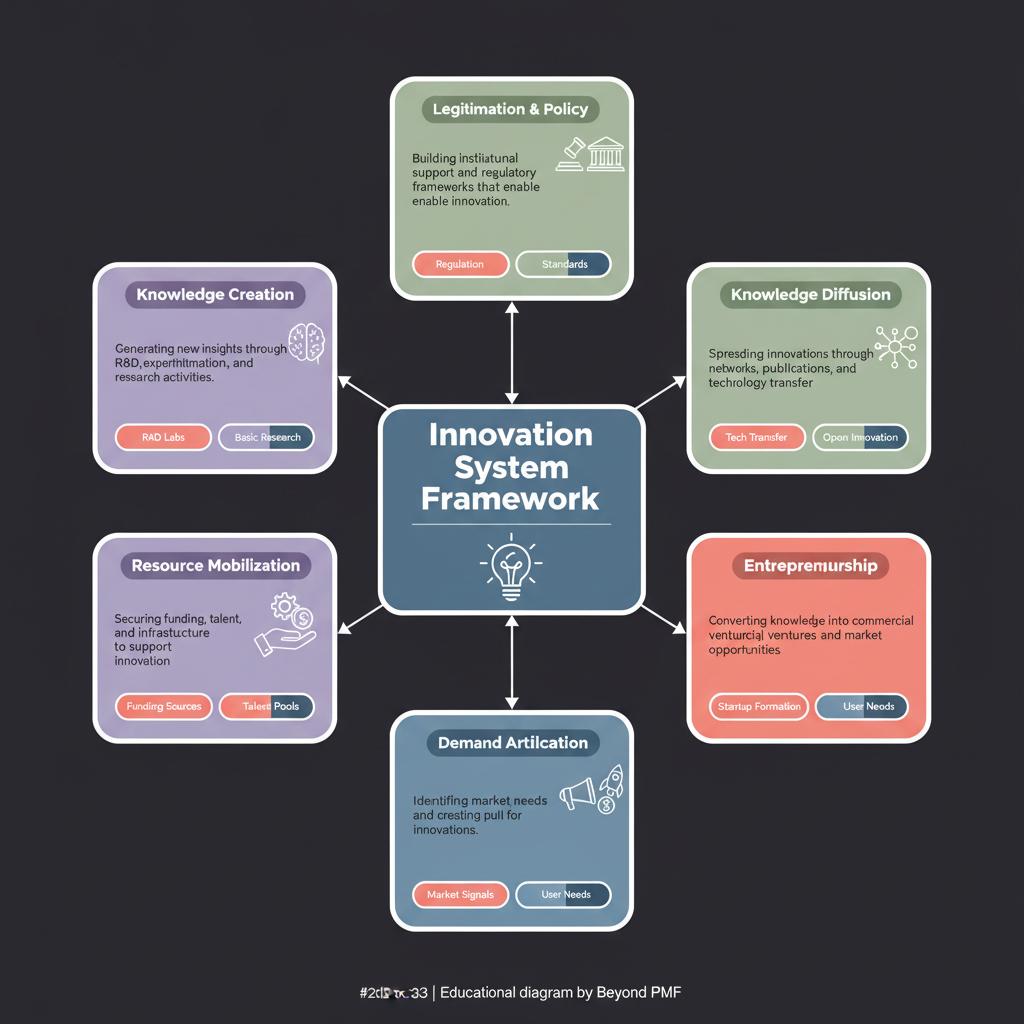
Innovation System Framework

https://ik.imagekit.io/beyondpmf/frameworks/innovation-system-framework.png
The Innovation System Framework focuses on guiding organizations towards economic growth and competitiveness through strategic innovation. It addresses the friction of unclear direction, lack of market alignment, and the need for a cohesive vision and strategy to drive innovation.

The Innovation System Framework is a comprehensive model used to understand and enhance the innovation capabilities of an organization or a regional economy. It emphasizes the interaction between various actors such as universities, firms, and government institutions. The framework helps in identifying the roles and relationships that contribute to a thriving innovation ecosystem, thereby facilitating targeted interventions that can lead to sustainable economic development and competitive advantage.

Steps / Detailed Description

Identify key stakeholders and their roles within the innovation ecosystem. | Map the existing interactions and flows of knowledge and resources. | Assess the strengths and weaknesses of the current innovation system. | Develop strategies to enhance collaboration and knowledge exchange. | Implement targeted interventions to address gaps and leverage strengths. | Monitor and evaluate the impact of interventions on the innovation ecosystem.

Best Practices

Regularly update the innovation system analysis to reflect changes. | Foster open communication and trust among stakeholders. | Leverage technology to facilitate knowledge sharing and collaboration.

Pros

Enhances collaboration among different innovation actors. | Improves the effectiveness of innovation processes. | Supports sustainable economic development.

Cons

Can be complex to implement due to diverse stakeholders. | Requires continuous monitoring and adaptation. | May lead to dependency on external funding sources.

When to Use

When aiming to boost regional or organizational innovation capabilities. | When there is a need to assess and enhance collaboration among innovation actors.

When Not to Use

In very small organizations with limited resources. | When quick, short-term innovation results are needed without systemic change.

Related Frameworks

Lifecycle

Not tied to a specific lifecycle stage

Scope

Scope not defined

Maturity Level

Maturity level not specified

Time to Implement

2–4 Weeks
3–6 Months
1–2 Weeks
3–6 Months
1–2 Months
3–6 Months
1–2 Weeks
Less Than 1 Day
1–2 Weeks
Longer Than 6 Months
1–2 Weeks
Longer Than 6 Months
1–2 Weeks
3–6 Months
1–2 Weeks
1–2 Weeks
1–2 Weeks
1–2 Weeks
1–2 Days
1–2 Weeks
1–2 Weeks
1–2 Weeks
1–2 Weeks
1–2 Weeks
1–2 Weeks
3–6 Months
1–2 Weeks
1–2 Weeks
1–2 Weeks
3–6 Months
1–2 Weeks
1–2 Weeks
2–4 Weeks
1–2 Weeks
1–2 Days
1–2 Weeks
Longer Than 6 Months
3–6 Months
Longer Than 6 Months
1–2 Weeks
Longer Than 6 Months
3–6 Months
Less Than 1 Day
3–6 Months
1–2 Months
3–6 Months
Longer Than 6 Months
3–6 Months
Less Than 1 Day
1–2 Weeks
3–6 Months
3–6 Months
1–2 Weeks
3–6 Months
1–2 Weeks
1–2 Weeks
1–2 Days
1–2 Weeks
1–2 Months
Longer Than 6 Months
1–2 Weeks
Longer Than 6 Months
1–2 Weeks
3–6 Months
1–2 Weeks
Less Than 1 Day
1–2 Weeks
3–6 Months
1–2 Weeks
3–6 Months
1–2 Weeks
1–2 Weeks
Longer Than 6 Months
Less Than 1 Day
3–6 Months
Longer Than 6 Months
1–2 Months
1–2 Weeks
Longer Than 6 Months
1–2 Weeks
3–6 Months
1–2 Weeks
1–2 Weeks
3–6 Months
Less Than 1 Day
1–2 Weeks
1–2 Weeks
3–6 Months
3–6 Months
Less Than 1 Day
1–2 Weeks
Longer Than 6 Months
1–2 Months
1–2 Weeks
1–2 Weeks
1–2 Weeks
Longer Than 6 Months

Copyright Information

Autor:
Unknown
N/A
Publication:
Generic Business Tool