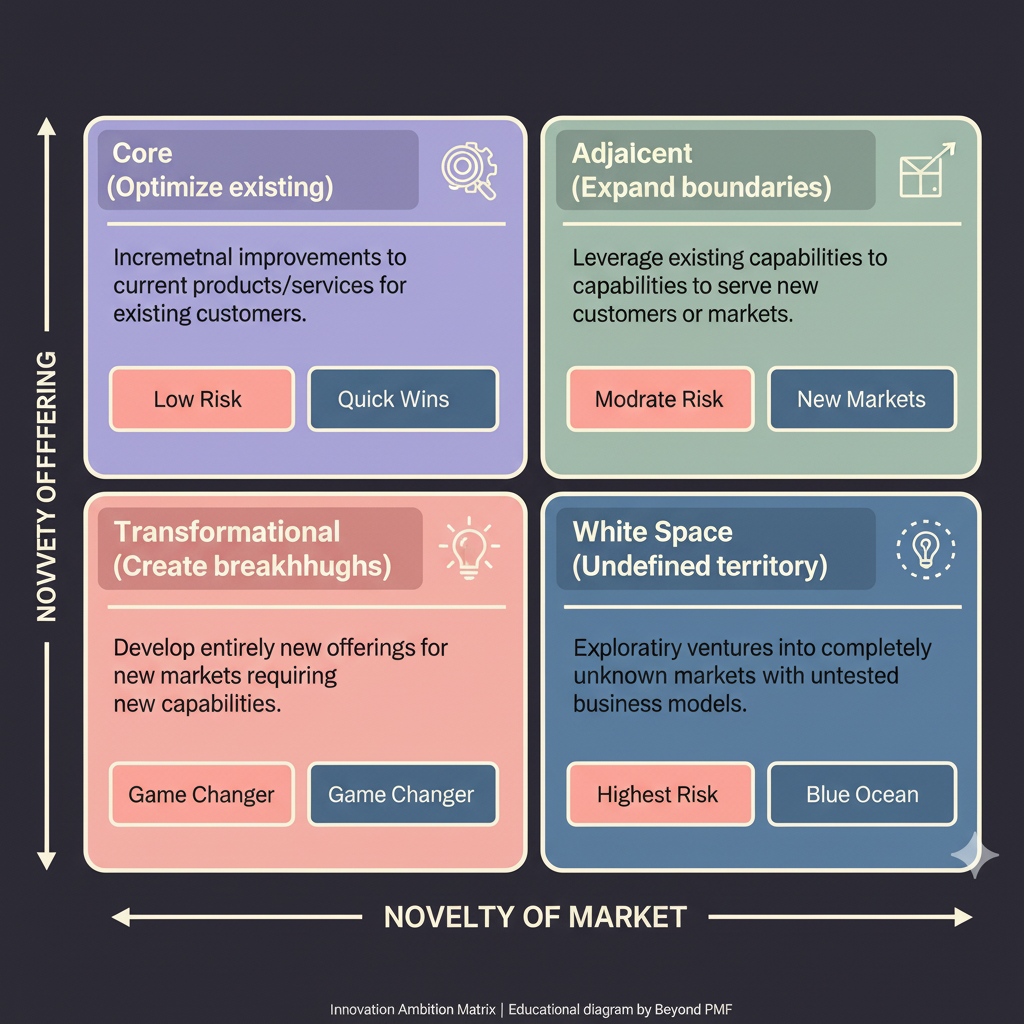
The Innovation Ambition Matrix helps organizations classify their innovation activities into three categories: core innovations, adjacent innovations, and transformational innovations. This framework is used to balance the innovation portfolio, ensuring a mix of short-term and long-term goals with varying degrees of risk and reward. It aids in aligning innovation strategies with business objectives and maximizing resource allocation efficiency.
Identify and list all current and planned innovation projects. | Categorize each project into core, adjacent, or transformational based on its market familiarity and technological novelty. | Assess the potential impact and resource requirements for each category. | Allocate resources and adjust strategies to achieve a balanced innovation portfolio. | Monitor and adjust the categorization as projects evolve and external conditions change.
Regularly review and recalibrate the innovation portfolio | Ensure top management involvement in categorization decisions | Balance the portfolio to include all three types of innovations
Encourages a balanced approach to innovation | Helps in strategic alignment of innovation projects | Facilitates better resource allocation
Can be overly simplistic for complex innovations | May lead to neglect of transformational innovations due to higher risk | Requires continuous updating and monitoring
When planning to diversify innovation efforts | When needing to align innovation projects with business strategy
In very small or resource-constrained organizations | When rapid innovation is required without detailed categorization