Influence Diagram Framework

https://ik.imagekit.io/beyondpmf/frameworks/influence-diagram-framework.png
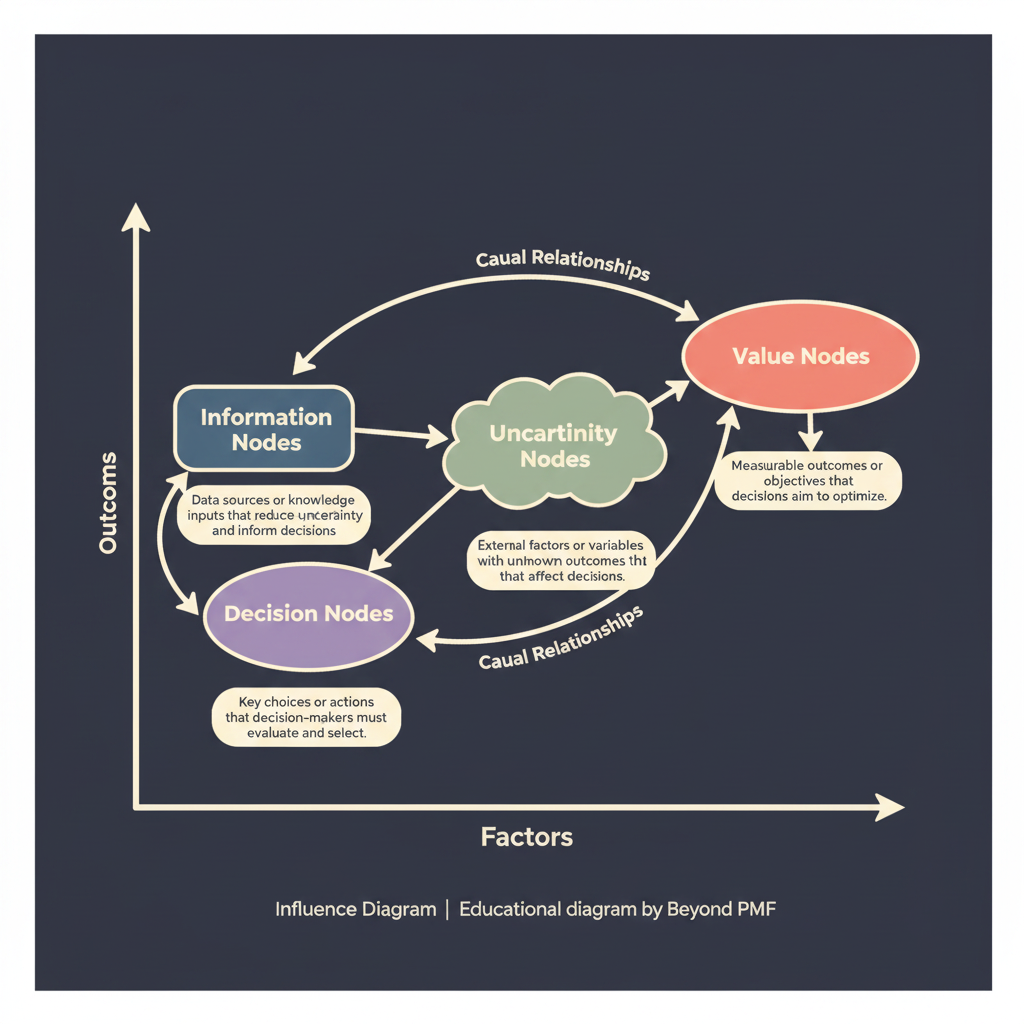
The Influence Diagram Framework helps to visualize and clarify the relationships between different factors in a decision-making process. This aids in improving coordination and governance by providing a clear understanding of how decisions, uncertainties, and objectives are interconnected.

The Influence Diagram Framework is a graphical representation used to simplify and visualize the decision-making process in complex scenarios. It helps identify the different elements involved, such as decisions, uncertainties, outcomes, and objectives, and illustrates the causal relationships between them. This framework is particularly beneficial for clarifying and communicating the structure of decision problems, facilitating more informed and effective decision-making.

Steps / Detailed Description

Identify all relevant decisions, uncertainties, and objectives. | Define the relationships and dependencies between these elements. | Construct the influence diagram by visually mapping these relationships. | Use the diagram to analyze the impact of different decisions and to identify key drivers of outcomes. | Refine the diagram as needed based on insights gained from discussions and analysis.

Best Practices

Ensure comprehensive identification of all relevant elements before diagram construction. | Regularly update the diagram to reflect any changes in the decision environment. | Use alongside other decision-making tools for comprehensive analysis.

Pros

Provides a clear visual representation of complex decision processes. | Facilitates better understanding and communication among stakeholders. | Helps in identifying and focusing on key elements that influence outcomes.

Cons

Can be overly simplistic for very complex decision scenarios. | Requires accurate identification of relationships to be effective. | May not capture dynamic changes in relationships over time.

When to Use

When needing to clarify complex decision-making processes. | In strategic planning and risk management scenarios.

When Not to Use

For decisions that are straightforward and lack complexity. | When the relationships between elements are not well understood.

Related Frameworks

Scope

Scope not defined

Maturity Level

Maturity level not specified

Time to Implement

2–4 Weeks
3–6 Months
1–2 Weeks
3–6 Months
1–2 Months
3–6 Months
1–2 Weeks
Less Than 1 Day
1–2 Weeks
Longer Than 6 Months
1–2 Weeks
Longer Than 6 Months
1–2 Weeks
3–6 Months
1–2 Weeks
1–2 Weeks
1–2 Weeks
1–2 Weeks
1–2 Days
1–2 Weeks
1–2 Weeks
1–2 Weeks
1–2 Weeks
1–2 Weeks
1–2 Weeks
3–6 Months
1–2 Weeks
1–2 Weeks
1–2 Weeks
3–6 Months
1–2 Weeks
1–2 Weeks
2–4 Weeks
1–2 Weeks
1–2 Days
1–2 Weeks
Longer Than 6 Months
3–6 Months
Longer Than 6 Months
1–2 Weeks
Longer Than 6 Months
3–6 Months
Less Than 1 Day
3–6 Months
1–2 Months
3–6 Months
Longer Than 6 Months
3–6 Months
Less Than 1 Day
1–2 Weeks
3–6 Months
3–6 Months
1–2 Weeks
3–6 Months
1–2 Weeks
1–2 Weeks
1–2 Days
1–2 Weeks
1–2 Months
Longer Than 6 Months
1–2 Weeks
Longer Than 6 Months
1–2 Weeks
3–6 Months
1–2 Weeks
Less Than 1 Day
1–2 Weeks
3–6 Months
1–2 Weeks
3–6 Months
1–2 Weeks
1–2 Weeks
Longer Than 6 Months
Less Than 1 Day
3–6 Months
Longer Than 6 Months
1–2 Months
1–2 Weeks
Longer Than 6 Months
1–2 Weeks
3–6 Months
1–2 Weeks
1–2 Weeks
3–6 Months
Less Than 1 Day
1–2 Weeks
1–2 Weeks
3–6 Months
3–6 Months
Less Than 1 Day
1–2 Weeks
Longer Than 6 Months
1–2 Months
1–2 Weeks
1–2 Weeks
1–2 Weeks
Longer Than 6 Months

Copyright Information

Autor:
Public Domain
N/A
Publication:
Generic Business Tool