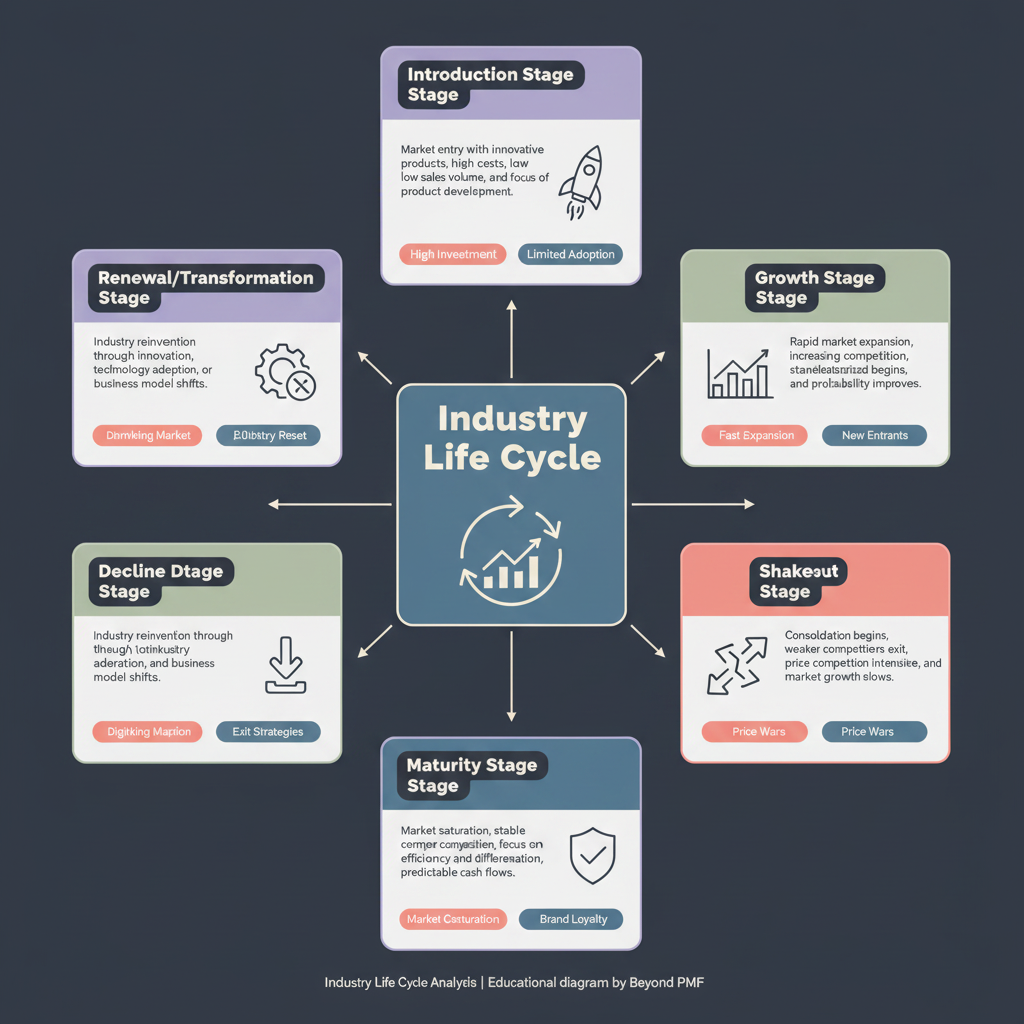
Industry Life Cycle Analysis

https://ik.imagekit.io/beyondpmf/frameworks/industry-life-cycle-analysis.png
Industry Life Cycle Analysis helps businesses understand their industry's current stage and anticipate future shifts. This framework addresses the strategic friction of market alignment and business model adaptability by informing decisions about product development, market focus, and resource allocation.

Industry Life Cycle Analysis examines the different stages an industry goes through, from inception to decline. This framework is crucial for businesses to understand market dynamics, anticipate future trends, and align their strategies accordingly. It aids in decision-making by providing insights into when to invest, innovate, or exit, and highlights the competitive landscape throughout the lifecycle of an industry.

Steps / Detailed Description

Identify the current stage of the industry: Introduction, Growth, Maturity, or Decline. | Analyze the characteristics of the current stage such as market size, growth rate, and competition. | Forecast future stages based on historical data and current market trends. | Develop strategic initiatives tailored to each stage to maximize profitability and market share. | Monitor and reassess regularly to adjust strategies in response to changes in the industry.

Best Practices

Regularly update data and assumptions as the industry evolves. | Combine with other analytical tools for comprehensive insights. | Consider external factors such as economic conditions and technological advancements.

Pros

Provides a structured approach to understanding market evolution. | Helps in strategic planning and forecasting. | Facilitates timely decision-making by predicting industry trends.

Cons

May oversimplify the complexities of some industries. | Relies heavily on accurate and comprehensive historical data. | Can be less effective in rapidly changing or innovative markets.

When to Use

When entering a new market or industry. | When planning long-term business strategies.

When Not to Use

In highly volatile or innovative industries where changes are rapid and unpredictable. | When insufficient historical data is available to accurately predict future stages.

Related Frameworks

Lifecycle

Not tied to a specific lifecycle stage

Scope

Scope not defined

Maturity Level

Maturity level not specified

Time to Implement

2–4 Weeks
3–6 Months
1–2 Weeks
3–6 Months
1–2 Months
3–6 Months
1–2 Weeks
Less Than 1 Day
1–2 Weeks
Longer Than 6 Months
1–2 Weeks
Longer Than 6 Months
1–2 Weeks
3–6 Months
1–2 Weeks
1–2 Weeks
1–2 Weeks
1–2 Weeks
1–2 Days
1–2 Weeks
1–2 Weeks
1–2 Weeks
1–2 Weeks
1–2 Weeks
1–2 Weeks
3–6 Months
1–2 Weeks
1–2 Weeks
1–2 Weeks
3–6 Months
1–2 Weeks
1–2 Weeks
2–4 Weeks
1–2 Weeks
1–2 Days
1–2 Weeks
Longer Than 6 Months
3–6 Months
Longer Than 6 Months
1–2 Weeks
Longer Than 6 Months
3–6 Months
Less Than 1 Day
3–6 Months
1–2 Months
3–6 Months
Longer Than 6 Months
3–6 Months
Less Than 1 Day
1–2 Weeks
3–6 Months
3–6 Months
1–2 Weeks
3–6 Months
1–2 Weeks
1–2 Weeks
1–2 Days
1–2 Weeks
1–2 Months
Longer Than 6 Months
1–2 Weeks
Longer Than 6 Months
1–2 Weeks
3–6 Months
1–2 Weeks
Less Than 1 Day
1–2 Weeks
3–6 Months
1–2 Weeks
3–6 Months
1–2 Weeks
1–2 Weeks
Longer Than 6 Months
Less Than 1 Day
3–6 Months
Longer Than 6 Months
1–2 Months
1–2 Weeks
Longer Than 6 Months
1–2 Weeks
3–6 Months
1–2 Weeks
1–2 Weeks
3–6 Months
Less Than 1 Day
1–2 Weeks
1–2 Weeks
3–6 Months
3–6 Months
Less Than 1 Day
1–2 Weeks
Longer Than 6 Months
1–2 Months
1–2 Weeks
1–2 Weeks
1–2 Weeks
Longer Than 6 Months

Copyright Information

Autor:
Public Domain
N/A
Publication:
Generic Business Tool