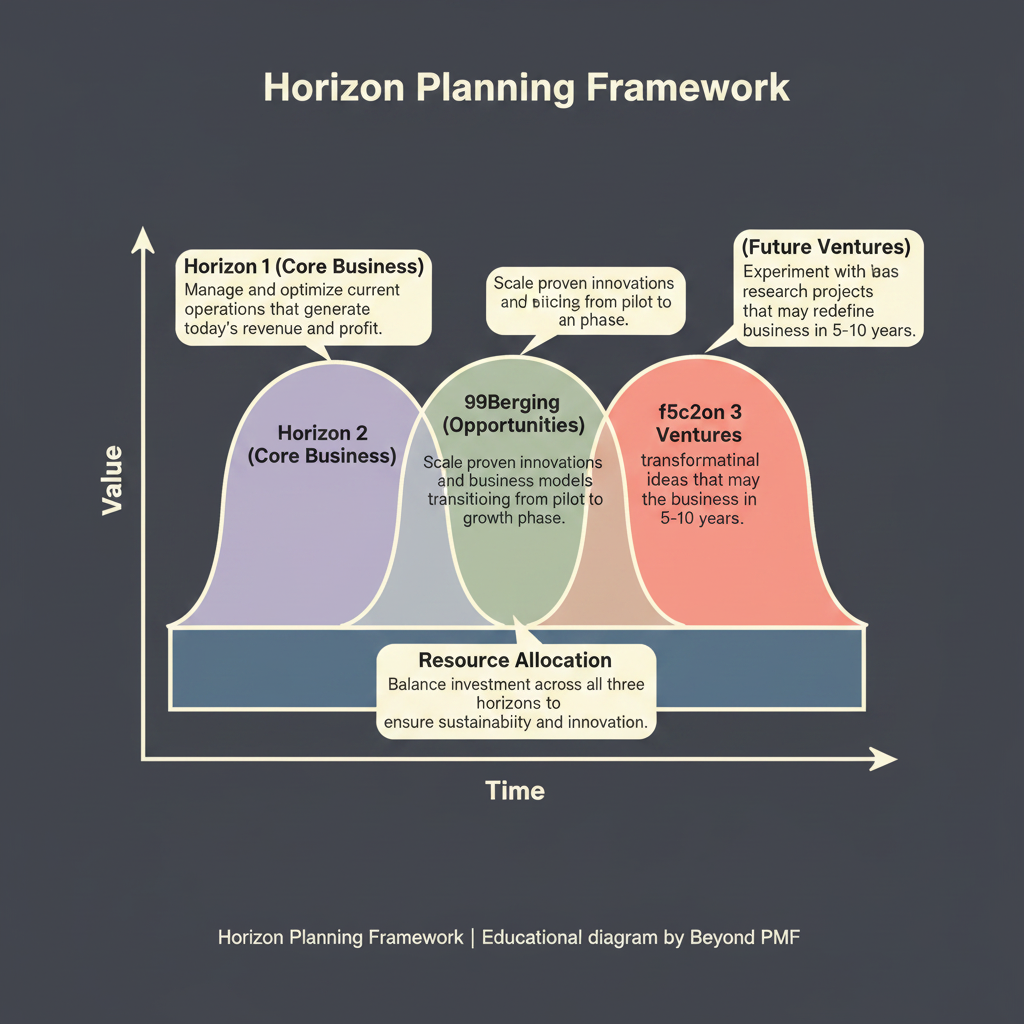
The Horizon Planning Framework, often referred to as the Three Horizons Framework, helps organizations balance their focus between current operations and future opportunities. It segments initiatives into three horizons: Horizon 1 focuses on improving current products and processes, Horizon 2 explores emerging opportunities, and Horizon 3 involves creating future-oriented innovations. This framework aids in ensuring that companies invest appropriately across these different stages, thus securing current performance while fostering future growth.
Identify and categorize current projects and initiatives into three horizons based on their time frame and potential impact. | Allocate resources and assign responsibilities for each horizon to balance focus between immediate gains and long-term growth. | Regularly review and adjust the initiatives in each horizon to reflect changes in the business environment and technological advancements.
Ensure clear communication and understanding of the framework across all levels of the organization | Regularly update the categorization of initiatives as markets and technologies evolve | Maintain a balanced investment in all three horizons to prevent stagnation or overextension
Encourages long-term thinking while maintaining short-term performance | Helps in allocating resources efficiently across different stages of growth | Facilitates innovation by systematically exploring future opportunities
Can be complex to implement and maintain across large organizations | May lead to neglect of mid-term goals if not balanced properly | Requires constant updating and flexibility to adapt to new information
When planning long-term business strategies | In times of significant technological or market changes
In very small or early-stage startups where immediate survival is the priority | When the business environment is extremely stable and current operations do not require innovation