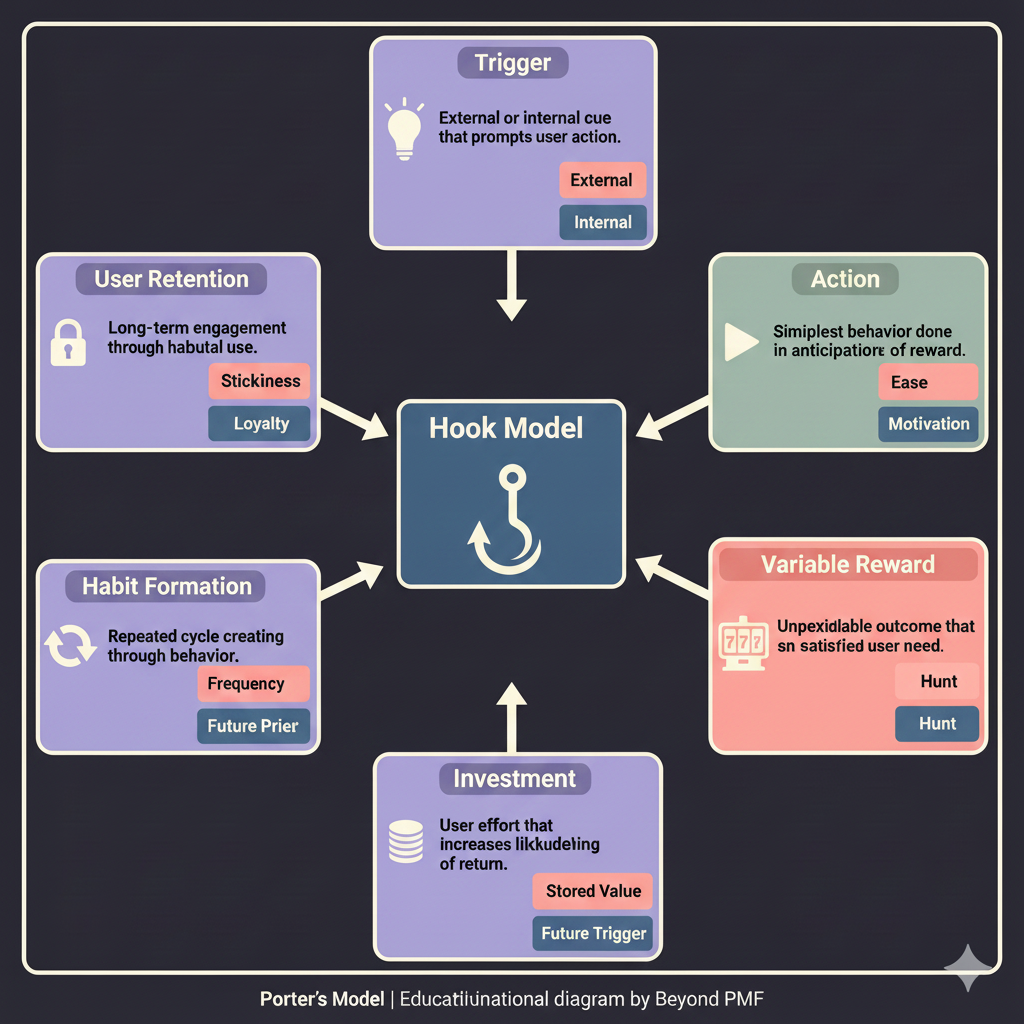
Hook Model

https://ik.imagekit.io/beyondpmf/frameworks/hook-model.png
The Hook Model directly addresses customer engagement and retention, which are integral aspects of the customer experience. By focusing on habit formation, it aims to reduce friction in user interaction and improve the overall product usage, aligning with execution-focused challenges.

The Hook Model is a behavioral design framework developed by Nir Eyal. It focuses on creating products that keep users coming back by forming habits. The model outlines a four-step process that hooks users by triggering their behavior, leading to actions that are rewarded and ultimately invested in. This cyclical process not only increases user engagement but also fosters customer loyalty and increases the product's intrinsic value.

Steps / Detailed Description

Trigger: Identifies the internal or external cues that prompt the user to action. | Action: Defines the simplest behavior in anticipation of a reward. | Variable Reward: Provides rewards that fulfill the user's needs but with enough variability to sustain their interest. | Investment: Involves the user making some form of investment in the product, which increases the likelihood of returning.

Best Practices

Clearly identify user needs and pain points to create effective triggers. | Ensure actions are easy to perform to reduce user effort. | Balance the frequency and type of rewards to maintain interest without causing fatigue.

Pros

Increases user engagement through repeated interactions. | Enhances customer retention by forming habits. | Drives product loyalty and long-term user relationships.

Cons

Risk of overdependence on psychological manipulation. | May lead to ethical concerns if misused. | Not suitable for all types of products or services.

When to Use

When developing products that benefit from frequent user interaction. | In markets where customer retention is critical for success.

When Not to Use

For products that do not require habitual use. | When ethical implications may arise from manipulating user behavior.

Related Frameworks

Lifecycle

Not tied to a specific lifecycle stage

Scope

Scope not defined

Maturity Level

Maturity level not specified

Time to Implement

2–4 Weeks
3–6 Months
1–2 Weeks
3–6 Months
1–2 Months
3–6 Months
1–2 Weeks
Less Than 1 Day
1–2 Weeks
Longer Than 6 Months
1–2 Weeks
Longer Than 6 Months
1–2 Weeks
3–6 Months
1–2 Weeks
1–2 Weeks
1–2 Weeks
1–2 Weeks
1–2 Days
1–2 Weeks
1–2 Weeks
1–2 Weeks
1–2 Weeks
1–2 Weeks
1–2 Weeks
3–6 Months
1–2 Weeks
1–2 Weeks
1–2 Weeks
3–6 Months
1–2 Weeks
1–2 Weeks
2–4 Weeks
1–2 Weeks
1–2 Days
1–2 Weeks
Longer Than 6 Months
3–6 Months
Longer Than 6 Months
1–2 Weeks
Longer Than 6 Months
3–6 Months
Less Than 1 Day
3–6 Months
1–2 Months
3–6 Months
Longer Than 6 Months
3–6 Months
Less Than 1 Day
1–2 Weeks
3–6 Months
3–6 Months
1–2 Weeks
3–6 Months
1–2 Weeks
1–2 Weeks
1–2 Days
1–2 Weeks
1–2 Months
Longer Than 6 Months
1–2 Weeks
Longer Than 6 Months
1–2 Weeks
3–6 Months
1–2 Weeks
Less Than 1 Day
1–2 Weeks
3–6 Months
1–2 Weeks
3–6 Months
1–2 Weeks
1–2 Weeks
Longer Than 6 Months
Less Than 1 Day
3–6 Months
Longer Than 6 Months
1–2 Months
1–2 Weeks
Longer Than 6 Months
1–2 Weeks
3–6 Months
1–2 Weeks
1–2 Weeks
3–6 Months
Less Than 1 Day
1–2 Weeks
1–2 Weeks
3–6 Months
3–6 Months
Less Than 1 Day
1–2 Weeks
Longer Than 6 Months
1–2 Months
1–2 Weeks
1–2 Weeks
1–2 Weeks
Longer Than 6 Months

Copyright Information

Autor:
Nir Eyal
2014
Publication:
Nir Eyal (Hooked: How to Build Habit-Forming Products)