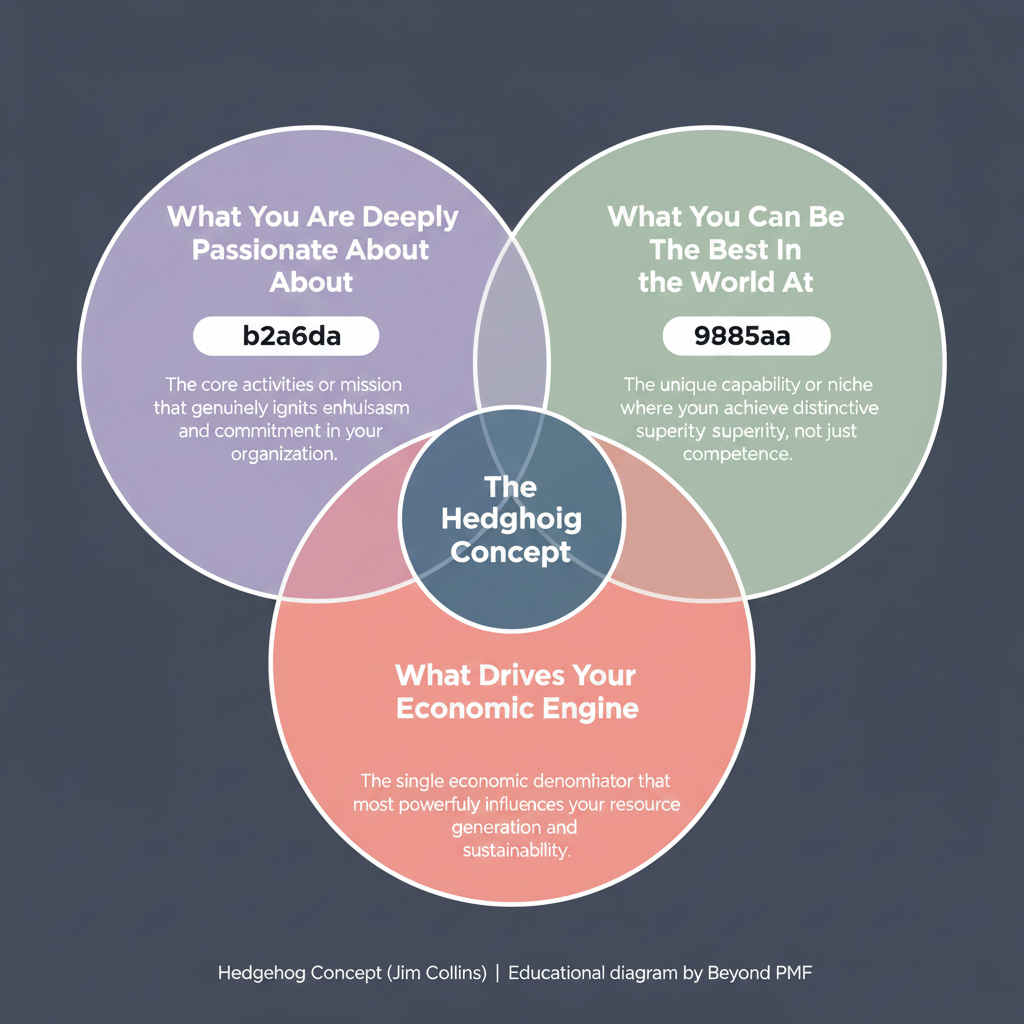
Hedgehog Concept (Jim Collins)

https://ik.imagekit.io/beyondpmf/frameworks/hedgehog-concept-jim-collins.png
The Hedgehog Concept addresses the friction of unclear direction and conflicting priorities. It helps organizations define a clear focus by identifying their core competencies and aligning strategy to achieve long-term success.

Developed by Jim Collins in his book 'Good to Great,' the Hedgehog Concept is a framework used by organizations to determine where they can excel. It involves a deep understanding of three intersecting circles: what you are deeply passionate about, what you can be the best in the world at, and what drives your economic engine. By focusing on the intersection of these three elements, organizations can simplify their strategy and concentrate on what they do best, leading to superior performance and sustainability.

Steps / Detailed Description

Identify what you are deeply passionate about: Understand what drives your organization's commitment and enthusiasm. | Determine what you can be the best in the world at: Analyze your capabilities to find where you can excel beyond competitors. | Define what drives your economic engine: Consider the economic factors that sustain your business. | Find the intersection of the three circles: Focus on where passion, best capability, and economic drivers overlap. | Implement strategies based on this intersection: Align organizational strategies and resources to leverage this focal point.

Best Practices

Regularly revisit and reassess the three circles as market conditions and internal capabilities evolve. | Ensure broad and deep input from across the organization to accurately define each circle. | Align organizational structure and resource allocation with the central Hedgehog Concept.

Pros

Provides a clear focus for strategic decision-making | Encourages alignment around core competencies | Simplifies complex strategic choices by concentrating on key areas

Cons

May overlook emerging opportunities outside the core focus | Can be overly simplistic in diverse and complex markets | Relies heavily on accurate self-assessment of capabilities and market conditions

When to Use

When refining organizational focus and strategy | During strategic planning sessions to determine long-term goals

When Not to Use

In highly volatile markets where flexibility is crucial | When innovation outside core areas is necessary for survival

Related Frameworks

Scope

Scope not defined

Maturity Level

Maturity level not specified

Time to Implement

2–4 Weeks
3–6 Months
1–2 Weeks
3–6 Months
1–2 Months
3–6 Months
1–2 Weeks
Less Than 1 Day
1–2 Weeks
Longer Than 6 Months
1–2 Weeks
Longer Than 6 Months
1–2 Weeks
3–6 Months
1–2 Weeks
1–2 Weeks
1–2 Weeks
1–2 Weeks
1–2 Days
1–2 Weeks
1–2 Weeks
1–2 Weeks
1–2 Weeks
1–2 Weeks
1–2 Weeks
3–6 Months
1–2 Weeks
1–2 Weeks
1–2 Weeks
3–6 Months
1–2 Weeks
1–2 Weeks
2–4 Weeks
1–2 Weeks
1–2 Days
1–2 Weeks
Longer Than 6 Months
3–6 Months
Longer Than 6 Months
1–2 Weeks
Longer Than 6 Months
3–6 Months
Less Than 1 Day
3–6 Months
1–2 Months
3–6 Months
Longer Than 6 Months
3–6 Months
Less Than 1 Day
1–2 Weeks
3–6 Months
3–6 Months
1–2 Weeks
3–6 Months
1–2 Weeks
1–2 Weeks
1–2 Days
1–2 Weeks
1–2 Months
Longer Than 6 Months
1–2 Weeks
Longer Than 6 Months
1–2 Weeks
3–6 Months
1–2 Weeks
Less Than 1 Day
1–2 Weeks
3–6 Months
1–2 Weeks
3–6 Months
1–2 Weeks
1–2 Weeks
Longer Than 6 Months
Less Than 1 Day
3–6 Months
Longer Than 6 Months
1–2 Months
1–2 Weeks
Longer Than 6 Months
1–2 Weeks
3–6 Months
1–2 Weeks
1–2 Weeks
3–6 Months
Less Than 1 Day
1–2 Weeks
1–2 Weeks
3–6 Months
3–6 Months
Less Than 1 Day
1–2 Weeks
Longer Than 6 Months
1–2 Months
1–2 Weeks
1–2 Weeks
1–2 Weeks
Longer Than 6 Months

Copyright Information

Autor:
Jim Collins
2001
Publication:
Good to Great