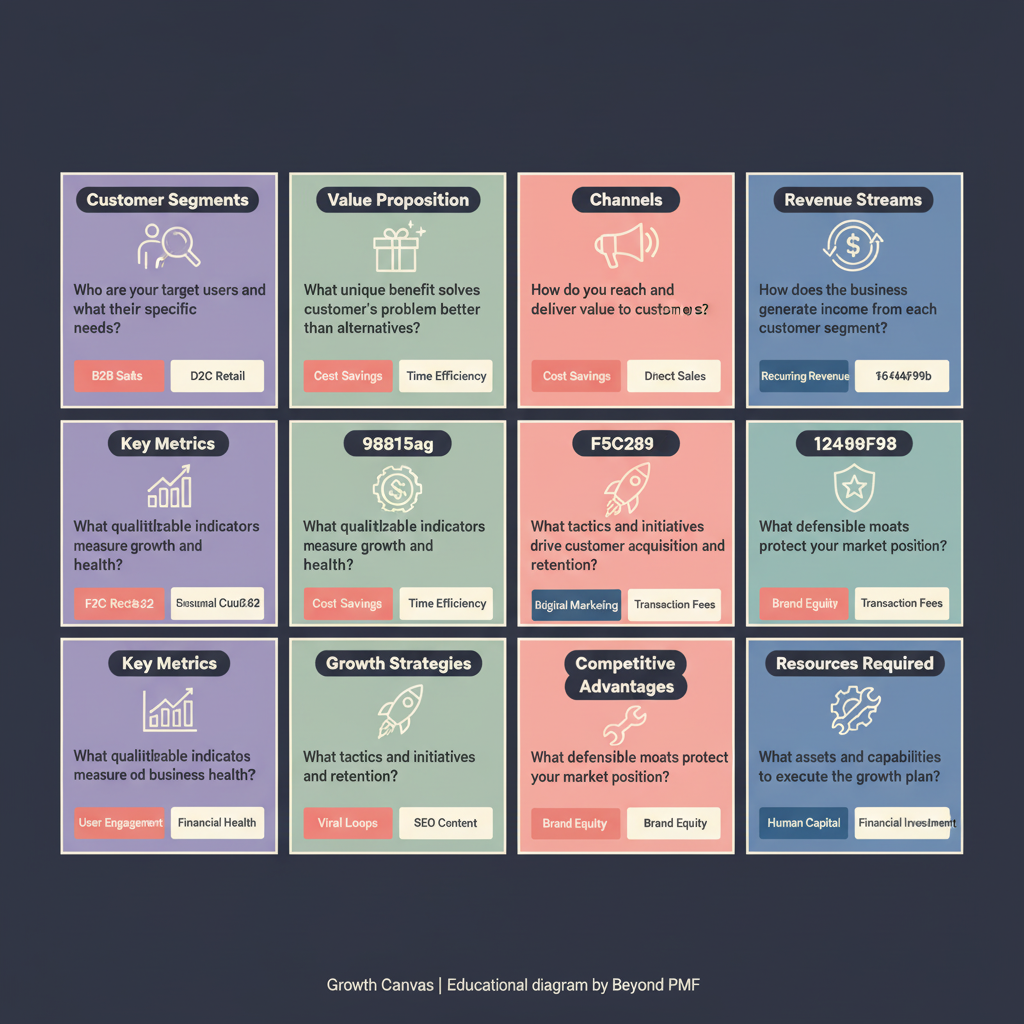
Growth Canvas

The Growth Canvas directly addresses the core strategic friction points related to defining paths for business growth and innovation. It helps clarify direction, refine business models, and achieve market alignment, which are all fundamental aspects of strategic planning and decision-making.

The Growth Canvas is a framework designed to help businesses identify and leverage opportunities for growth and innovation. It provides a structured approach to brainstorming, strategizing, and visualizing the potential avenues for business expansion. This framework is particularly beneficial for aligning team goals, focusing on customer needs, and optimizing resources to maximize growth potential.

Steps / Detailed Description

Identify your current value proposition and how it meets customer needs. | Analyze the market and competitive landscape to identify growth opportunities. | Brainstorm potential innovations or improvements in products, services, or processes. | Map out the key activities, resources, and partnerships needed to realize growth opportunities. | Define success metrics and establish a timeline for implementation and review.

Best Practices

Regularly update the canvas to reflect changes in the market and business environment. | Involve stakeholders from different departments to gain diverse insights. | Use real data to back up assumptions and decisions made during the process.

Pros

Facilitates strategic alignment and focus on growth objectives. | Encourages innovation by systematically exploring opportunities. | Helps in resource optimization by identifying key growth levers.

Cons

Can be time-consuming to implement thoroughly. | May require substantial data and market insights to be effective. | Risk of overlooking external factors that could impact the growth strategies.

When to Use

When planning to enter new markets or launch new products. | When seeking to innovate or improve existing products and services.

When Not to Use

In highly unstable or unpredictable market conditions. | When immediate, tactical decisions are required rather than strategic planning.

Related Frameworks

Scope

Scope not defined

Maturity Level

Maturity level not specified

Time to Implement

2–4 Weeks
3–6 Months
1–2 Weeks
3–6 Months
1–2 Months
3–6 Months
1–2 Weeks
Less Than 1 Day
1–2 Weeks
Longer Than 6 Months
1–2 Weeks
Longer Than 6 Months
1–2 Weeks
3–6 Months
1–2 Weeks
1–2 Weeks
1–2 Weeks
1–2 Weeks
1–2 Days
1–2 Weeks
1–2 Weeks
1–2 Weeks
1–2 Weeks
1–2 Weeks
1–2 Weeks
3–6 Months
1–2 Weeks
1–2 Weeks
1–2 Weeks
3–6 Months
1–2 Weeks
1–2 Weeks
2–4 Weeks
1–2 Weeks
1–2 Days
1–2 Weeks
Longer Than 6 Months
3–6 Months
Longer Than 6 Months
1–2 Weeks
Longer Than 6 Months
3–6 Months
Less Than 1 Day
3–6 Months
1–2 Months
3–6 Months
Longer Than 6 Months
3–6 Months
Less Than 1 Day
1–2 Weeks
3–6 Months
3–6 Months
1–2 Weeks
3–6 Months
1–2 Weeks
1–2 Weeks
1–2 Days
1–2 Weeks
1–2 Months
Longer Than 6 Months
1–2 Weeks
Longer Than 6 Months
1–2 Weeks
3–6 Months
1–2 Weeks
Less Than 1 Day
1–2 Weeks
3–6 Months
1–2 Weeks
3–6 Months
1–2 Weeks
1–2 Weeks
Longer Than 6 Months
Less Than 1 Day
3–6 Months
Longer Than 6 Months
1–2 Months
1–2 Weeks
Longer Than 6 Months
1–2 Weeks
3–6 Months
1–2 Weeks
1–2 Weeks
3–6 Months
Less Than 1 Day
1–2 Weeks
1–2 Weeks
3–6 Months
3–6 Months
Less Than 1 Day
1–2 Weeks
Longer Than 6 Months
1–2 Months
1–2 Weeks
1–2 Weeks
1–2 Weeks
Longer Than 6 Months

Copyright Information

Autor:
Unknown
N/A
Publication:
Unknown