Gherkin Specification

https://ik.imagekit.io/beyondpmf/frameworks/gherkin-specification.png
Gherkin Specification focuses on writing test cases for behavior-driven development. This directly impacts the execution phase of software development, improving delivery speed and potentially influencing the quality of the software by facilitating automated testing and ensuring alignment with desired behavior.

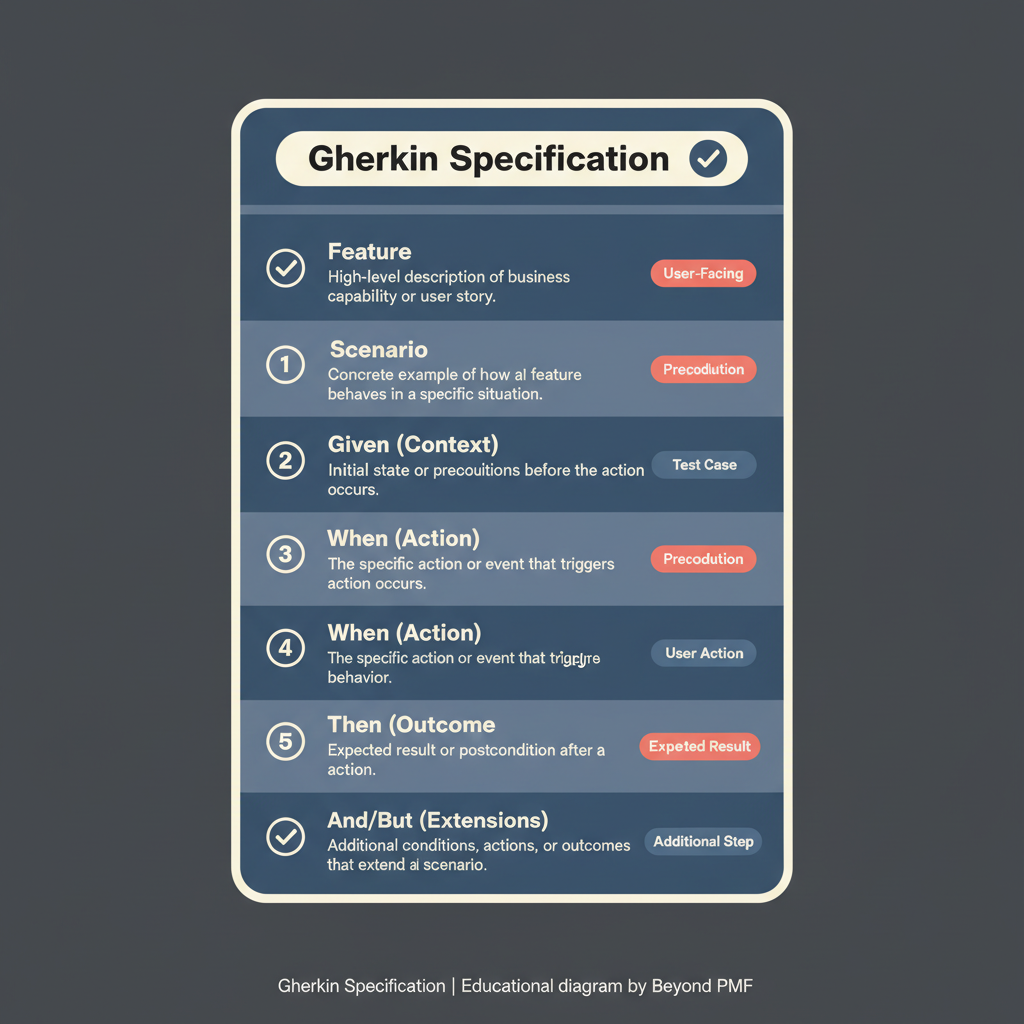
Gherkin Specification is a structured language used primarily in software development for behavior-driven development (BDD). It allows developers, testers, and business stakeholders to create test cases in plain language that can be easily understood by all parties. The framework is designed to promote communication and collaboration, ensuring that all features are developed with clear and agreed-upon expectations. Its syntax is human-readable, which helps in bridging the communication gap between technical and non-technical team members and facilitates the automation of test cases.

Steps / Detailed Description

Define the Feature: Start by defining the feature that needs testing or development. | Write User Stories: Create user stories that describe the desired functionality from the user's perspective. | Scenario Outline: Write scenarios using Given-When-Then format to outline the conditions, actions, and expected outcomes. | Parameterization: Use Examples tables to provide parameters for scenarios, allowing multiple inputs to be tested. | Automate Tests: Implement the scenarios as automated tests using a tool like Cucumber.

Best Practices

Keep scenarios simple and focused on user outcomes | Regularly review and update test cases to align with evolving requirements | Use clear and consistent language to avoid ambiguity

Pros

Improves communication between technical and non-technical team members | Facilitates the automation of acceptance testing | Ensures clarity and agreement on feature requirements before development begins

Cons

Requires precise language, which can be time-consuming | Can lead to overly detailed test cases that are hard to maintain | Dependent on tool support for implementation and execution

When to Use

In projects where clear communication between stakeholders is crucial | In agile development environments emphasizing behavior-driven development

When Not to Use

For very small projects where the overhead might outweigh the benefits | When rapid prototyping or exploratory testing is more suitable

Related Frameworks

Categories

Scope

Scope not defined

Maturity Level

Maturity level not specified

Time to Implement

2–4 Weeks
3–6 Months
1–2 Weeks
3–6 Months
1–2 Months
3–6 Months
1–2 Weeks
Less Than 1 Day
1–2 Weeks
Longer Than 6 Months
1–2 Weeks
Longer Than 6 Months
1–2 Weeks
3–6 Months
1–2 Weeks
1–2 Weeks
1–2 Weeks
1–2 Weeks
1–2 Days
1–2 Weeks
1–2 Weeks
1–2 Weeks
1–2 Weeks
1–2 Weeks
1–2 Weeks
3–6 Months
1–2 Weeks
1–2 Weeks
1–2 Weeks
3–6 Months
1–2 Weeks
1–2 Weeks
2–4 Weeks
1–2 Weeks
1–2 Days
1–2 Weeks
Longer Than 6 Months
3–6 Months
Longer Than 6 Months
1–2 Weeks
Longer Than 6 Months
3–6 Months
Less Than 1 Day
3–6 Months
1–2 Months
3–6 Months
Longer Than 6 Months
3–6 Months
Less Than 1 Day
1–2 Weeks
3–6 Months
3–6 Months
1–2 Weeks
3–6 Months
1–2 Weeks
1–2 Weeks
1–2 Days
1–2 Weeks
1–2 Months
Longer Than 6 Months
1–2 Weeks
Longer Than 6 Months
1–2 Weeks
3–6 Months
1–2 Weeks
Less Than 1 Day
1–2 Weeks
3–6 Months
1–2 Weeks
3–6 Months
1–2 Weeks
1–2 Weeks
Longer Than 6 Months
Less Than 1 Day
3–6 Months
Longer Than 6 Months
1–2 Months
1–2 Weeks
Longer Than 6 Months
1–2 Weeks
3–6 Months
1–2 Weeks
1–2 Weeks
3–6 Months
Less Than 1 Day
1–2 Weeks
1–2 Weeks
3–6 Months
3–6 Months
Less Than 1 Day
1–2 Weeks
Longer Than 6 Months
1–2 Months
1–2 Weeks
1–2 Weeks
1–2 Weeks
Longer Than 6 Months

Copyright Information

Autor:
Unknown
Unknown
Publication:
Unknown