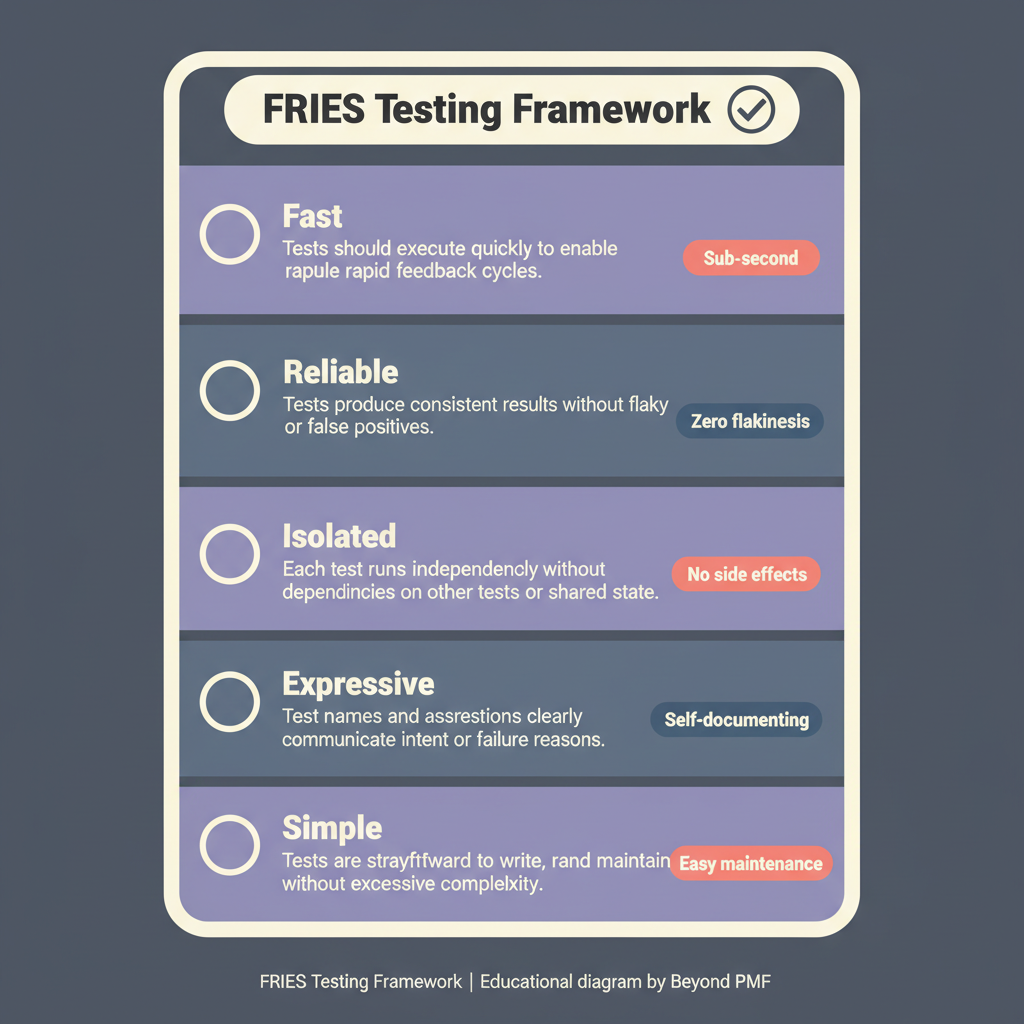
FRIES Testing Framework

https://ik.imagekit.io/beyondpmf/frameworks/fries-testing-framework.png
The FRIES framework directly addresses friction related to software testing, including repeatability, isolation, and efficiency. This framework primarily targets improving the technical quality and speed of software delivery, which falls under execution.

The FRIES Testing Framework is designed to enhance the quality and efficiency of software testing processes. It focuses on creating tests that are Flexible, Repeatable, Isolated, Efficient, and Scalable, thereby ensuring that software products meet their requirements consistently under varied conditions. This framework is particularly beneficial in environments where rapid development and frequent testing are required, as it helps in identifying defects early and reducing the time to market.

Steps / Detailed Description

Define the test objectives and ensure they are Flexible to adapt to changes. | Create Repeatable tests that can be used to verify software functionality consistently. | Ensure tests are Isolated to prevent interference and obtain reliable results. | Design tests to be Efficient, minimizing resources and time while maximizing coverage. | Scale tests to handle different loads and scenarios to ensure software performance under stress.

Best Practices

Regularly review and update tests to maintain flexibility | Use automation tools to enhance repeatability and efficiency | Maintain clear documentation for scalability and future reference

Pros

Improves test accuracy and reliability | Reduces time and resources spent on testing | Facilitates early detection of defects

Cons

Requires initial investment in test design | May be complex to implement for smaller projects | Potential overemphasis on structure could limit creativity in test cases

When to Use

In agile development environments | When developing large-scale software systems

When Not to Use

For very small or short-term projects | When testing needs are minimal and straightforward

Related Frameworks

Categories

Scope

Scope not defined

Maturity Level

Maturity level not specified

Time to Implement

2–4 Weeks
3–6 Months
1–2 Weeks
3–6 Months
1–2 Months
3–6 Months
1–2 Weeks
Less Than 1 Day
1–2 Weeks
Longer Than 6 Months
1–2 Weeks
Longer Than 6 Months
1–2 Weeks
3–6 Months
1–2 Weeks
1–2 Weeks
1–2 Weeks
1–2 Weeks
1–2 Days
1–2 Weeks
1–2 Weeks
1–2 Weeks
1–2 Weeks
1–2 Weeks
1–2 Weeks
3–6 Months
1–2 Weeks
1–2 Weeks
1–2 Weeks
3–6 Months
1–2 Weeks
1–2 Weeks
2–4 Weeks
1–2 Weeks
1–2 Days
1–2 Weeks
Longer Than 6 Months
3–6 Months
Longer Than 6 Months
1–2 Weeks
Longer Than 6 Months
3–6 Months
Less Than 1 Day
3–6 Months
1–2 Months
3–6 Months
Longer Than 6 Months
3–6 Months
Less Than 1 Day
1–2 Weeks
3–6 Months
3–6 Months
1–2 Weeks
3–6 Months
1–2 Weeks
1–2 Weeks
1–2 Days
1–2 Weeks
1–2 Months
Longer Than 6 Months
1–2 Weeks
Longer Than 6 Months
1–2 Weeks
3–6 Months
1–2 Weeks
Less Than 1 Day
1–2 Weeks
3–6 Months
1–2 Weeks
3–6 Months
1–2 Weeks
1–2 Weeks
Longer Than 6 Months
Less Than 1 Day
3–6 Months
Longer Than 6 Months
1–2 Months
1–2 Weeks
Longer Than 6 Months
1–2 Weeks
3–6 Months
1–2 Weeks
1–2 Weeks
3–6 Months
Less Than 1 Day
1–2 Weeks
1–2 Weeks
3–6 Months
3–6 Months
Less Than 1 Day
1–2 Weeks
Longer Than 6 Months
1–2 Months
1–2 Weeks
1–2 Weeks
1–2 Weeks
Longer Than 6 Months

Copyright Information

Autor:
Unknown
N/A
Publication:
Unknown