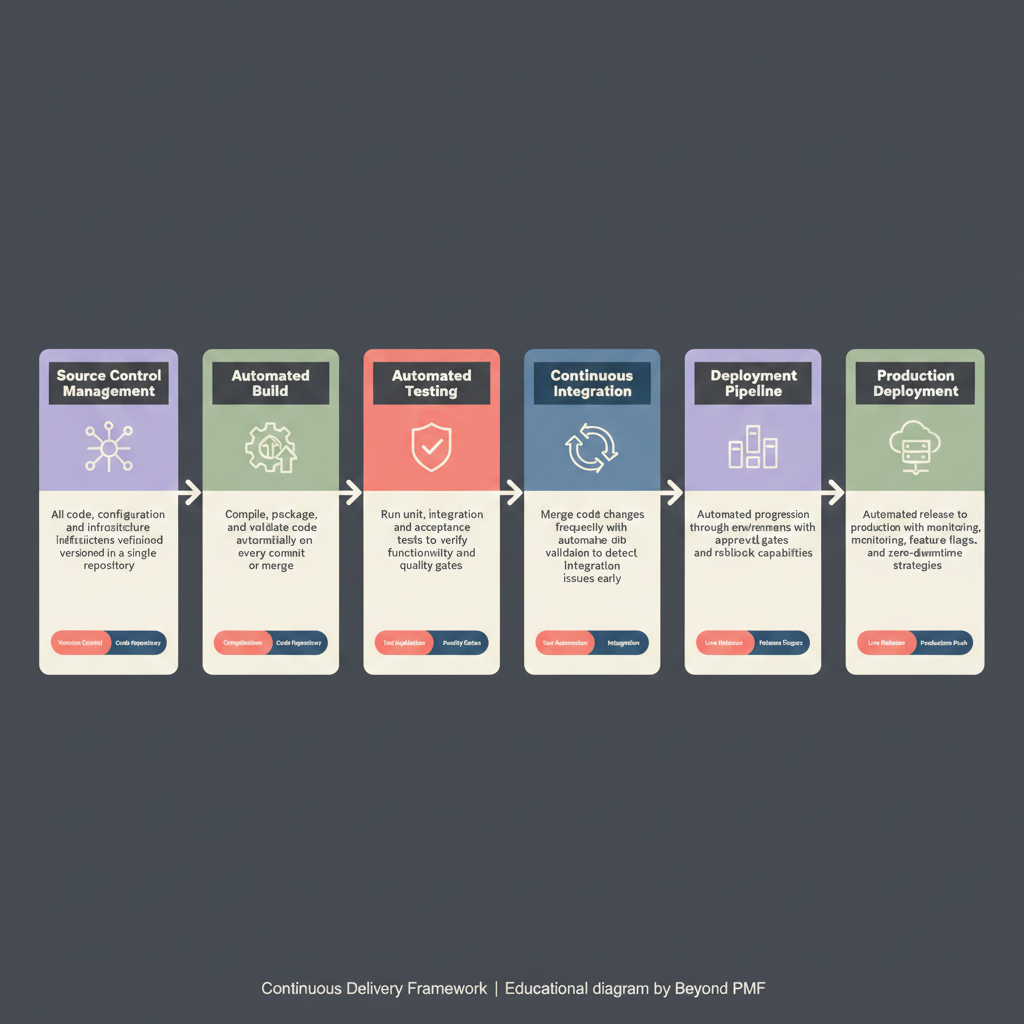
Continuous Delivery Framework

https://ik.imagekit.io/beyondpmf/frameworks/continuous-delivery-framework.png
The Continuous Delivery Framework primarily tackles friction related to software delivery speed, technical quality, and the implementation of software releases. It aims to improve the customer experience by enabling faster and more frequent releases with fewer issues.

The Continuous Delivery Framework is a set of practices and principles aimed at enabling software development teams to deliver code changes more frequently and reliably. This approach emphasizes the automation of software delivery processes to minimize manual work and ensure consistent deployments. By integrating regularly and automating the deployment process, teams can release updates with speed, less risk, and higher quality.

Steps / Detailed Description

Version Control: All production code is stored in a version control system. | Automated Testing: Develop automated tests to validate all aspects of the code. | Continuous Integration: Regularly merge code changes into a central repository followed by automated builds and tests. | Automated Deployment: Automatically deploy applications to production environments. | Monitoring and Feedback: Monitor the performance of applications in production and use feedback to guide future development.

Best Practices

Maintain a robust suite of automated tests. | Ensure the deployment process is repeatable and reliable. | Foster a culture of continuous improvement.

Pros

Reduced Deployment Risk | Faster Time to Market | Higher Product Quality

Cons

Initial Setup Complexity | Requires Cultural Change | High Dependency on Automation Tools

When to Use

When rapid delivery of features is critical. | When working on large projects with multiple contributors.

When Not to Use

In projects with low change frequency. | When the team lacks expertise in automation tools.

Related Frameworks

Categories

Lifecycle

Not tied to a specific lifecycle stage

Scope

Scope not defined

Maturity Level

Maturity level not specified

Time to Implement

2–4 Weeks
3–6 Months
1–2 Weeks
3–6 Months
1–2 Months
3–6 Months
1–2 Weeks
Less Than 1 Day
1–2 Weeks
Longer Than 6 Months
1–2 Weeks
Longer Than 6 Months
1–2 Weeks
3–6 Months
1–2 Weeks
1–2 Weeks
1–2 Weeks
1–2 Weeks
1–2 Days
1–2 Weeks
1–2 Weeks
1–2 Weeks
1–2 Weeks
1–2 Weeks
1–2 Weeks
3–6 Months
1–2 Weeks
1–2 Weeks
1–2 Weeks
3–6 Months
1–2 Weeks
1–2 Weeks
2–4 Weeks
1–2 Weeks
1–2 Days
1–2 Weeks
Longer Than 6 Months
3–6 Months
Longer Than 6 Months
1–2 Weeks
Longer Than 6 Months
3–6 Months
Less Than 1 Day
3–6 Months
1–2 Months
3–6 Months
Longer Than 6 Months
3–6 Months
Less Than 1 Day
1–2 Weeks
3–6 Months
3–6 Months
1–2 Weeks
3–6 Months
1–2 Weeks
1–2 Weeks
1–2 Days
1–2 Weeks
1–2 Months
Longer Than 6 Months
1–2 Weeks
Longer Than 6 Months
1–2 Weeks
3–6 Months
1–2 Weeks
Less Than 1 Day
1–2 Weeks
3–6 Months
1–2 Weeks
3–6 Months
1–2 Weeks
1–2 Weeks
Longer Than 6 Months
Less Than 1 Day
3–6 Months
Longer Than 6 Months
1–2 Months
1–2 Weeks
Longer Than 6 Months
1–2 Weeks
3–6 Months
1–2 Weeks
1–2 Weeks
3–6 Months
Less Than 1 Day
1–2 Weeks
1–2 Weeks
3–6 Months
3–6 Months
Less Than 1 Day
1–2 Weeks
Longer Than 6 Months
1–2 Months
1–2 Weeks
1–2 Weeks
1–2 Weeks
Longer Than 6 Months

Copyright Information

Autor:
Unknown
N/A
Publication:
Generic Business Tool