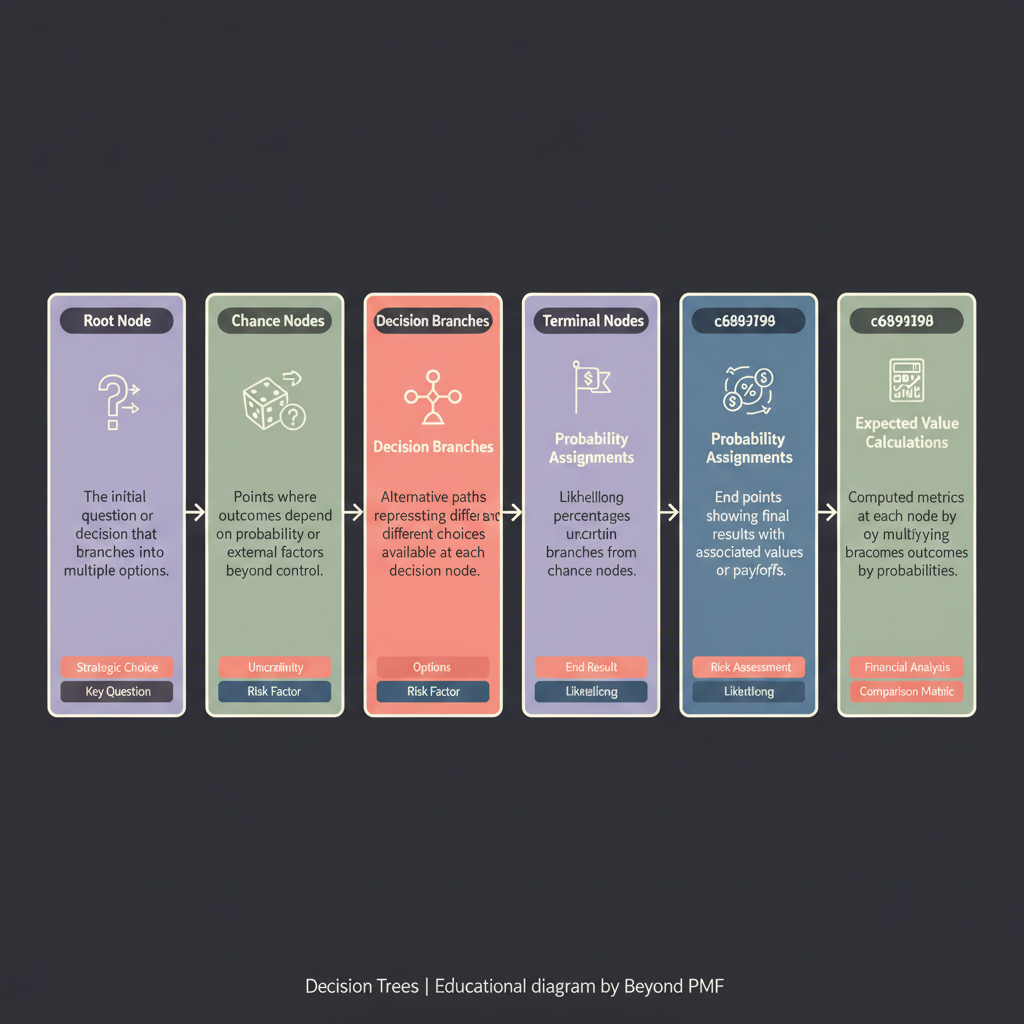
Decision Trees

https://ik.imagekit.io/beyondpmf/frameworks/decision-trees.png
Decision Trees primarily address friction related to the operational aspects of decision-making. They help to streamline and improve the process of evaluating choices by visualizing potential outcomes and consequences, leading to more coordinated and efficient decision workflows.

Decision Trees are a popular framework used in decision analysis to help identify a strategy most likely to reach a goal. It is a schematic representation involving branches that represent decision paths and each node denotes a test on an attribute, leading to a decision or classification. This framework is favored for its simplicity and effectiveness in laying out multiple decision paths and assessing the implications of various choices, thereby facilitating complex decision-making processes.

Steps / Detailed Description

Define the problem or decision to be made. | Identify all possible options and outcomes for each decision. | Structure these decisions and outcomes in a tree format, starting with the initial decision at the root. | Analyze the potential consequences of each decision path, including risks, costs, and benefits. | Use statistical data to estimate the outcomes for each scenario if applicable. | Review the decision tree to ensure all possible outcomes are considered. | Make a decision based on the most favorable outcome analyzed from the tree.

Best Practices

Keep the tree as simple as possible to enhance understanding and usability. | Regularly update the decision tree with new information and outcomes to maintain relevance. | Use software tools for constructing and analyzing complex trees.

Pros

Provides a clear visualization of decision paths and outcomes. | Facilitates understanding of potential consequences before decisions are made. | Helps to systematically analyze complex decision problems.

Cons

Can become overly complex with many decisions and outcomes. | Relies on accurate input data for effective decision-making. | May not account for unforeseen variables or outcomes.

When to Use

When needing to analyze a series of decisions involving multiple choices and outcomes. | In project management to forecast potential project paths and their outcomes.

When Not to Use

For decisions that are straightforward and do not involve multiple layers of outcomes. | When insufficient data is available to estimate the outcomes accurately.

Related Frameworks

Categories

Lifecycle

Not tied to a specific lifecycle stage

Scope

Scope not defined

Maturity Level

Maturity level not specified

Time to Implement

2–4 Weeks
3–6 Months
1–2 Weeks
3–6 Months
1–2 Months
3–6 Months
1–2 Weeks
Less Than 1 Day
1–2 Weeks
Longer Than 6 Months
1–2 Weeks
Longer Than 6 Months
1–2 Weeks
3–6 Months
1–2 Weeks
1–2 Weeks
1–2 Weeks
1–2 Weeks
1–2 Days
1–2 Weeks
1–2 Weeks
1–2 Weeks
1–2 Weeks
1–2 Weeks
1–2 Weeks
3–6 Months
1–2 Weeks
1–2 Weeks
1–2 Weeks
3–6 Months
1–2 Weeks
1–2 Weeks
2–4 Weeks
1–2 Weeks
1–2 Days
1–2 Weeks
Longer Than 6 Months
3–6 Months
Longer Than 6 Months
1–2 Weeks
Longer Than 6 Months
3–6 Months
Less Than 1 Day
3–6 Months
1–2 Months
3–6 Months
Longer Than 6 Months
3–6 Months
Less Than 1 Day
1–2 Weeks
3–6 Months
3–6 Months
1–2 Weeks
3–6 Months
1–2 Weeks
1–2 Weeks
1–2 Days
1–2 Weeks
1–2 Months
Longer Than 6 Months
1–2 Weeks
Longer Than 6 Months
1–2 Weeks
3–6 Months
1–2 Weeks
Less Than 1 Day
1–2 Weeks
3–6 Months
1–2 Weeks
3–6 Months
1–2 Weeks
1–2 Weeks
Longer Than 6 Months
Less Than 1 Day
3–6 Months
Longer Than 6 Months
1–2 Months
1–2 Weeks
Longer Than 6 Months
1–2 Weeks
3–6 Months
1–2 Weeks
1–2 Weeks
3–6 Months
Less Than 1 Day
1–2 Weeks
1–2 Weeks
3–6 Months
3–6 Months
Less Than 1 Day
1–2 Weeks
Longer Than 6 Months
1–2 Months
1–2 Weeks
1–2 Weeks
1–2 Weeks
Longer Than 6 Months

Copyright Information

Autor:
Public Domain
N/A
Publication:
Generic Business Tool