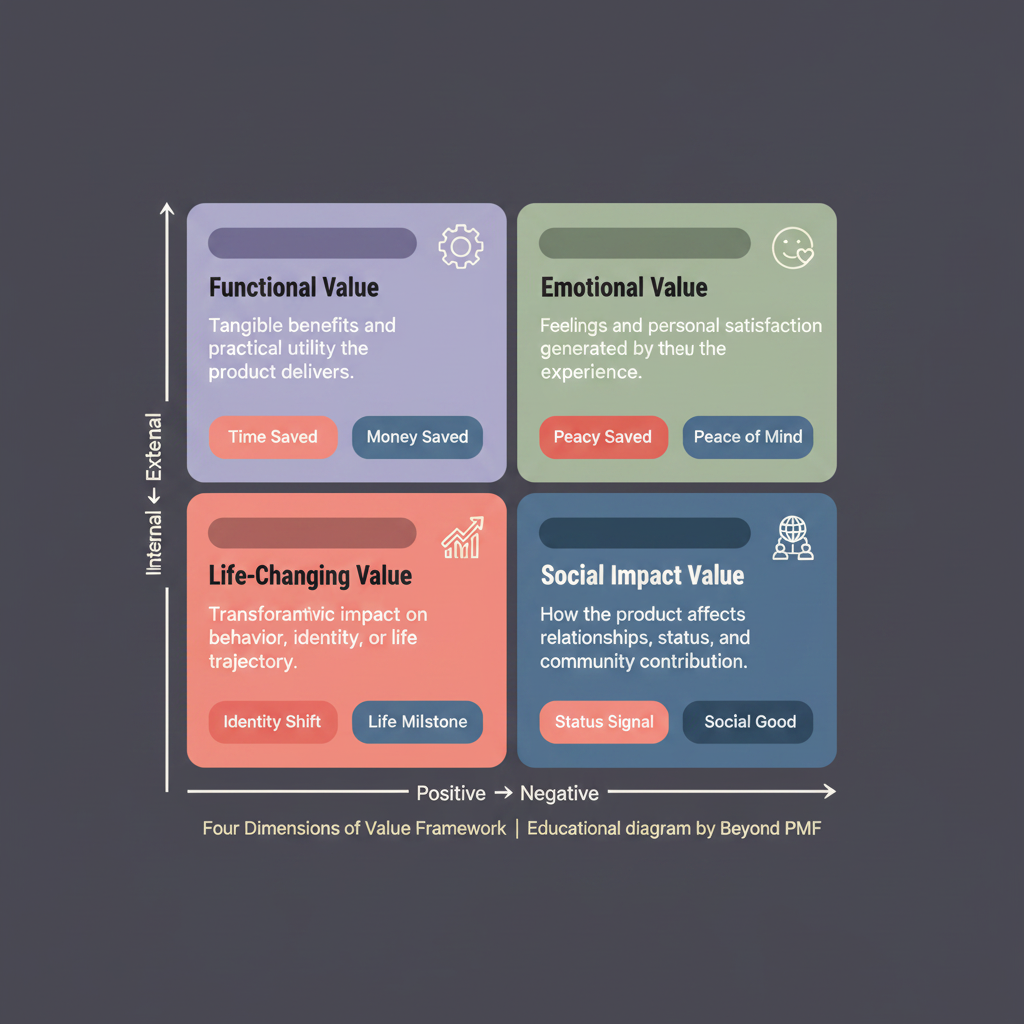
Four Dimensions of Value Framework

The Four Dimensions of Value Framework directly addresses strategic friction by providing a structured approach to assess and enhance value creation. It helps businesses clarify their direction and ensure alignment across various aspects of value.

The Four Dimensions of Value Framework is designed to help organizations evaluate and optimize their value proposition by examining four critical aspects: financial, customer, internal process, and learning and growth. By systematically assessing each dimension, companies can identify areas of strength and opportunity, align their operations more closely with their strategic goals, and foster sustainable growth. This holistic approach ensures a balanced focus on both short-term performance and long-term capability development.

Steps / Detailed Description

Identify key stakeholders and define value criteria for each of the four dimensions. | Conduct assessments to measure current performance in each dimension. | Analyze results to pinpoint discrepancies between current outcomes and desired goals. | Develop strategic initiatives to enhance performance in targeted dimensions. | Implement changes and monitor progress, adjusting strategies as necessary.

Best Practices

Regularly update and review the framework to reflect changes in business strategy. | Ensure clear communication and involvement of all relevant stakeholders. | Use a balanced scorecard to track progress and maintain focus on long-term goals.

Pros

Provides a comprehensive view of organizational value creation. | Facilitates strategic alignment and prioritization of resources. | Enhances understanding of how different business areas contribute to overall goals.

Cons

Can be complex and time-consuming to implement effectively. | Requires substantial data collection and analysis. | May lead to short-term focus if not balanced properly.

When to Use

When redefining or clarifying the company's value proposition. | In strategic planning sessions to align business activities with overall objectives.

When Not to Use

In very small or early-stage companies where data and resources are limited. | When immediate, tactical decisions are required without the need for comprehensive analysis.

Related Frameworks

Scope

Scope not defined

Maturity Level

Maturity level not specified

Time to Implement

2–4 Weeks
3–6 Months
1–2 Weeks
3–6 Months
1–2 Months
3–6 Months
1–2 Weeks
Less Than 1 Day
1–2 Weeks
Longer Than 6 Months
1–2 Weeks
Longer Than 6 Months
1–2 Weeks
3–6 Months
1–2 Weeks
1–2 Weeks
1–2 Weeks
1–2 Weeks
1–2 Days
1–2 Weeks
1–2 Weeks
1–2 Weeks
1–2 Weeks
1–2 Weeks
1–2 Weeks
3–6 Months
1–2 Weeks
1–2 Weeks
1–2 Weeks
3–6 Months
1–2 Weeks
1–2 Weeks
2–4 Weeks
1–2 Weeks
1–2 Days
1–2 Weeks
Longer Than 6 Months
3–6 Months
Longer Than 6 Months
1–2 Weeks
Longer Than 6 Months
3–6 Months
Less Than 1 Day
3–6 Months
1–2 Months
3–6 Months
Longer Than 6 Months
3–6 Months
Less Than 1 Day
1–2 Weeks
3–6 Months
3–6 Months
1–2 Weeks
3–6 Months
1–2 Weeks
1–2 Weeks
1–2 Days
1–2 Weeks
1–2 Months
Longer Than 6 Months
1–2 Weeks
Longer Than 6 Months
1–2 Weeks
3–6 Months
1–2 Weeks
Less Than 1 Day
1–2 Weeks
3–6 Months
1–2 Weeks
3–6 Months
1–2 Weeks
1–2 Weeks
Longer Than 6 Months
Less Than 1 Day
3–6 Months
Longer Than 6 Months
1–2 Months
1–2 Weeks
Longer Than 6 Months
1–2 Weeks
3–6 Months
1–2 Weeks
1–2 Weeks
3–6 Months
Less Than 1 Day
1–2 Weeks
1–2 Weeks
3–6 Months
3–6 Months
Less Than 1 Day
1–2 Weeks
Longer Than 6 Months
1–2 Months
1–2 Weeks
1–2 Weeks
1–2 Weeks
Longer Than 6 Months

Copyright Information

Autor:
Unknown
N/A
Publication:
Unknown