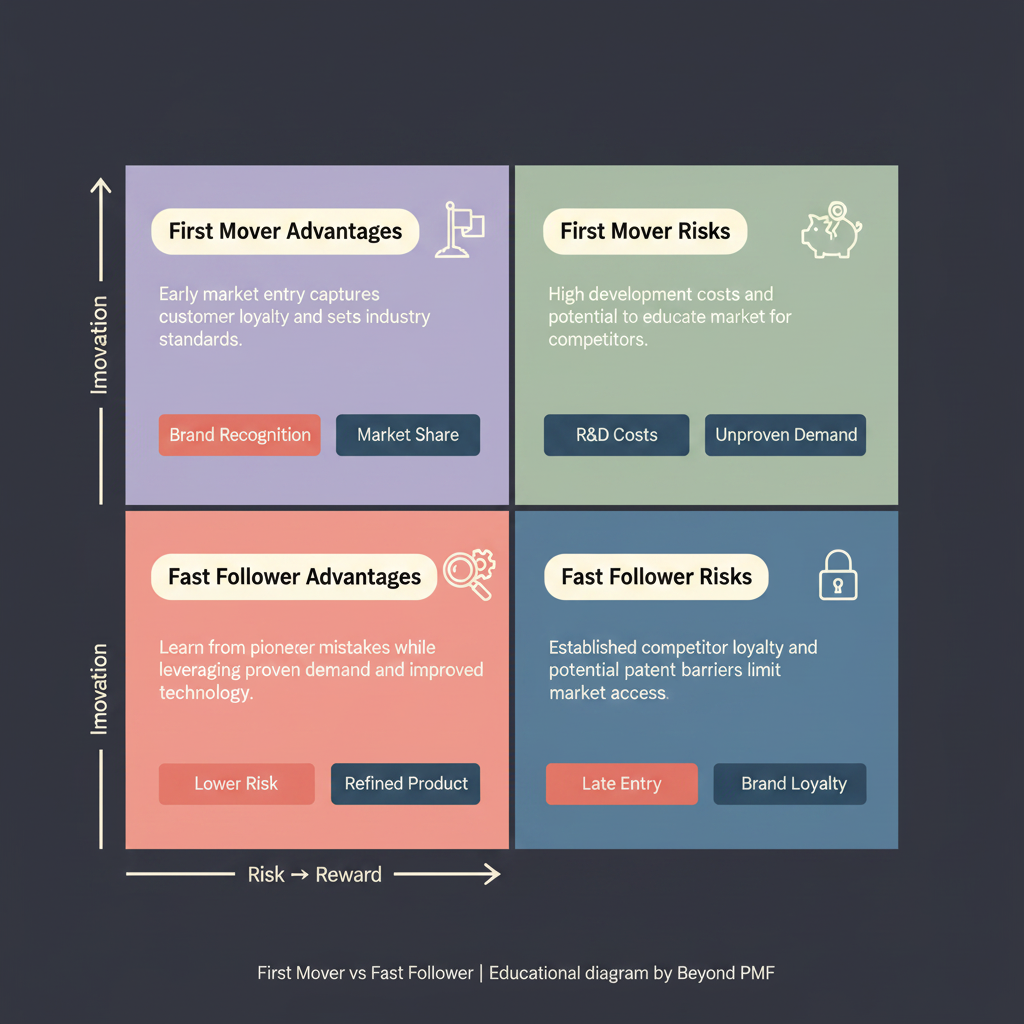
First Mover vs Fast Follower

https://ik.imagekit.io/beyondpmf/frameworks/first-mover-vs-fast-follower.png
The First Mover vs. Fast Follower framework addresses the strategic friction of market positioning. It helps organizations decide how to align their business model and strategic direction based on the timing of market entry and competitive landscape.

The First Mover vs Fast Follower framework is used to assess the advantages and disadvantages of being the first company to introduce a product or service to the market versus entering the market after competitors. This strategic decision impacts market share, brand loyalty, and the ability to shape customer preferences. Companies use this framework to determine the most advantageous timing and approach for launching new products or entering new markets.

Steps / Detailed Description

Identify market opportunities and potential for innovation. | Analyze competitor landscape and timing of market entry. | Assess internal capabilities for innovation and speed to market. | Evaluate potential risks and rewards of each position. | Develop a strategic plan based on the chosen approach.

Best Practices

Conduct thorough market research and competitor analysis. | Focus on core competencies and unique value propositions. | Maintain flexibility to adapt strategies based on market feedback.

Pros

First Mover: Establishes market dominance, sets industry standards, captures early market share. | Fast Follower: Learns from first mover's mistakes, optimizes product and strategy, reduces initial market entry costs.

Cons

First Mover: Higher risk and costs of market education, potential for rapid obsolescence. | Fast Follower: May struggle with brand differentiation, could miss out on early market share.

When to Use

Launching a revolutionary product. | Entering a market with few established competitors.

When Not to Use

Limited resources for market education. | High risk of technological obsolescence.

Related Frameworks

Scope

Scope not defined

Maturity Level

Maturity level not specified

Time to Implement

2–4 Weeks
3–6 Months
1–2 Weeks
3–6 Months
1–2 Months
3–6 Months
1–2 Weeks
Less Than 1 Day
1–2 Weeks
Longer Than 6 Months
1–2 Weeks
Longer Than 6 Months
1–2 Weeks
3–6 Months
1–2 Weeks
1–2 Weeks
1–2 Weeks
1–2 Weeks
1–2 Days
1–2 Weeks
1–2 Weeks
1–2 Weeks
1–2 Weeks
1–2 Weeks
1–2 Weeks
3–6 Months
1–2 Weeks
1–2 Weeks
1–2 Weeks
3–6 Months
1–2 Weeks
1–2 Weeks
2–4 Weeks
1–2 Weeks
1–2 Days
1–2 Weeks
Longer Than 6 Months
3–6 Months
Longer Than 6 Months
1–2 Weeks
Longer Than 6 Months
3–6 Months
Less Than 1 Day
3–6 Months
1–2 Months
3–6 Months
Longer Than 6 Months
3–6 Months
Less Than 1 Day
1–2 Weeks
3–6 Months
3–6 Months
1–2 Weeks
3–6 Months
1–2 Weeks
1–2 Weeks
1–2 Days
1–2 Weeks
1–2 Months
Longer Than 6 Months
1–2 Weeks
Longer Than 6 Months
1–2 Weeks
3–6 Months
1–2 Weeks
Less Than 1 Day
1–2 Weeks
3–6 Months
1–2 Weeks
3–6 Months
1–2 Weeks
1–2 Weeks
Longer Than 6 Months
Less Than 1 Day
3–6 Months
Longer Than 6 Months
1–2 Months
1–2 Weeks
Longer Than 6 Months
1–2 Weeks
3–6 Months
1–2 Weeks
1–2 Weeks
3–6 Months
Less Than 1 Day
1–2 Weeks
1–2 Weeks
3–6 Months
3–6 Months
Less Than 1 Day
1–2 Weeks
Longer Than 6 Months
1–2 Months
1–2 Weeks
1–2 Weeks
1–2 Weeks
Longer Than 6 Months

Copyright Information

Autor:
Public Domain
N/A
Publication:
Generic Business Tool