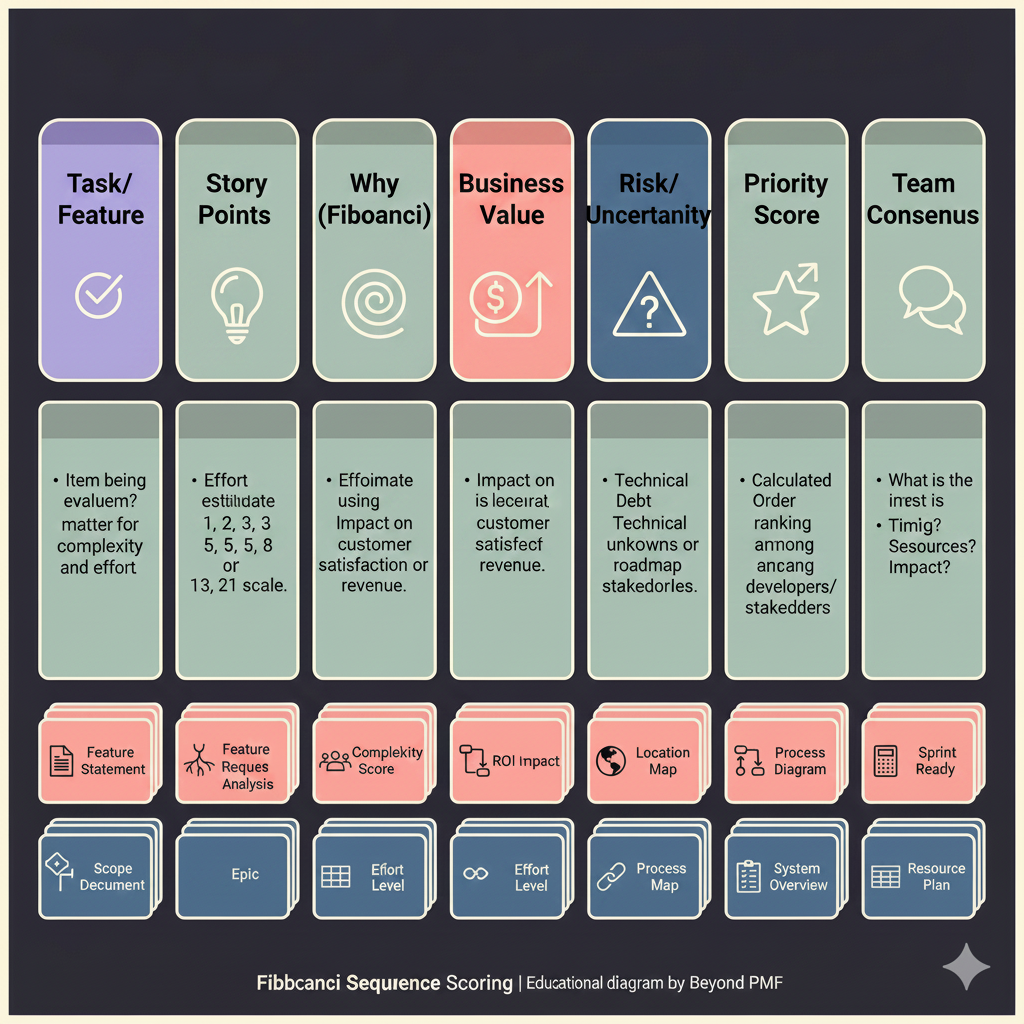
Fibonacci Sequence Scoring

https://ik.imagekit.io/beyondpmf/frameworks/fibonacci-sequence-scoring.png
Fibonacci Sequence Scoring directly addresses the friction of estimating task size and effort, which impacts delivery speed and quality. This helps teams make more accurate predictions and manage implementation.

Fibonacci Sequence Scoring utilizes the Fibonacci sequence to assign values to tasks or features, reflecting their complexity or effort. This method is favored because it naturally reflects the inherent uncertainty in estimating larger items, which tend to have more variability than smaller ones. It is widely used in Agile methodologies, particularly in planning poker, to achieve consensus and improve estimation accuracy.

Steps / Detailed Description

Define the scope of each task or feature to be estimated. | Introduce the Fibonacci sequence (0, 1, 1, 2, 3, 5, 8, 13, etc.) to the team. | Each team member selects a Fibonacci number that represents their estimate of effort or complexity. | Discuss the estimates as a team, especially where there are large discrepancies. | Adjust and converge on a final estimate for each task, using the sequence to guide decision-making.

Best Practices

Use historical data to calibrate estimates and improve accuracy. | Ensure all team members are trained on the Fibonacci sequence and its application. | Regularly review and adjust the estimation process based on feedback and outcomes.

Pros

Encourages team consensus and collaborative decision-making. | Reflects the non-linear nature of task complexity. | Helps manage estimation uncertainty for larger, more complex tasks.

Cons

Can be confusing for teams new to the Fibonacci sequence or Agile practices. | May lead to overestimation if not calibrated with historical data. | Relies heavily on team member experience and intuition.

When to Use

In Agile project management during sprint planning. | When estimating tasks that have a degree of uncertainty or complexity.

When Not to Use

For very small or well-defined tasks where simpler estimation methods are sufficient. | In non-Agile, highly structured project environments where detailed upfront planning is required.

Related Frameworks

Categories

Lifecycle

Scope

Scope not defined

Maturity Level

Maturity level not specified

Time to Implement

2–4 Weeks
3–6 Months
1–2 Weeks
3–6 Months
1–2 Months
3–6 Months
1–2 Weeks
Less Than 1 Day
1–2 Weeks
Longer Than 6 Months
1–2 Weeks
Longer Than 6 Months
1–2 Weeks
3–6 Months
1–2 Weeks
1–2 Weeks
1–2 Weeks
1–2 Weeks
1–2 Days
1–2 Weeks
1–2 Weeks
1–2 Weeks
1–2 Weeks
1–2 Weeks
1–2 Weeks
3–6 Months
1–2 Weeks
1–2 Weeks
1–2 Weeks
3–6 Months
1–2 Weeks
1–2 Weeks
2–4 Weeks
1–2 Weeks
1–2 Days
1–2 Weeks
Longer Than 6 Months
3–6 Months
Longer Than 6 Months
1–2 Weeks
Longer Than 6 Months
3–6 Months
Less Than 1 Day
3–6 Months
1–2 Months
3–6 Months
Longer Than 6 Months
3–6 Months
Less Than 1 Day
1–2 Weeks
3–6 Months
3–6 Months
1–2 Weeks
3–6 Months
1–2 Weeks
1–2 Weeks
1–2 Days
1–2 Weeks
1–2 Months
Longer Than 6 Months
1–2 Weeks
Longer Than 6 Months
1–2 Weeks
3–6 Months
1–2 Weeks
Less Than 1 Day
1–2 Weeks
3–6 Months
1–2 Weeks
3–6 Months
1–2 Weeks
1–2 Weeks
Longer Than 6 Months
Less Than 1 Day
3–6 Months
Longer Than 6 Months
1–2 Months
1–2 Weeks
Longer Than 6 Months
1–2 Weeks
3–6 Months
1–2 Weeks
1–2 Weeks
3–6 Months
Less Than 1 Day
1–2 Weeks
1–2 Weeks
3–6 Months
3–6 Months
Less Than 1 Day
1–2 Weeks
Longer Than 6 Months
1–2 Months
1–2 Weeks
1–2 Weeks
1–2 Weeks
Longer Than 6 Months

Copyright Information

Autor:
Public Domain
N/A
Publication:
Generic Business Tool