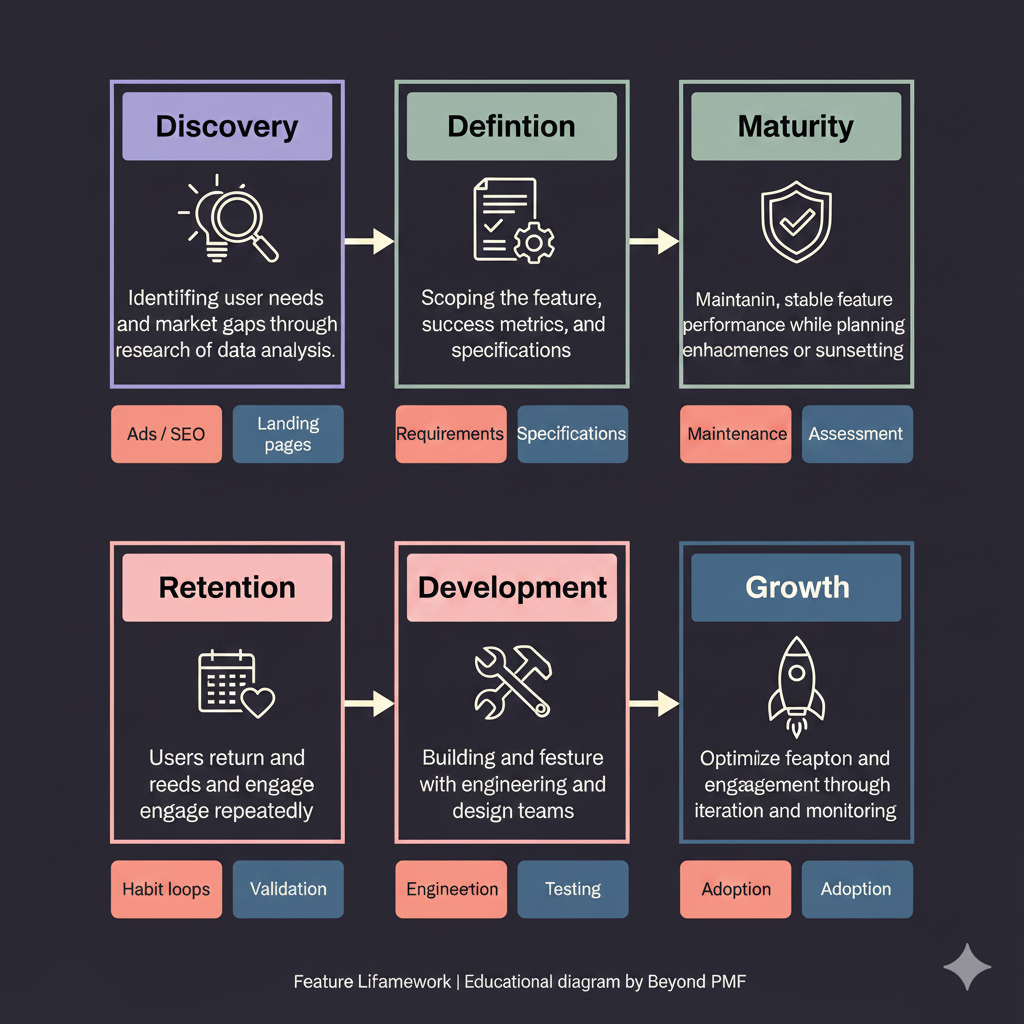
Feature Lifecycle Framework

https://ik.imagekit.io/beyondpmf/frameworks/feature-lifecycle-framework.png
The Feature Lifecycle Framework primarily addresses operational friction by managing the process of feature development and maintenance across the entire lifecycle. It focuses on orchestration, workflows, and coordination of tasks from inception to retirement.

The Feature Lifecycle Framework provides a structured methodology for overseeing the entire lifecycle of a product feature. It helps organizations to systematically develop, launch, evaluate, and enhance or retire product features based on performance and market feedback. This framework is crucial for ensuring that features remain relevant and valuable to users, and it supports continuous improvement in product offerings.

Steps / Detailed Description

Conceptualization: Identifying and defining the need for a new feature based on market research and user feedback. | Development: Designing and developing the feature in alignment with the product's overall strategy. | Testing: Rigorously testing the feature to ensure it meets quality standards and user requirements. | Deployment: Rolling out the feature to users, often in stages to gauge response and effectiveness. | Evaluation: Monitoring performance metrics and gathering user feedback to assess the impact of the feature. | Enhancement or Retirement: Deciding whether to enhance the feature based on feedback and performance or to retire it if it no longer meets user needs.

Best Practices

Regularly update and review the feature roadmap | Incorporate user feedback at each stage | Use metrics and KPIs to evaluate feature success

Pros

Ensures systematic management of feature development | Facilitates continuous improvement based on feedback | Helps in aligning features with market needs and strategic goals

Cons

Can be resource-intensive | May slow down time-to-market due to extensive processes | Risk of over-engineering or excessive iteration

When to Use

When developing new features for a product | When updating or phasing out existing features

When Not to Use

For very small or minor updates that do not significantly impact the product | When rapid deployment is more critical than structured evaluation

Related Frameworks

Lifecycle

Not tied to a specific lifecycle stage

Scope

Scope not defined

Maturity Level

Maturity level not specified

Time to Implement

2–4 Weeks
3–6 Months
1–2 Weeks
3–6 Months
1–2 Months
3–6 Months
1–2 Weeks
Less Than 1 Day
1–2 Weeks
Longer Than 6 Months
1–2 Weeks
Longer Than 6 Months
1–2 Weeks
3–6 Months
1–2 Weeks
1–2 Weeks
1–2 Weeks
1–2 Weeks
1–2 Days
1–2 Weeks
1–2 Weeks
1–2 Weeks
1–2 Weeks
1–2 Weeks
1–2 Weeks
3–6 Months
1–2 Weeks
1–2 Weeks
1–2 Weeks
3–6 Months
1–2 Weeks
1–2 Weeks
2–4 Weeks
1–2 Weeks
1–2 Days
1–2 Weeks
Longer Than 6 Months
3–6 Months
Longer Than 6 Months
1–2 Weeks
Longer Than 6 Months
3–6 Months
Less Than 1 Day
3–6 Months
1–2 Months
3–6 Months
Longer Than 6 Months
3–6 Months
Less Than 1 Day
1–2 Weeks
3–6 Months
3–6 Months
1–2 Weeks
3–6 Months
1–2 Weeks
1–2 Weeks
1–2 Days
1–2 Weeks
1–2 Months
Longer Than 6 Months
1–2 Weeks
Longer Than 6 Months
1–2 Weeks
3–6 Months
1–2 Weeks
Less Than 1 Day
1–2 Weeks
3–6 Months
1–2 Weeks
3–6 Months
1–2 Weeks
1–2 Weeks
Longer Than 6 Months
Less Than 1 Day
3–6 Months
Longer Than 6 Months
1–2 Months
1–2 Weeks
Longer Than 6 Months
1–2 Weeks
3–6 Months
1–2 Weeks
1–2 Weeks
3–6 Months
Less Than 1 Day
1–2 Weeks
1–2 Weeks
3–6 Months
3–6 Months
Less Than 1 Day
1–2 Weeks
Longer Than 6 Months
1–2 Months
1–2 Weeks
1–2 Weeks
1–2 Weeks
Longer Than 6 Months

Copyright Information

Autor:
Unknown
N/A
Publication:
Generic Business Tool