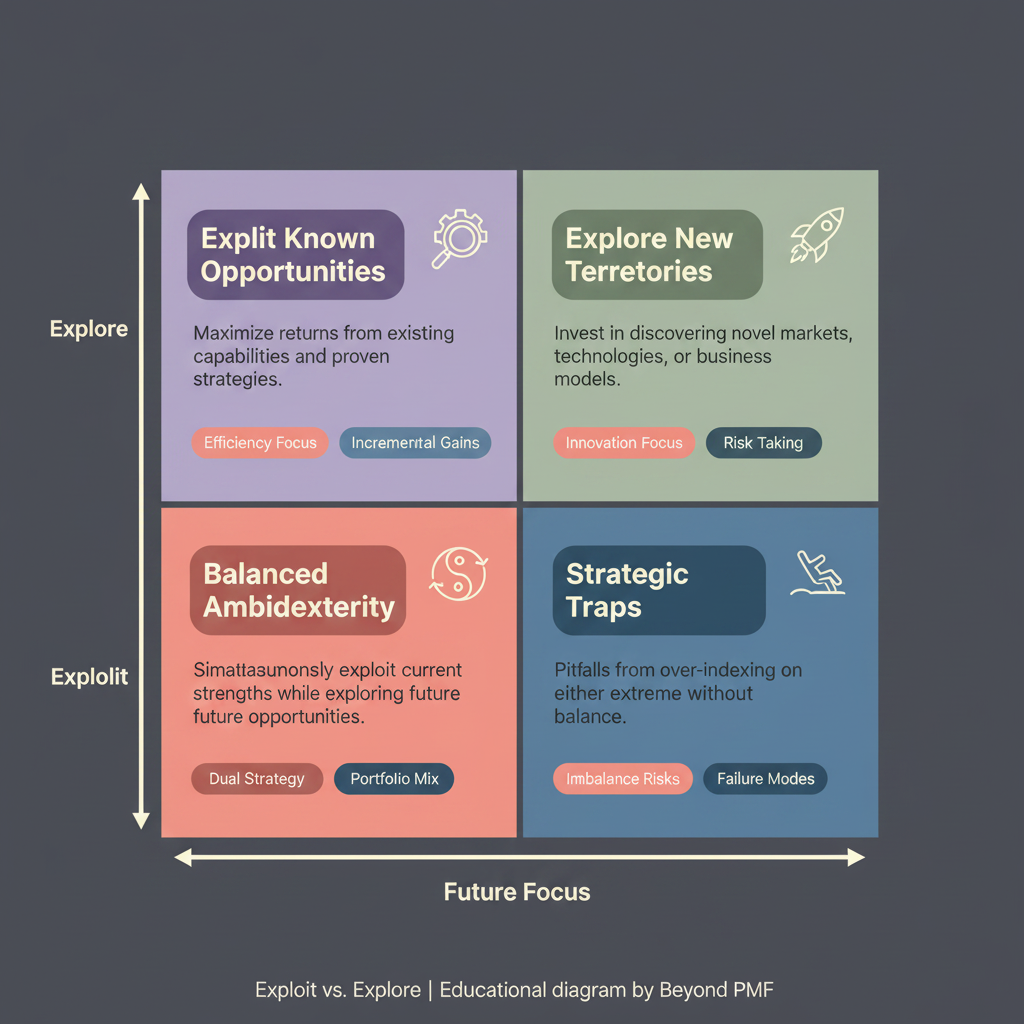
Exploit vs. Explore

https://ik.imagekit.io/beyondpmf/frameworks/exploit-vs-explore.png
The Exploit vs. Explore framework primarily addresses the strategic friction of balancing current market leverage (exploitation) with future growth opportunities (exploration). It helps organizations define priorities and allocate resources appropriately between these potentially conflicting strategic goals.

The Exploit vs. Explore framework is a strategic tool used by businesses to manage and balance their focus between exploiting existing capabilities and exploring new opportunities. This framework is crucial for sustaining growth and adapting to changing market conditions. It encourages organizations to allocate resources efficiently to optimize current operations while also investing in innovation and future growth.

Steps / Detailed Description

Identify current resources and capabilities to exploit. | Analyze market trends and opportunities for exploration. | Allocate resources strategically between exploitation and exploration activities. | Implement actions for both exploiting and exploring. | Monitor and adjust the balance between exploit and explore strategies as needed.

Best Practices

Regularly review and adjust the resource allocation. | Encourage a culture that supports both innovation and optimization. | Use data-driven insights to guide decisions in exploiting and exploring.

Pros

Ensures a balanced approach to risk and innovation. | Helps sustain long-term growth by managing current and future opportunities. | Promotes organizational agility and adaptability.

Cons

Can be challenging to find the right balance between exploit and explore. | May require significant resources to implement effectively. | Risk of neglecting potential opportunities if too focused on exploitation.

When to Use

When needing to balance short-term performance with long-term growth. | In rapidly changing industries where innovation is key to survival.

When Not to Use

In extremely stable markets with little change. | When the organization lacks the resources to invest in exploration.

Related Frameworks

Lifecycle

Not tied to a specific lifecycle stage

Scope

Scope not defined

Maturity Level

Maturity level not specified

Time to Implement

2–4 Weeks
3–6 Months
1–2 Weeks
3–6 Months
1–2 Months
3–6 Months
1–2 Weeks
Less Than 1 Day
1–2 Weeks
Longer Than 6 Months
1–2 Weeks
Longer Than 6 Months
1–2 Weeks
3–6 Months
1–2 Weeks
1–2 Weeks
1–2 Weeks
1–2 Weeks
1–2 Days
1–2 Weeks
1–2 Weeks
1–2 Weeks
1–2 Weeks
1–2 Weeks
1–2 Weeks
3–6 Months
1–2 Weeks
1–2 Weeks
1–2 Weeks
3–6 Months
1–2 Weeks
1–2 Weeks
2–4 Weeks
1–2 Weeks
1–2 Days
1–2 Weeks
Longer Than 6 Months
3–6 Months
Longer Than 6 Months
1–2 Weeks
Longer Than 6 Months
3–6 Months
Less Than 1 Day
3–6 Months
1–2 Months
3–6 Months
Longer Than 6 Months
3–6 Months
Less Than 1 Day
1–2 Weeks
3–6 Months
3–6 Months
1–2 Weeks
3–6 Months
1–2 Weeks
1–2 Weeks
1–2 Days
1–2 Weeks
1–2 Months
Longer Than 6 Months
1–2 Weeks
Longer Than 6 Months
1–2 Weeks
3–6 Months
1–2 Weeks
Less Than 1 Day
1–2 Weeks
3–6 Months
1–2 Weeks
3–6 Months
1–2 Weeks
1–2 Weeks
Longer Than 6 Months
Less Than 1 Day
3–6 Months
Longer Than 6 Months
1–2 Months
1–2 Weeks
Longer Than 6 Months
1–2 Weeks
3–6 Months
1–2 Weeks
1–2 Weeks
3–6 Months
Less Than 1 Day
1–2 Weeks
1–2 Weeks
3–6 Months
3–6 Months
Less Than 1 Day
1–2 Weeks
Longer Than 6 Months
1–2 Months
1–2 Weeks
1–2 Weeks
1–2 Weeks
Longer Than 6 Months

Copyright Information

Autor:
Public Domain
N/A
Publication:
Generic Business Tool