
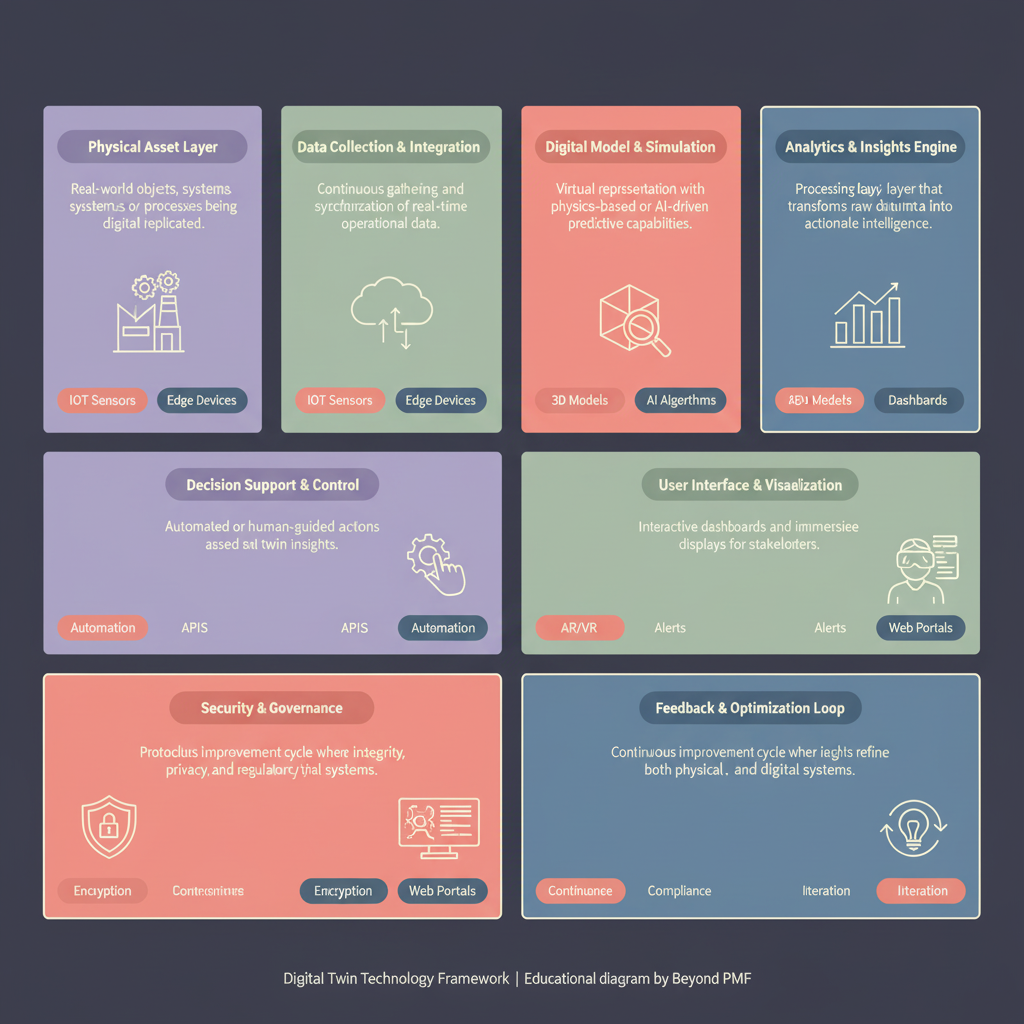
The Digital Twin Technology Framework involves the creation of a digital twin, a virtual model of a physical object or system, to simulate, analyze, and predict performance under various conditions. This framework is used to enhance decision-making in industries such as manufacturing, healthcare, and urban planning by providing deep insights into the lifecycle of assets. It helps in optimizing operations, reducing downtime, and improving overall efficiency.
Identify the physical assets or processes to be twinned. | Collect and integrate relevant data from sensors and other data sources. | Create a dynamic virtual model that updates with real-time data. | Use simulations to predict future performance and identify potential issues. | Implement insights and optimizations in the physical counterpart.
Ensure accurate and timely data collection for effective simulation. | Regularly update the digital twin to reflect changes in the physical asset. | Integrate robust cybersecurity measures to protect data integrity.
Enhanced predictive maintenance and forecasting | Improved operational efficiency and asset management | Real-time monitoring and decision-making capabilities
High initial setup and implementation costs | Complexity in integrating and managing data from multiple sources | Potential issues with data privacy and security
In complex manufacturing processes requiring high precision | For large-scale infrastructure projects to monitor and optimize performance
In small-scale projects where the cost outweighs the benefits | When real-time data is not available or is unreliable