
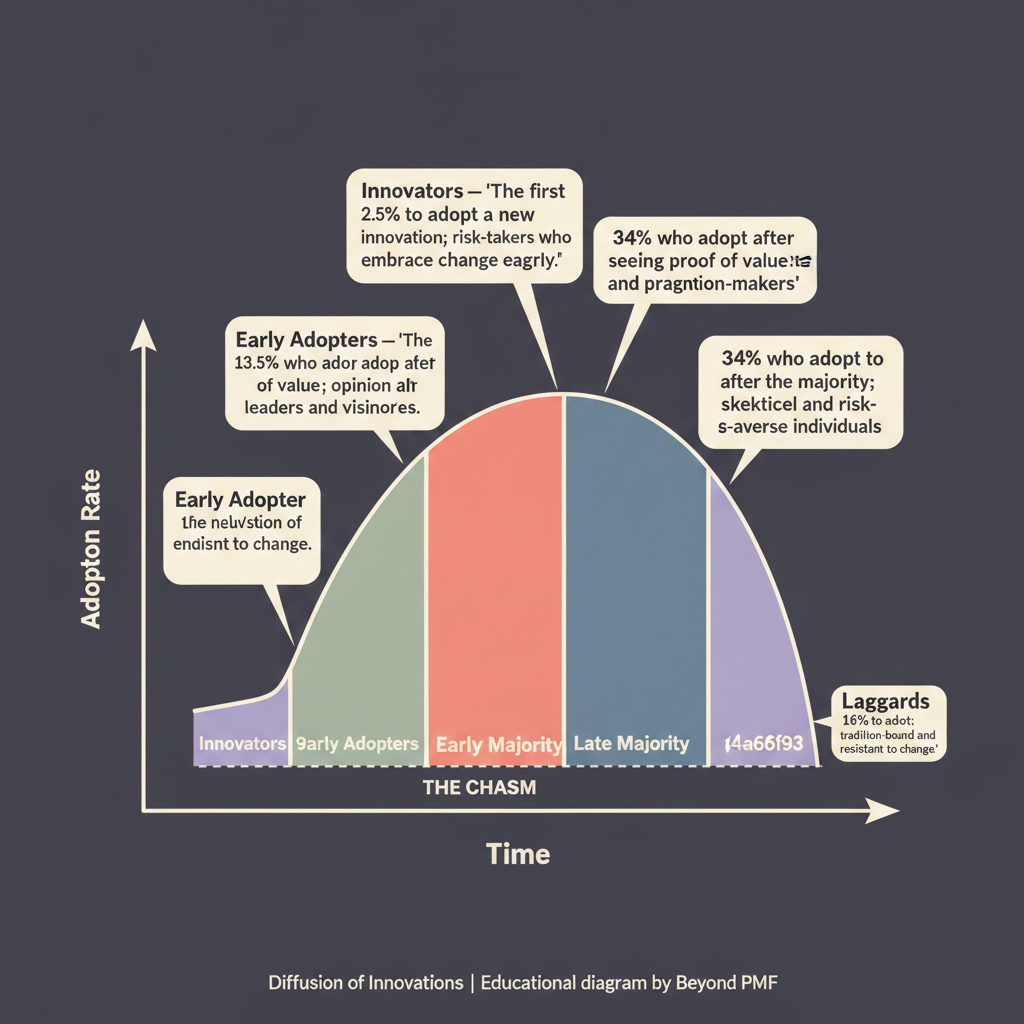
The Diffusion of Innovations framework, developed by Everett Rogers in 1962, describes the process by which an innovation is communicated through certain channels over time among the members of a social system. It is used to understand how new ideas and technologies spread and are adopted by groups and cultures. The framework helps businesses and policymakers to strategize the introduction and adoption of new technologies or ideas, maximizing reach and acceptance while minimizing resistance.
Knowledge: Individuals become aware of the innovation and gain some understanding of how it functions. | Persuasion: Individuals form a favorable or unfavorable attitude toward the innovation. | Decision: Individuals engage in activities that lead to a choice to adopt or reject the innovation. | Implementation: Individuals put the innovation to use. | Confirmation: Individuals seek reinforcement of the decision they have made and the innovation may be adopted by others based on the perceived success.
Identify and target early adopters to leverage their influence in the market. | Use multiple communication channels to spread knowledge about the innovation. | Monitor and adapt strategies based on the feedback from different adopter categories.
Provides a structured approach to understanding adoption patterns. | Helps in tailoring marketing strategies to different segments of the adoption curve. | Can predict the long-term success and sustainability of an innovation.
May oversimplify the adoption process by not accounting for all variables influencing decisions. | Can be less applicable in cases where innovations rapidly evolve. | Relies heavily on the categories of adopters, which might not be distinct in all scenarios.
Introducing a new product or technology to the market. | Planning a marketing strategy for a new innovation.
When the market conditions are rapidly changing. | For products that do not rely on social influence or network effects.