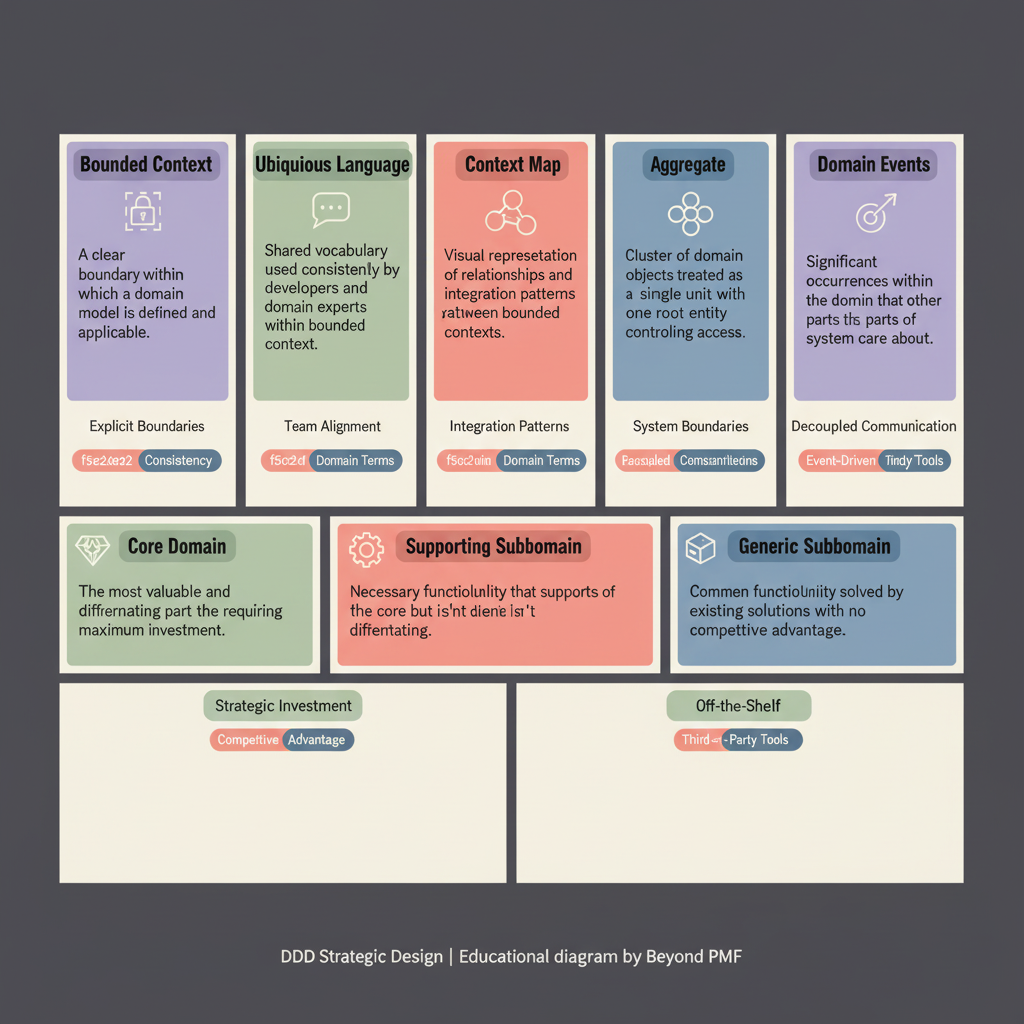
DDD Strategic Design

https://ik.imagekit.io/beyondpmf/frameworks/ddd-strategic-design.png
DDD Strategic Design focuses on aligning software architecture with business domain complexities. It primarily addresses the strategic friction of ensuring the software reflects and supports the overall business strategy and market positioning, guiding the direction of software development in line with business goals.

Domain-Driven Design (DDD) Strategic Design is a methodology used in software development to align complex software designs with business needs. It emphasizes collaboration between technical and domain experts to identify distinct areas within the domain, known as bounded contexts, and ensures that these contexts are reflected in the software architecture. This approach helps in managing large-scale systems by isolating domain-specific logic and reducing dependencies.

Steps / Detailed Description

Identify the domain model and involve domain experts in the process. | Divide the domain into bounded contexts to encapsulate the domain model. | Define context maps to manage relationships and interactions between bounded contexts. | Continuously integrate and align the design with emerging business insights.

Best Practices

Engage domain experts throughout the development process. | Regularly review and refine bounded contexts. | Use context maps to clearly outline dependencies and interactions.

Pros

Improves software modularity and clarity | Facilitates alignment between software and business needs | Reduces complexity in large-scale systems

Cons

Requires deep domain expertise | Can be time-consuming to implement correctly | May lead to over-engineering in smaller projects

When to Use

In complex software projects with intricate business rules | When building systems that require clear modular separation

When Not to Use

In small-scale projects with limited domain complexity | When rapid prototyping and quick deliveries are prioritized over architectural clarity

Related Frameworks

Lifecycle

Not tied to a specific lifecycle stage

Scope

Scope not defined

Maturity Level

Maturity level not specified

Time to Implement

2–4 Weeks
3–6 Months
1–2 Weeks
3–6 Months
1–2 Months
3–6 Months
1–2 Weeks
Less Than 1 Day
1–2 Weeks
Longer Than 6 Months
1–2 Weeks
Longer Than 6 Months
1–2 Weeks
3–6 Months
1–2 Weeks
1–2 Weeks
1–2 Weeks
1–2 Weeks
1–2 Days
1–2 Weeks
1–2 Weeks
1–2 Weeks
1–2 Weeks
1–2 Weeks
1–2 Weeks
3–6 Months
1–2 Weeks
1–2 Weeks
1–2 Weeks
3–6 Months
1–2 Weeks
1–2 Weeks
2–4 Weeks
1–2 Weeks
1–2 Days
1–2 Weeks
Longer Than 6 Months
3–6 Months
Longer Than 6 Months
1–2 Weeks
Longer Than 6 Months
3–6 Months
Less Than 1 Day
3–6 Months
1–2 Months
3–6 Months
Longer Than 6 Months
3–6 Months
Less Than 1 Day
1–2 Weeks
3–6 Months
3–6 Months
1–2 Weeks
3–6 Months
1–2 Weeks
1–2 Weeks
1–2 Days
1–2 Weeks
1–2 Months
Longer Than 6 Months
1–2 Weeks
Longer Than 6 Months
1–2 Weeks
3–6 Months
1–2 Weeks
Less Than 1 Day
1–2 Weeks
3–6 Months
1–2 Weeks
3–6 Months
1–2 Weeks
1–2 Weeks
Longer Than 6 Months
Less Than 1 Day
3–6 Months
Longer Than 6 Months
1–2 Months
1–2 Weeks
Longer Than 6 Months
1–2 Weeks
3–6 Months
1–2 Weeks
1–2 Weeks
3–6 Months
Less Than 1 Day
1–2 Weeks
1–2 Weeks
3–6 Months
3–6 Months
Less Than 1 Day
1–2 Weeks
Longer Than 6 Months
1–2 Months
1–2 Weeks
1–2 Weeks
1–2 Weeks
Longer Than 6 Months

Copyright Information

Autor:
Eric Evans
2003
Publication:
Domain-Driven Design: Tackling Complexity in the Heart of Software