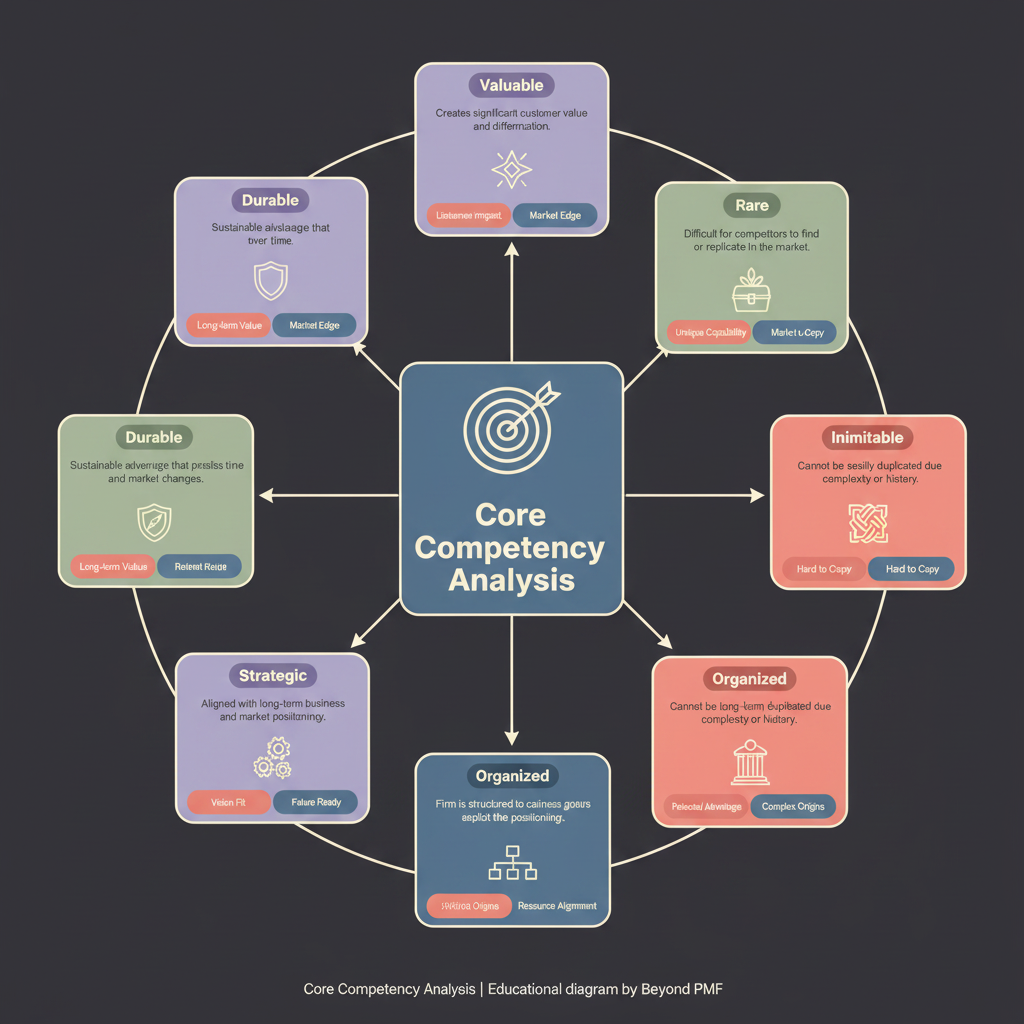
Core Competency Analysis

https://ik.imagekit.io/beyondpmf/frameworks/core-competency-analysis.png
Core Competency Analysis helps businesses define their unique strengths and how they relate to the market, which directly addresses the strategic friction of unclear direction, lack of market alignment, and business model fit.

Core Competency Analysis is a framework that helps organizations identify their unique capabilities that provide competitive advantages. The analysis focuses on strengths that are not only central to a company's performance but also unique in comparison to its competitors. This approach is used to guide strategic planning, resource allocation, and can influence decision-making processes. The benefits of conducting a Core Competency Analysis include improved strategic alignment, enhanced market positioning, and better focus on long-term goals.

Steps / Detailed Description

Identify all existing competencies and capabilities within the organization. | Evaluate the importance of each competency in achieving strategic goals. | Assess the uniqueness of each competency compared to competitors. | Determine which competencies can be leveraged for sustainable competitive advantage. | Develop strategies to strengthen and capitalize on these core competencies.

Best Practices

Regularly update the competency analysis to reflect changes in the market. | Integrate findings with overall strategic planning. | Ensure broad and inclusive input from across the organization.

Pros

Enhances strategic focus and alignment | Facilitates sustainable competitive advantage | Guides resource allocation effectively

Cons

Can lead to overemphasis on current strengths | May overlook potential new market opportunities | Requires continuous reevaluation to remain relevant

When to Use

During strategic planning sessions | When entering new markets or launching new products

When Not to Use

In rapidly changing industries where core competencies may quickly become obsolete | When a company is in early stages and still defining its business model

Related Frameworks

Scope

Scope not defined

Maturity Level

Maturity level not specified

Time to Implement

2–4 Weeks
3–6 Months
1–2 Weeks
3–6 Months
1–2 Months
3–6 Months
1–2 Weeks
Less Than 1 Day
1–2 Weeks
Longer Than 6 Months
1–2 Weeks
Longer Than 6 Months
1–2 Weeks
3–6 Months
1–2 Weeks
1–2 Weeks
1–2 Weeks
1–2 Weeks
1–2 Days
1–2 Weeks
1–2 Weeks
1–2 Weeks
1–2 Weeks
1–2 Weeks
1–2 Weeks
3–6 Months
1–2 Weeks
1–2 Weeks
1–2 Weeks
3–6 Months
1–2 Weeks
1–2 Weeks
2–4 Weeks
1–2 Weeks
1–2 Days
1–2 Weeks
Longer Than 6 Months
3–6 Months
Longer Than 6 Months
1–2 Weeks
Longer Than 6 Months
3–6 Months
Less Than 1 Day
3–6 Months
1–2 Months
3–6 Months
Longer Than 6 Months
3–6 Months
Less Than 1 Day
1–2 Weeks
3–6 Months
3–6 Months
1–2 Weeks
3–6 Months
1–2 Weeks
1–2 Weeks
1–2 Days
1–2 Weeks
1–2 Months
Longer Than 6 Months
1–2 Weeks
Longer Than 6 Months
1–2 Weeks
3–6 Months
1–2 Weeks
Less Than 1 Day
1–2 Weeks
3–6 Months
1–2 Weeks
3–6 Months
1–2 Weeks
1–2 Weeks
Longer Than 6 Months
Less Than 1 Day
3–6 Months
Longer Than 6 Months
1–2 Months
1–2 Weeks
Longer Than 6 Months
1–2 Weeks
3–6 Months
1–2 Weeks
1–2 Weeks
3–6 Months
Less Than 1 Day
1–2 Weeks
1–2 Weeks
3–6 Months
3–6 Months
Less Than 1 Day
1–2 Weeks
Longer Than 6 Months
1–2 Months
1–2 Weeks
1–2 Weeks
1–2 Weeks
Longer Than 6 Months

Copyright Information

Autor:
Public Domain
N/A
Publication:
Generic Business Tool