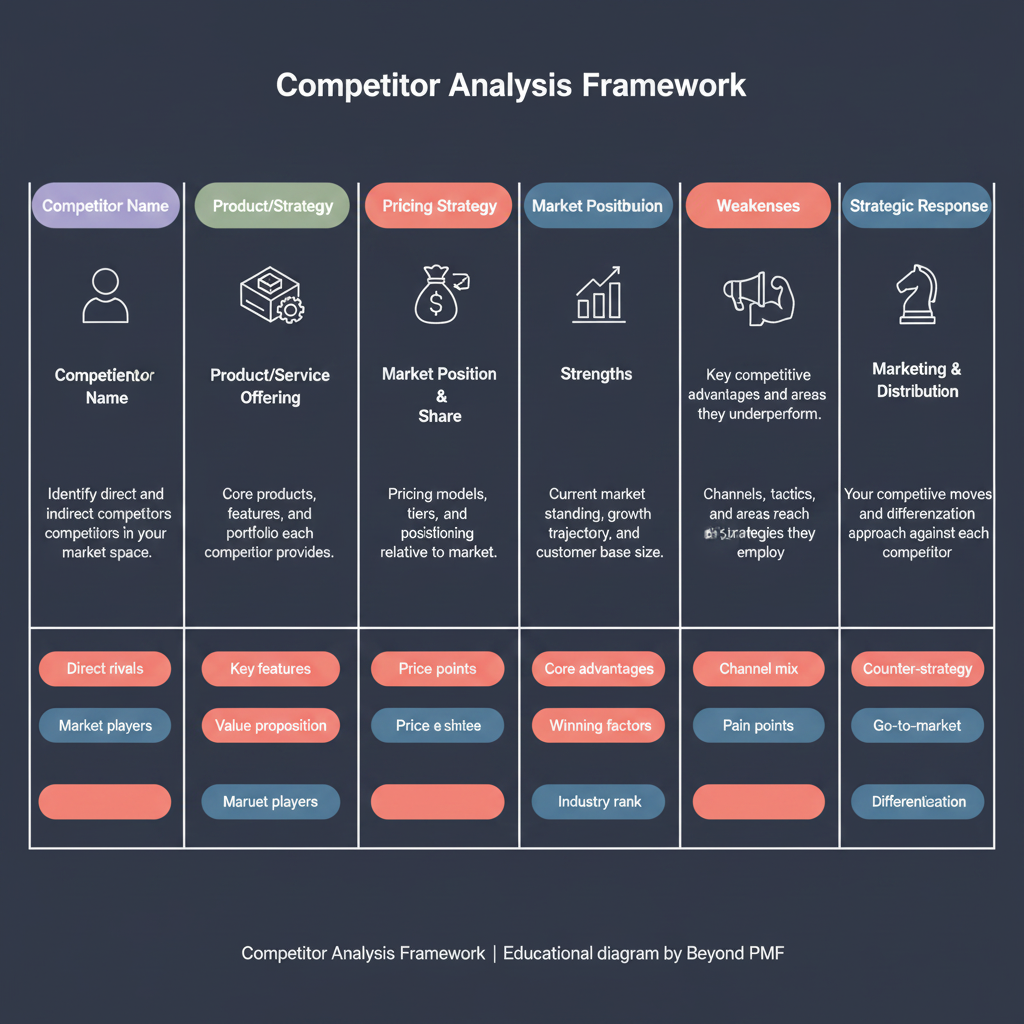
Competitor Analysis Framework

https://ik.imagekit.io/beyondpmf/frameworks/competitor-analysis-framework.png
The Competitor Analysis Framework primarily addresses strategic friction by providing a structured method for understanding the competitive landscape. This aids in defining market positioning, informing business strategy, and ensuring alignment with the external environment.

The Competitor Analysis Framework helps businesses identify and analyze their competitors to understand strengths, weaknesses, market positions, and strategies. This framework is crucial for developing competitive strategies and making informed business decisions. It enables companies to anticipate competitor moves, discover market opportunities, and identify potential threats.

Steps / Detailed Description

Identify key competitors: List out direct and indirect competitors in the market. | Gather information: Collect data on competitors' products, sales, marketing strategies, and customer feedback. | Analyze competitive data: Use SWOT analysis to assess competitors' strengths, weaknesses, opportunities, and threats. | Compare competitive positions: Evaluate how your business stacks up against each competitor in various market aspects. | Monitor continuously: Keep updating the data and analysis to reflect changes in the competitive landscape.

Best Practices

Use a variety of sources for data collection to ensure accuracy. | Regularly update the analysis to keep it relevant. | Focus on actionable insights that can directly impact business strategies.

Pros

Provides insights into market dynamics | Helps in strategic planning and decision making | Enables proactive responses to competitive threats

Cons

Can be time-consuming and resource-intensive | May lead to an excessive focus on competitors rather than customer needs | Risk of incomplete or biased information

When to Use

When entering a new market | When launching a new product

When Not to Use

In highly innovative markets where competitors are not well-defined | When the focus should be on market creation rather than competition

Related Frameworks

Categories

Scope

Scope not defined

Maturity Level

Maturity level not specified

Time to Implement

2–4 Weeks
3–6 Months
1–2 Weeks
3–6 Months
1–2 Months
3–6 Months
1–2 Weeks
Less Than 1 Day
1–2 Weeks
Longer Than 6 Months
1–2 Weeks
Longer Than 6 Months
1–2 Weeks
3–6 Months
1–2 Weeks
1–2 Weeks
1–2 Weeks
1–2 Weeks
1–2 Days
1–2 Weeks
1–2 Weeks
1–2 Weeks
1–2 Weeks
1–2 Weeks
1–2 Weeks
3–6 Months
1–2 Weeks
1–2 Weeks
1–2 Weeks
3–6 Months
1–2 Weeks
1–2 Weeks
2–4 Weeks
1–2 Weeks
1–2 Days
1–2 Weeks
Longer Than 6 Months
3–6 Months
Longer Than 6 Months
1–2 Weeks
Longer Than 6 Months
3–6 Months
Less Than 1 Day
3–6 Months
1–2 Months
3–6 Months
Longer Than 6 Months
3–6 Months
Less Than 1 Day
1–2 Weeks
3–6 Months
3–6 Months
1–2 Weeks
3–6 Months
1–2 Weeks
1–2 Weeks
1–2 Days
1–2 Weeks
1–2 Months
Longer Than 6 Months
1–2 Weeks
Longer Than 6 Months
1–2 Weeks
3–6 Months
1–2 Weeks
Less Than 1 Day
1–2 Weeks
3–6 Months
1–2 Weeks
3–6 Months
1–2 Weeks
1–2 Weeks
Longer Than 6 Months
Less Than 1 Day
3–6 Months
Longer Than 6 Months
1–2 Months
1–2 Weeks
Longer Than 6 Months
1–2 Weeks
3–6 Months
1–2 Weeks
1–2 Weeks
3–6 Months
Less Than 1 Day
1–2 Weeks
1–2 Weeks
3–6 Months
3–6 Months
Less Than 1 Day
1–2 Weeks
Longer Than 6 Months
1–2 Months
1–2 Weeks
1–2 Weeks
1–2 Weeks
Longer Than 6 Months

Copyright Information

Autor:
Public Domain
N/A
Publication:
Generic Business Tool