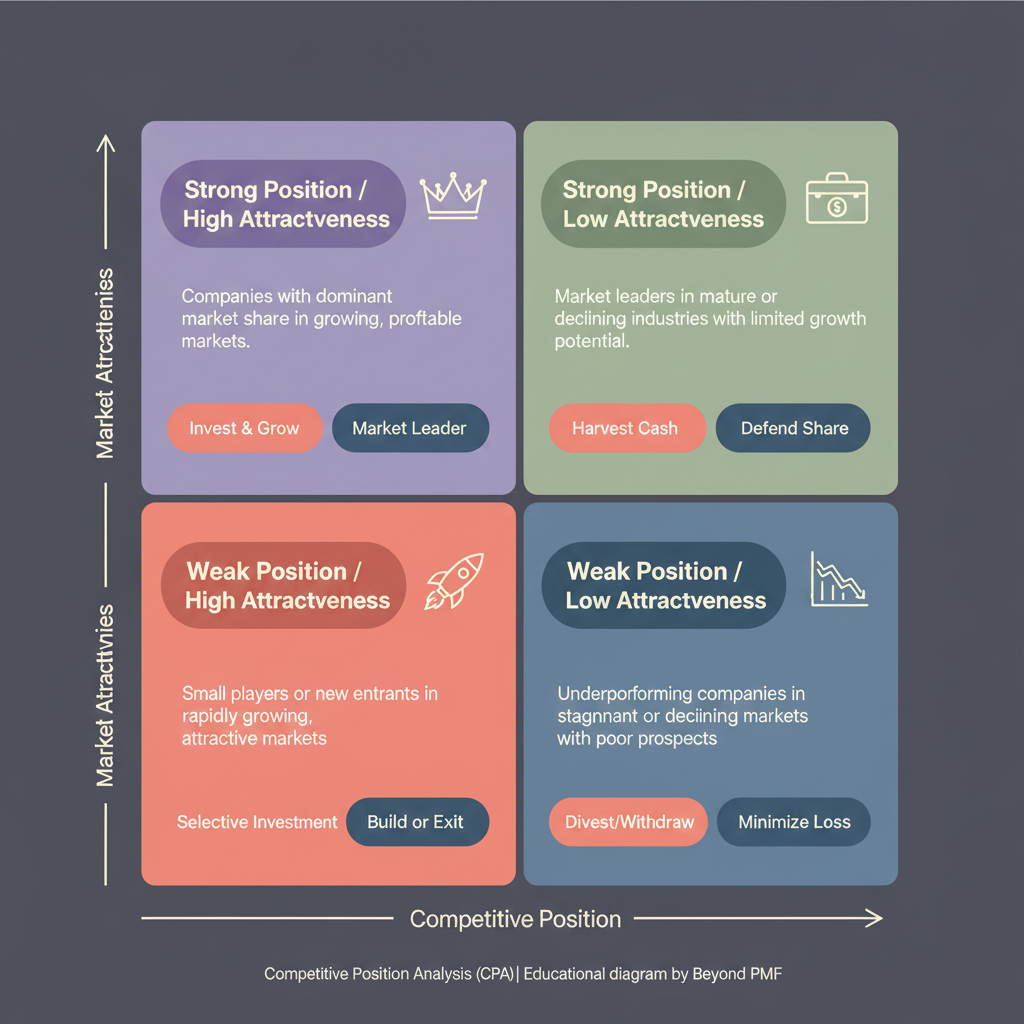
Competitive Position Analysis (CPA)

https://ik.imagekit.io/beyondpmf/frameworks/competitive-position-analysis-cpa.png
Competitive Position Analysis (CPA) helps organizations understand their strategic position relative to competitors. It addresses the friction caused by unclear market alignment and a lack of understanding of the competitive landscape, ultimately impacting strategic direction and business model choices.

Competitive Position Analysis (CPA) is a framework designed to assess a company's position relative to its competitors. It involves analyzing various factors such as market share, product differentiation, and customer loyalty to understand the company's strengths and weaknesses. This analysis helps businesses strategize effectively, capitalize on their competitive advantages, and identify areas for improvement.

Steps / Detailed Description

Identify key competitors in the market. | Analyze competitors' strengths, weaknesses, opportunities, and threats (SWOT). | Evaluate market share and growth rates of competitors. | Assess product or service differentiation and positioning. | Analyze customer loyalty and brand strength. | Synthesize findings to determine competitive position.

Best Practices

Regularly update competitive data to maintain accuracy. | Combine with internal analyses for a holistic view. | Use multiple sources of information to avoid biases.

Pros

Provides a clear understanding of market dynamics. | Helps in strategic planning and decision making. | Identifies potential areas for competitive advantage.

Cons

Can be time-consuming and resource-intensive. | May rely on outdated or inaccurate data. | Focuses primarily on external factors, possibly neglecting internal capabilities.

When to Use

When entering a new market. | When considering new product launches.

When Not to Use

In highly dynamic markets where data changes frequently. | When internal data is insufficient or unreliable.

Related Frameworks

Scope

Scope not defined

Maturity Level

Maturity level not specified

Time to Implement

2–4 Weeks
3–6 Months
1–2 Weeks
3–6 Months
1–2 Months
3–6 Months
1–2 Weeks
Less Than 1 Day
1–2 Weeks
Longer Than 6 Months
1–2 Weeks
Longer Than 6 Months
1–2 Weeks
3–6 Months
1–2 Weeks
1–2 Weeks
1–2 Weeks
1–2 Weeks
1–2 Days
1–2 Weeks
1–2 Weeks
1–2 Weeks
1–2 Weeks
1–2 Weeks
1–2 Weeks
3–6 Months
1–2 Weeks
1–2 Weeks
1–2 Weeks
3–6 Months
1–2 Weeks
1–2 Weeks
2–4 Weeks
1–2 Weeks
1–2 Days
1–2 Weeks
Longer Than 6 Months
3–6 Months
Longer Than 6 Months
1–2 Weeks
Longer Than 6 Months
3–6 Months
Less Than 1 Day
3–6 Months
1–2 Months
3–6 Months
Longer Than 6 Months
3–6 Months
Less Than 1 Day
1–2 Weeks
3–6 Months
3–6 Months
1–2 Weeks
3–6 Months
1–2 Weeks
1–2 Weeks
1–2 Days
1–2 Weeks
1–2 Months
Longer Than 6 Months
1–2 Weeks
Longer Than 6 Months
1–2 Weeks
3–6 Months
1–2 Weeks
Less Than 1 Day
1–2 Weeks
3–6 Months
1–2 Weeks
3–6 Months
1–2 Weeks
1–2 Weeks
Longer Than 6 Months
Less Than 1 Day
3–6 Months
Longer Than 6 Months
1–2 Months
1–2 Weeks
Longer Than 6 Months
1–2 Weeks
3–6 Months
1–2 Weeks
1–2 Weeks
3–6 Months
Less Than 1 Day
1–2 Weeks
1–2 Weeks
3–6 Months
3–6 Months
Less Than 1 Day
1–2 Weeks
Longer Than 6 Months
1–2 Months
1–2 Weeks
1–2 Weeks
1–2 Weeks
Longer Than 6 Months

Copyright Information

Autor:
Public Domain
N/A
Publication:
Generic Business Tool