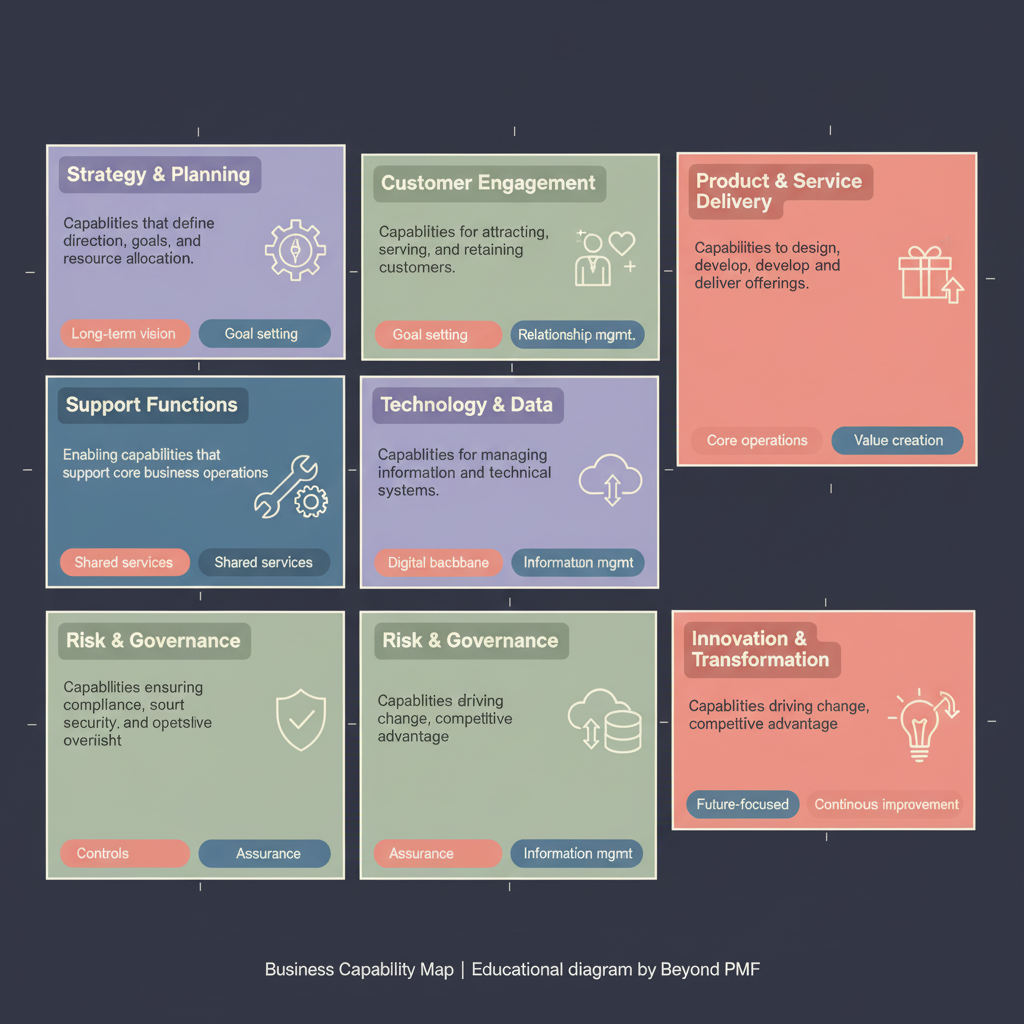
Business Capability Map

A Business Capability Map helps clarify organizational design by visually representing what a business does. This can improve clarity of ownership and accountability for different business functions, thereby reducing structural friction.

A Business Capability Map is a comprehensive framework that outlines the essential capabilities of a business, aligning them with strategic goals and objectives. It serves as a tool to visualize and understand the core functions and processes of an organization, facilitating better decision-making and resource allocation. By mapping out capabilities, businesses can identify redundancies, streamline operations, and prioritize investments, ultimately leading to enhanced operational efficiency and competitive advantage.

Steps / Detailed Description

Identify strategic objectives: Define what the business aims to achieve in the long term. | Determine necessary capabilities: List all capabilities needed to meet the strategic objectives. | Map capabilities to business processes: Connect each capability with specific business processes. | Assess capability maturity: Evaluate the current effectiveness and efficiency of each capability. | Identify gaps and opportunities: Highlight areas where capabilities need to be developed or optimized. | Implement improvements: Develop action plans to enhance capabilities and address gaps. | Monitor and update the map: Regularly review and revise the capability map to reflect changes in the business environment.

Best Practices

Engage stakeholders from all business levels during the mapping process. | Regularly update the capability map to reflect changes in the business strategy and environment. | Use a standardized framework to ensure consistency and comparability.

Pros

Enhanced strategic alignment | Improved resource allocation | Increased operational efficiency

Cons

Can be time-consuming to develop | Requires deep organizational knowledge | May become quickly outdated if not regularly updated

When to Use

During strategic planning sessions | When undergoing organizational restructuring

When Not to Use

In very small or static organizations where capabilities are clear and unchanging | When immediate, tactical decisions are required rather than strategic insights

Related Frameworks

Lifecycle

Not tied to a specific lifecycle stage

Scope

Scope not defined

Maturity Level

Maturity level not specified

Time to Implement

2–4 Weeks
3–6 Months
1–2 Weeks
3–6 Months
1–2 Months
3–6 Months
1–2 Weeks
Less Than 1 Day
1–2 Weeks
Longer Than 6 Months
1–2 Weeks
Longer Than 6 Months
1–2 Weeks
3–6 Months
1–2 Weeks
1–2 Weeks
1–2 Weeks
1–2 Weeks
1–2 Days
1–2 Weeks
1–2 Weeks
1–2 Weeks
1–2 Weeks
1–2 Weeks
1–2 Weeks
3–6 Months
1–2 Weeks
1–2 Weeks
1–2 Weeks
3–6 Months
1–2 Weeks
1–2 Weeks
2–4 Weeks
1–2 Weeks
1–2 Days
1–2 Weeks
Longer Than 6 Months
3–6 Months
Longer Than 6 Months
1–2 Weeks
Longer Than 6 Months
3–6 Months
Less Than 1 Day
3–6 Months
1–2 Months
3–6 Months
Longer Than 6 Months
3–6 Months
Less Than 1 Day
1–2 Weeks
3–6 Months
3–6 Months
1–2 Weeks
3–6 Months
1–2 Weeks
1–2 Weeks
1–2 Days
1–2 Weeks
1–2 Months
Longer Than 6 Months
1–2 Weeks
Longer Than 6 Months
1–2 Weeks
3–6 Months
1–2 Weeks
Less Than 1 Day
1–2 Weeks
3–6 Months
1–2 Weeks
3–6 Months
1–2 Weeks
1–2 Weeks
Longer Than 6 Months
Less Than 1 Day
3–6 Months
Longer Than 6 Months
1–2 Months
1–2 Weeks
Longer Than 6 Months
1–2 Weeks
3–6 Months
1–2 Weeks
1–2 Weeks
3–6 Months
Less Than 1 Day
1–2 Weeks
1–2 Weeks
3–6 Months
3–6 Months
Less Than 1 Day
1–2 Weeks
Longer Than 6 Months
1–2 Months
1–2 Weeks
1–2 Weeks
1–2 Weeks
Longer Than 6 Months

Copyright Information

Autor:
Public Domain
N/A
Publication:
Generic Business Tool