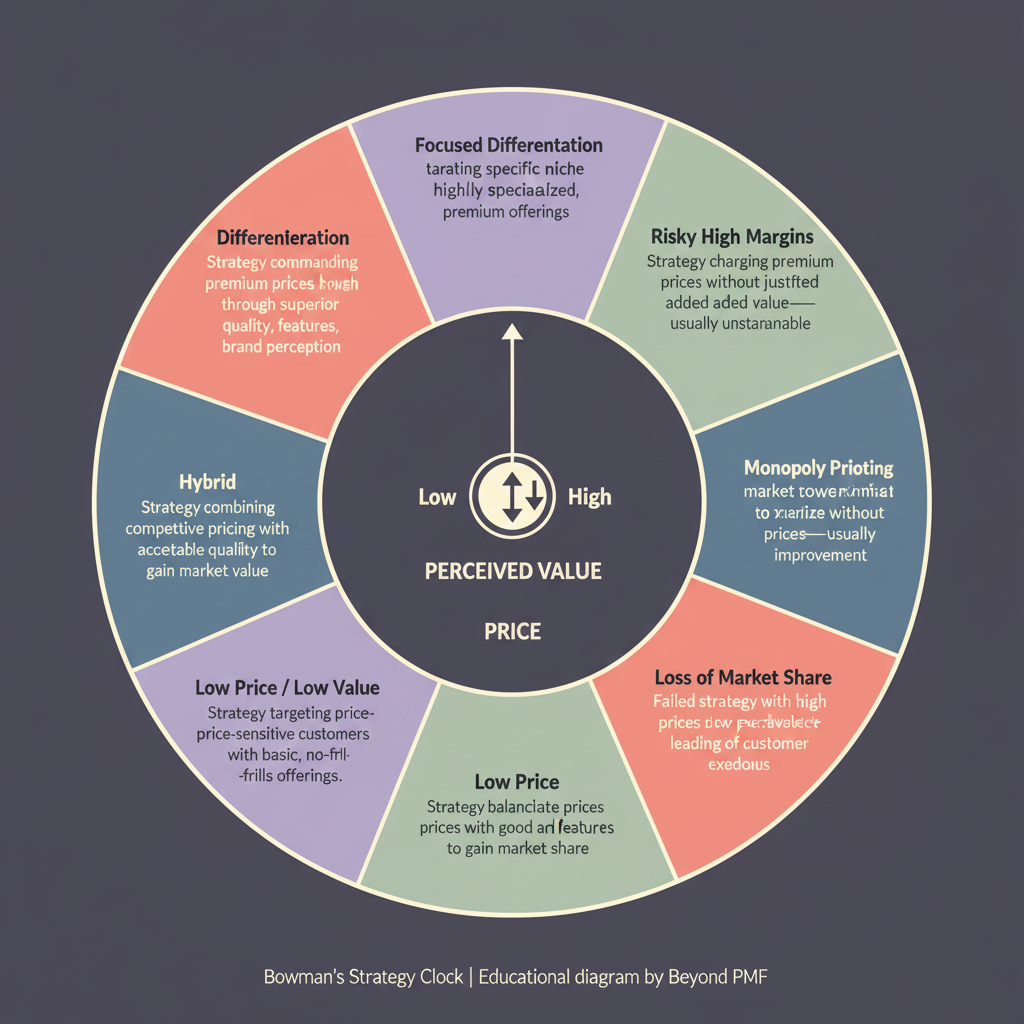
Bowman's Strategy Clock

https://ik.imagekit.io/beyondpmf/frameworks/bowmans-strategy-clock.png
Bowman's Strategy Clock directly addresses strategic friction by providing a framework to analyze a company's competitive position and strategic choices. It helps in understanding market alignment, competitive advantage, and ultimately, the overall business direction.

Bowman's Strategy Clock is a framework used in strategic management and marketing to analyze and determine a business's competitive positioning against its competitors. It extends Porter's Generic Strategies and involves eight different positions that a company can occupy on a clock-shaped diagram based on the dimensions of price and perceived value. This framework helps businesses understand how they can effectively position their products or services in a competitive market to maximize their potential.

Steps / Detailed Description

Identify the market and competitors. | Analyze current positioning in terms of price and perceived value. | Choose an appropriate position on the clock to aim for. | Develop strategic actions to achieve the desired positioning. | Implement the strategy and monitor results.

Best Practices

Regularly update market data to keep the analysis current. | Combine with other strategic tools for comprehensive analysis. | Consider the impact of digital transformation on competitive positioning.

Pros

Provides a clear analysis of competitive positioning. | Helps in identifying strategic options based on market conditions. | Facilitates targeted marketing and pricing strategies.

Cons

May oversimplify market dynamics. | Relies heavily on accurate market and internal data. | Can lead to competitive escalation if not used carefully.

When to Use

When reevaluating the company’s market strategy. | When entering a new market or launching a new product.

When Not to Use

In markets with little to no competition. | When the company has a dominant, unchallenged market position.

Related Frameworks

Lifecycle

Not tied to a specific lifecycle stage

Scope

Scope not defined

Maturity Level

Maturity level not specified

Time to Implement

2–4 Weeks
3–6 Months
1–2 Weeks
3–6 Months
1–2 Months
3–6 Months
1–2 Weeks
Less Than 1 Day
1–2 Weeks
Longer Than 6 Months
1–2 Weeks
Longer Than 6 Months
1–2 Weeks
3–6 Months
1–2 Weeks
1–2 Weeks
1–2 Weeks
1–2 Weeks
1–2 Days
1–2 Weeks
1–2 Weeks
1–2 Weeks
1–2 Weeks
1–2 Weeks
1–2 Weeks
3–6 Months
1–2 Weeks
1–2 Weeks
1–2 Weeks
3–6 Months
1–2 Weeks
1–2 Weeks
2–4 Weeks
1–2 Weeks
1–2 Days
1–2 Weeks
Longer Than 6 Months
3–6 Months
Longer Than 6 Months
1–2 Weeks
Longer Than 6 Months
3–6 Months
Less Than 1 Day
3–6 Months
1–2 Months
3–6 Months
Longer Than 6 Months
3–6 Months
Less Than 1 Day
1–2 Weeks
3–6 Months
3–6 Months
1–2 Weeks
3–6 Months
1–2 Weeks
1–2 Weeks
1–2 Days
1–2 Weeks
1–2 Months
Longer Than 6 Months
1–2 Weeks
Longer Than 6 Months
1–2 Weeks
3–6 Months
1–2 Weeks
Less Than 1 Day
1–2 Weeks
3–6 Months
1–2 Weeks
3–6 Months
1–2 Weeks
1–2 Weeks
Longer Than 6 Months
Less Than 1 Day
3–6 Months
Longer Than 6 Months
1–2 Months
1–2 Weeks
Longer Than 6 Months
1–2 Weeks
3–6 Months
1–2 Weeks
1–2 Weeks
3–6 Months
Less Than 1 Day
1–2 Weeks
1–2 Weeks
3–6 Months
3–6 Months
Less Than 1 Day
1–2 Weeks
Longer Than 6 Months
1–2 Months
1–2 Weeks
1–2 Weeks
1–2 Weeks
Longer Than 6 Months

Copyright Information

Autor:
Cliff Bowman and David Faulkner
1996
Publication:
Competitive and Corporate Strategy