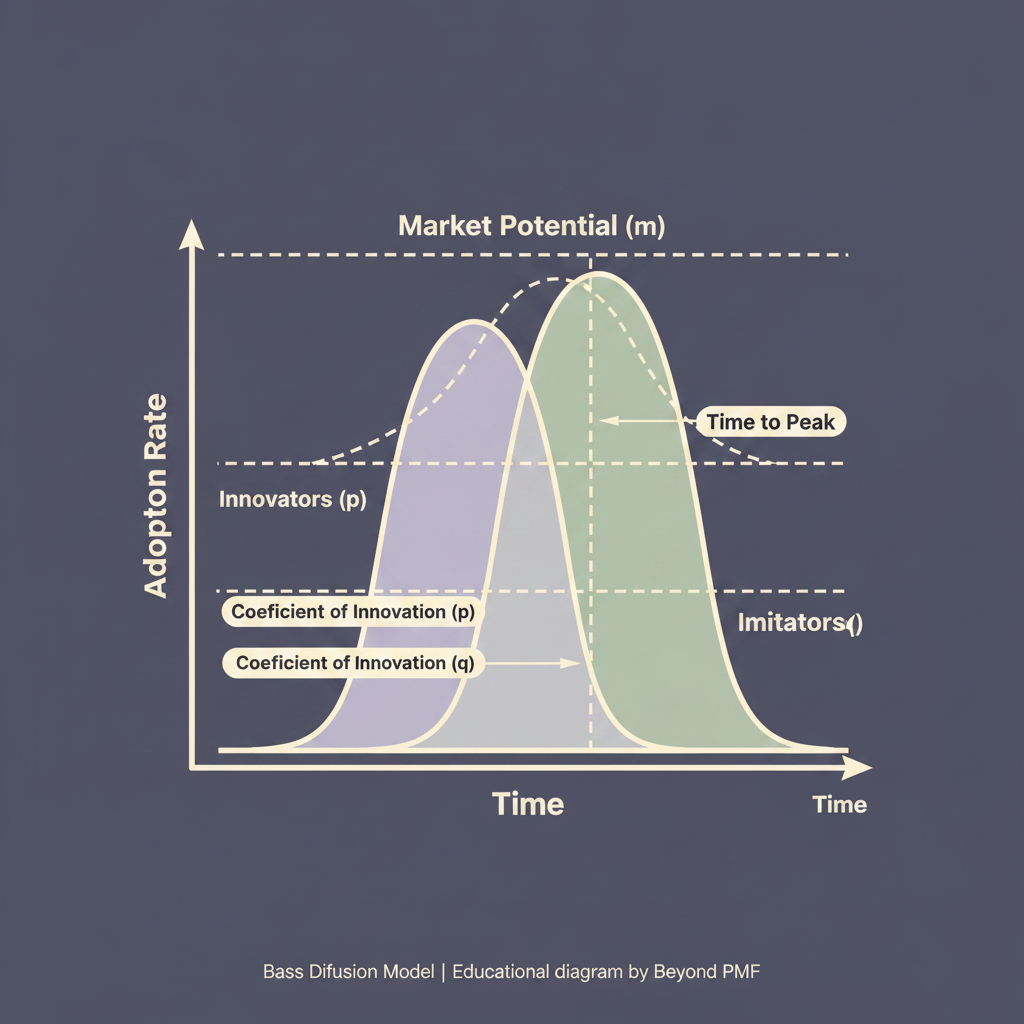
The Bass Diffusion Model, developed by Frank Bass in 1969, is a mathematical model used to forecast the adoption of new products and technologies. It combines factors of innovation and imitation to predict how new offerings will be adopted over time. This model helps companies in planning marketing strategies, managing product life cycles, and estimating market potential. Its application spans various industries, making it a versatile tool for strategic decision-making.
Identify the target market and product characteristics. | Estimate the parameters of innovation (coefficient of innovation) and imitation (coefficient of imitation). | Gather historical adoption data if available to calibrate the model. | Use the model to forecast future adoption rates over time. | Adjust the model parameters based on ongoing market feedback and product performance.
Regularly update the model parameters as new data becomes available | Combine with other market analysis tools for comprehensive insights | Use sensitivity analysis to understand the impact of parameter changes
Provides a quantitative method for forecasting product adoption | Helps in strategic planning and market analysis | Applicable across different products and industries
Relies on accurate estimation of parameters, which can be challenging | May not account for external factors affecting adoption | Assumes market homogeneity, which may not always be the case
Launching a new product | Entering a new market
Markets with rapid, unpredictable changes | When detailed consumer behavior data is unavailable