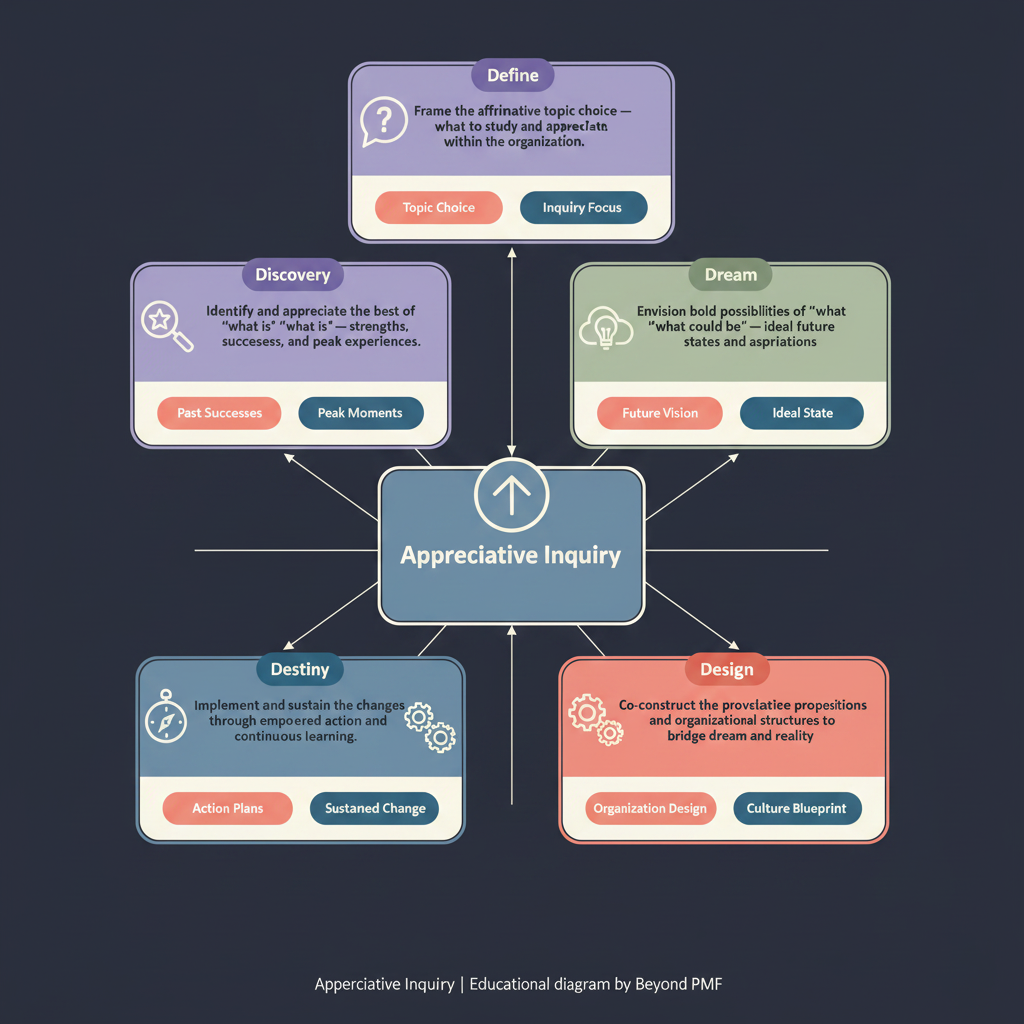
Appreciative Inquiry

https://ik.imagekit.io/beyondpmf/frameworks/appreciative-inquiry.png
Appreciative Inquiry helps organizations identify and leverage existing strengths to create positive change. It addresses friction related to vision and direction by focusing on what is working well and amplifying it.

Appreciative Inquiry (AI) is a model that seeks to engage stakeholders in self-determined change. Rather than focusing on negating problems, AI focuses on identifying and leveraging an organization's core strengths. It is used to foster positive development and transformation, encouraging collaborative and participatory processes. This approach helps organizations increase their capacity for positive change and improve their performance by promoting a positive view of the future.

Steps / Detailed Description

Define: Clarify the area of focus and what will be explored during the inquiry. | Discover: Identify and appreciate the best of 'what is' by collecting stories and examples that illustrate the organization's strengths. | Dream: Envision 'what could be' by imagining a future where these strengths are maximized and new potentials are realized. | Design: Plan 'what should be' by creating propositions of the ideal organization, building on its strengths identified in the discovery phase. | Destiny/Deliver: Implement the proposed design and sustain the change by ensuring that the new strategies are embedded in the organization.

Best Practices

Ensure broad and diverse participation | Maintain a clear focus on positive aspects | Use storytelling to share and discover strengths

Pros

Focuses on strengths rather than weaknesses | Encourages participation and collaboration | Creates a positive organizational culture

Cons

May overlook serious problems by focusing too much on positives | Can be time-consuming | May not be suitable for addressing urgent crises

When to Use

Organizational change initiatives | Team building and development

When Not to Use

Crisis situations requiring immediate, corrective actions | When a comprehensive analysis of failures is needed

Related Frameworks

Lifecycle

Scope

Scope not defined

Maturity Level

Maturity level not specified

Time to Implement

2–4 Weeks
3–6 Months
1–2 Weeks
3–6 Months
1–2 Months
3–6 Months
1–2 Weeks
Less Than 1 Day
1–2 Weeks
Longer Than 6 Months
1–2 Weeks
Longer Than 6 Months
1–2 Weeks
3–6 Months
1–2 Weeks
1–2 Weeks
1–2 Weeks
1–2 Weeks
1–2 Days
1–2 Weeks
1–2 Weeks
1–2 Weeks
1–2 Weeks
1–2 Weeks
1–2 Weeks
3–6 Months
1–2 Weeks
1–2 Weeks
1–2 Weeks
3–6 Months
1–2 Weeks
1–2 Weeks
2–4 Weeks
1–2 Weeks
1–2 Days
1–2 Weeks
Longer Than 6 Months
3–6 Months
Longer Than 6 Months
1–2 Weeks
Longer Than 6 Months
3–6 Months
Less Than 1 Day
3–6 Months
1–2 Months
3–6 Months
Longer Than 6 Months
3–6 Months
Less Than 1 Day
1–2 Weeks
3–6 Months
3–6 Months
1–2 Weeks
3–6 Months
1–2 Weeks
1–2 Weeks
1–2 Days
1–2 Weeks
1–2 Months
Longer Than 6 Months
1–2 Weeks
Longer Than 6 Months
1–2 Weeks
3–6 Months
1–2 Weeks
Less Than 1 Day
1–2 Weeks
3–6 Months
1–2 Weeks
3–6 Months
1–2 Weeks
1–2 Weeks
Longer Than 6 Months
Less Than 1 Day
3–6 Months
Longer Than 6 Months
1–2 Months
1–2 Weeks
Longer Than 6 Months
1–2 Weeks
3–6 Months
1–2 Weeks
1–2 Weeks
3–6 Months
Less Than 1 Day
1–2 Weeks
1–2 Weeks
3–6 Months
3–6 Months
Less Than 1 Day
1–2 Weeks
Longer Than 6 Months
1–2 Months
1–2 Weeks
1–2 Weeks
1–2 Weeks
Longer Than 6 Months

Copyright Information

Autor:
David Cooperrider and Suresh Srivastva
1987
Publication:
Case Western Reserve University