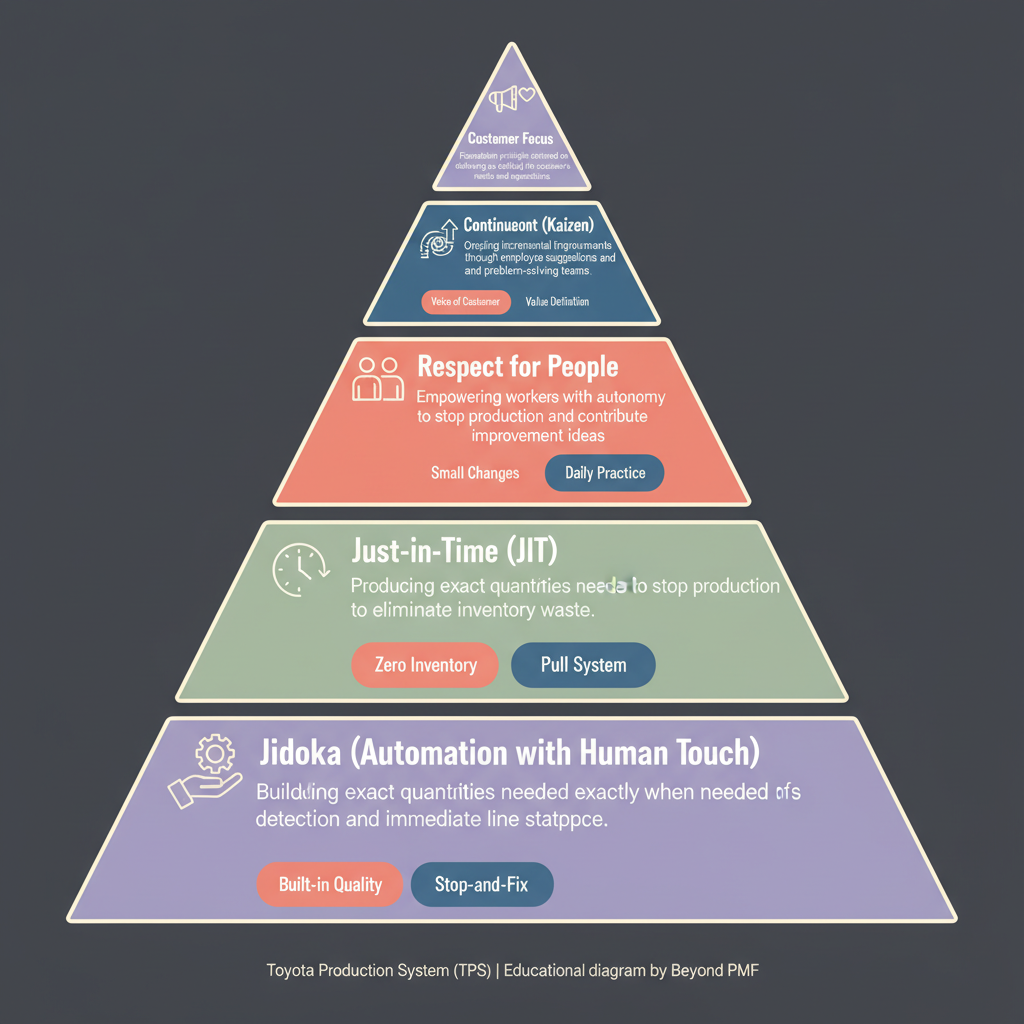
The Toyota Production System (TPS) is a comprehensive production framework developed by Toyota to streamline manufacturing processes, reduce waste, and improve product quality. TPS is grounded in two main concepts: 'Just-in-Time' production, which ensures that parts are only produced as needed, and 'Jidoka', which empowers workers to stop production to fix problems, ensuring quality. The system's focus on continuous improvement (Kaizen) and respect for people has made it influential in lean manufacturing and operational strategies globally.
Identify Value: Define what value means to the customer to guide the production process. | Map the Value Stream: Analyze all the steps in the production process and eliminate anything that does not add value. | Create Flow: Arrange production so that work moves smoothly without interruptions. | Establish Pull: Ensure that products are only made as needed, reducing waste and improving responsiveness. | Pursue Perfection: Continually improve processes and eliminate waste through Kaizen.
Engage all employees in continuous improvement | Focus on customer-driven value in every process | Implement visual management for better transparency and communication
Increases efficiency by eliminating waste | Improves quality through continuous improvement and error-proofing | Reduces inventory and production costs
Requires significant cultural shift and employee training | Can be difficult to implement in non-manufacturing environments | High initial implementation costs
In manufacturing settings to improve efficiency and quality | When aiming to reduce waste and operational costs
In highly variable production environments where flexibility is more valuable than efficiency | When the organization is not ready to adopt significant cultural changes