Spotify Model

https://ik.imagekit.io/beyondpmf/frameworks/spotify-model.png
The Spotify Model primarily addresses structural friction by focusing on team autonomy and alignment within a scaled agile environment. It helps to organize teams effectively and manage dependencies, which are key aspects of addressing structural challenges.

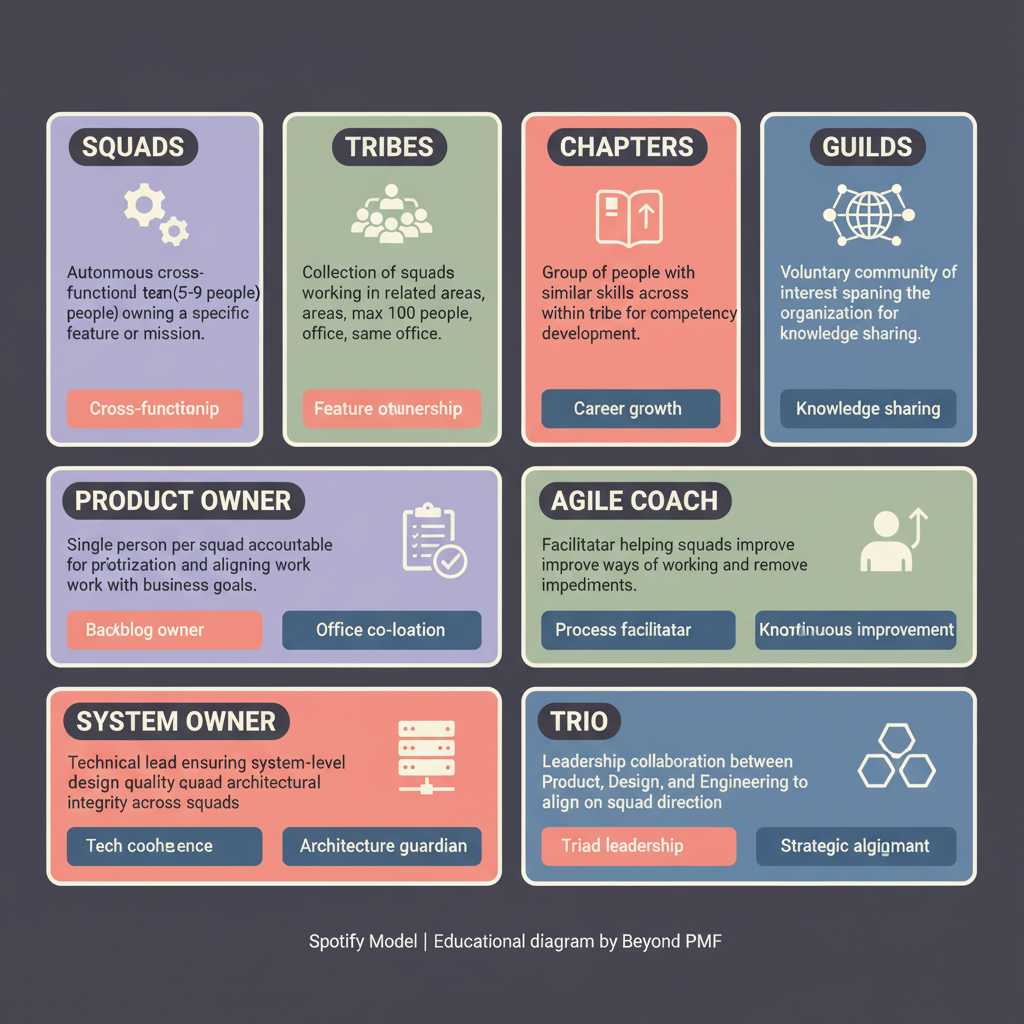
The Spotify Model is a framework designed to help companies scale agile practices. Originally developed by Spotify to manage rapid growth, the model organizes employees into small, cross-functional, and autonomous squads focused on specific features or services. This structure is complemented by chapters, guilds, and tribes to ensure alignment and communication across the organization. The model encourages a high degree of autonomy while maintaining alignment with the organization’s strategic goals, fostering innovation and accelerating product development cycles.

Steps / Detailed Description

Define the mission and long-term goals of each squad. | Organize squads into larger tribes to align multiple squads with related goals. | Establish chapters to group individuals with similar skills across different squads for knowledge sharing. | Form guilds as voluntary groups to share knowledge and practices across the whole organization. | Implement a leadership model that focuses on coaching rather than command and control. | Regularly review and adapt the model to ensure it meets the evolving needs of the organization.

Best Practices

Ensure clear communication of strategic goals to all squads | Maintain flexibility in the model to adapt to organizational changes | Foster a strong culture of collaboration and continuous improvement

Pros

Enhances team autonomy and empowerment | Promotes a faster response to change | Facilitates innovation and rapid experimentation

Cons

Can lead to duplication of efforts across squads | Requires a mature organization with a strong agile mindset | May create challenges in maintaining organizational alignment

When to Use

Scaling agile practices in medium to large organizations | Organizations looking to foster innovation and autonomy in teams

When Not to Use

In very small organizations where simpler models are more effective | Where strict control and standardization of processes are required

Related Frameworks

Categories

Lifecycle

Not tied to a specific lifecycle stage

Scope

Scope not defined

Maturity Level

Maturity level not specified

Time to Implement

2–4 Weeks
3–6 Months
1–2 Weeks
3–6 Months
1–2 Months
3–6 Months
1–2 Weeks
Less Than 1 Day
1–2 Weeks
Longer Than 6 Months
1–2 Weeks
Longer Than 6 Months
1–2 Weeks
3–6 Months
1–2 Weeks
1–2 Weeks
1–2 Weeks
1–2 Weeks
1–2 Days
1–2 Weeks
1–2 Weeks
1–2 Weeks
1–2 Weeks
1–2 Weeks
1–2 Weeks
3–6 Months
1–2 Weeks
1–2 Weeks
1–2 Weeks
3–6 Months
1–2 Weeks
1–2 Weeks
2–4 Weeks
1–2 Weeks
1–2 Days
1–2 Weeks
Longer Than 6 Months
3–6 Months
Longer Than 6 Months
1–2 Weeks
Longer Than 6 Months
3–6 Months
Less Than 1 Day
3–6 Months
1–2 Months
3–6 Months
Longer Than 6 Months
3–6 Months
Less Than 1 Day
1–2 Weeks
3–6 Months
3–6 Months
1–2 Weeks
3–6 Months
1–2 Weeks
1–2 Weeks
1–2 Days
1–2 Weeks
1–2 Months
Longer Than 6 Months
1–2 Weeks
Longer Than 6 Months
1–2 Weeks
3–6 Months
1–2 Weeks
Less Than 1 Day
1–2 Weeks
3–6 Months
1–2 Weeks
3–6 Months
1–2 Weeks
1–2 Weeks
Longer Than 6 Months
Less Than 1 Day
3–6 Months
Longer Than 6 Months
1–2 Months
1–2 Weeks
Longer Than 6 Months
1–2 Weeks
3–6 Months
1–2 Weeks
1–2 Weeks
3–6 Months
Less Than 1 Day
1–2 Weeks
1–2 Weeks
3–6 Months
3–6 Months
Less Than 1 Day
1–2 Weeks
Longer Than 6 Months
1–2 Months
1–2 Weeks
1–2 Weeks
1–2 Weeks
Longer Than 6 Months

Copyright Information

Autor:
Spotify
Unknown
Publication:
Spotify