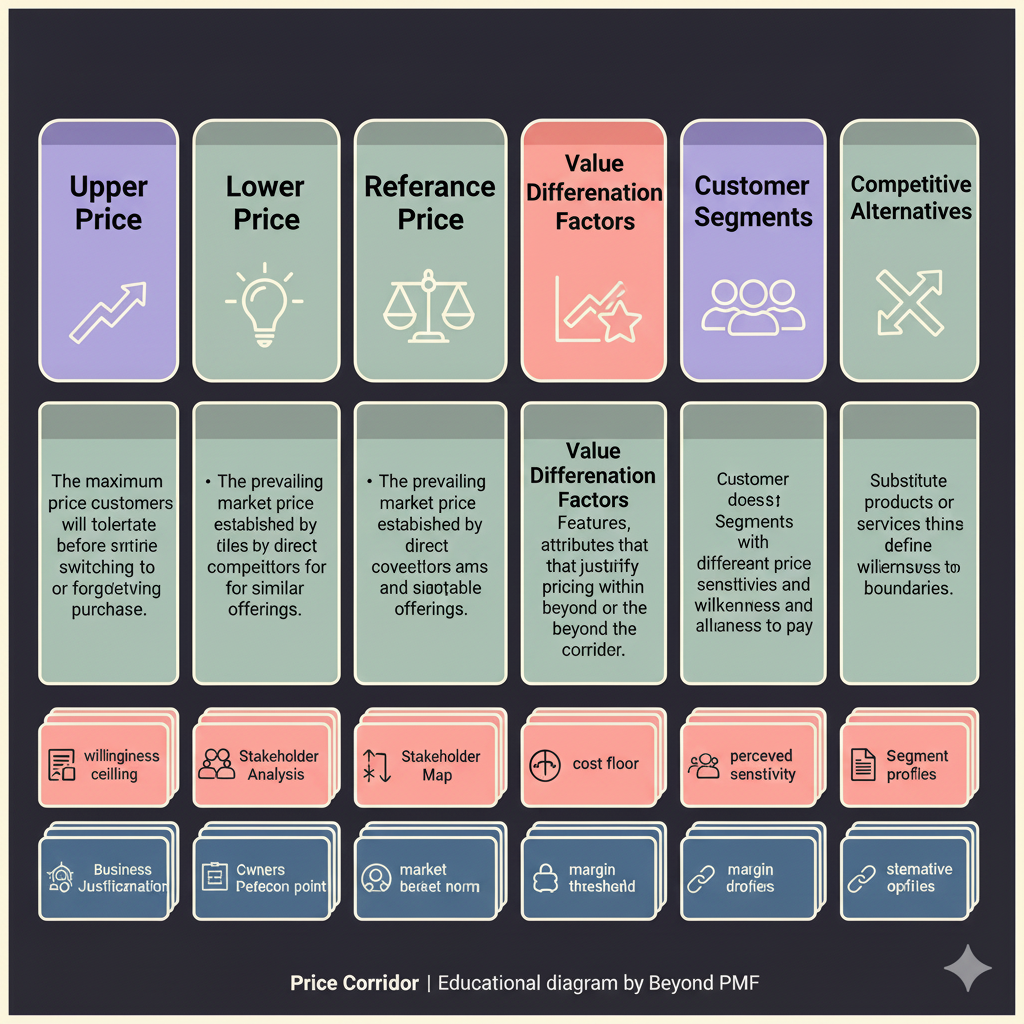
Price Corridor Framework

The Price Corridor Framework directly addresses strategic friction by providing a method to analyze competitor pricing and customer value, ultimately informing the optimal price strategy and market positioning. This supports defining and refining the overall business model.

The Price Corridor Framework helps businesses identify the most effective pricing zone by considering the price points of direct and indirect competitors and the perceived value to the customer. This framework is particularly useful in maximizing profitability while ensuring competitive alignment. It involves a detailed analysis of market conditions, competitor strategies, and customer demand to set a price that optimizes both sales volume and profit margins.

Steps / Detailed Description

Identify direct and indirect competitors and gather their pricing data. | Analyze the value proposition of your product relative to competitors. | Determine the customer's perceived value of your product. | Map out the price corridor by identifying the lower and upper price limits based on competitor pricing and customer value. | Adjust the pricing strategy within the corridor to find the optimal price point. | Continuously monitor market changes and adjust the price corridor as necessary.

Best Practices

Regularly update competitor data to maintain pricing relevance. | Engage in customer feedback to understand changes in value perception. | Use a cross-functional team to gather and analyze data.

Pros

Allows for competitive pricing while considering customer value perception. | Helps in maximizing profitability by finding the optimal price point. | Flexible to changes in market conditions and competitor strategies.

Cons

Requires comprehensive and ongoing market and competitor analysis. | May not be suitable for products with unique or niche markets. | Dependent on accurate data collection and analysis.

When to Use

When entering a new market with established competitors. | When launching a new product similar to existing market offerings.

When Not to Use

In highly innovative or unique product markets where competitors are not comparable. | When market data is insufficient or unreliable.

Related Frameworks

Scope

Scope not defined

Maturity Level

Maturity level not specified

Time to Implement

2–4 Weeks
3–6 Months
1–2 Weeks
3–6 Months
1–2 Months
3–6 Months
1–2 Weeks
Less Than 1 Day
1–2 Weeks
Longer Than 6 Months
1–2 Weeks
Longer Than 6 Months
1–2 Weeks
3–6 Months
1–2 Weeks
1–2 Weeks
1–2 Weeks
1–2 Weeks
1–2 Days
1–2 Weeks
1–2 Weeks
1–2 Weeks
1–2 Weeks
1–2 Weeks
1–2 Weeks
3–6 Months
1–2 Weeks
1–2 Weeks
1–2 Weeks
3–6 Months
1–2 Weeks
1–2 Weeks
2–4 Weeks
1–2 Weeks
1–2 Days
1–2 Weeks
Longer Than 6 Months
3–6 Months
Longer Than 6 Months
1–2 Weeks
Longer Than 6 Months
3–6 Months
Less Than 1 Day
3–6 Months
1–2 Months
3–6 Months
Longer Than 6 Months
3–6 Months
Less Than 1 Day
1–2 Weeks
3–6 Months
3–6 Months
1–2 Weeks
3–6 Months
1–2 Weeks
1–2 Weeks
1–2 Days
1–2 Weeks
1–2 Months
Longer Than 6 Months
1–2 Weeks
Longer Than 6 Months
1–2 Weeks
3–6 Months
1–2 Weeks
Less Than 1 Day
1–2 Weeks
3–6 Months
1–2 Weeks
3–6 Months
1–2 Weeks
1–2 Weeks
Longer Than 6 Months
Less Than 1 Day
3–6 Months
Longer Than 6 Months
1–2 Months
1–2 Weeks
Longer Than 6 Months
1–2 Weeks
3–6 Months
1–2 Weeks
1–2 Weeks
3–6 Months
Less Than 1 Day
1–2 Weeks
1–2 Weeks
3–6 Months
3–6 Months
Less Than 1 Day
1–2 Weeks
Longer Than 6 Months
1–2 Months
1–2 Weeks
1–2 Weeks
1–2 Weeks
Longer Than 6 Months

Copyright Information

Autor:
Public Domain
N/A
Publication:
Generic Business Tool