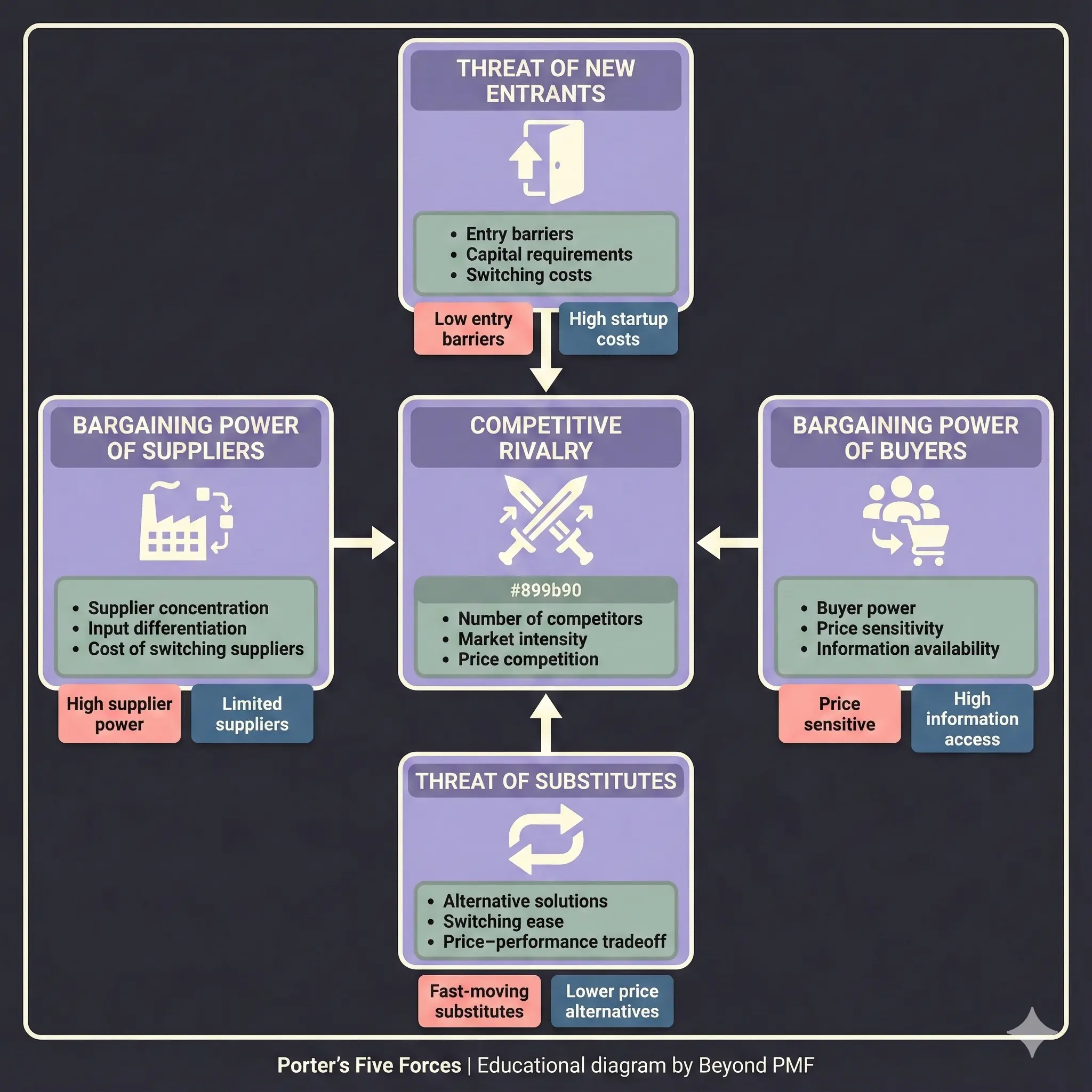
Developed by Michael E. Porter in 1979, Porter's Five Forces framework is used to analyze the competitive forces that shape every industry, and helps determine an industry's weaknesses and strengths. The framework focuses on five forces that determine the competitive intensity and therefore attractiveness of a market. These forces are: competitive rivalry, threat of new entrants, threat of substitute products, bargaining power of buyers, and bargaining power of suppliers. This analysis is crucial for developing strategic positioning and understanding the competitive landscape.
Identify competitive rivalry within the industry. | Analyze the threat of new entrants to the market. | Evaluate the threat of substitute products or services. | Assess the bargaining power of buyers. | Determine the bargaining power of suppliers.
Regularly update the analysis to reflect market changes. | Combine with other strategic tools for comprehensive insights. | Customize analysis to specific industry characteristics.
Provides a thorough understanding of industry structure. | Helps in strategic planning and market positioning. | Facilitates assessment of potential profitability in an industry.
May oversimplify the complexities of some industries. | Can be less effective in rapidly changing markets. | Focuses mainly on external factors, ignoring internal dynamics.
When entering a new market. | When considering business expansion or diversification.
In highly volatile industries where data changes frequently. | When internal factors are more significant than external ones.