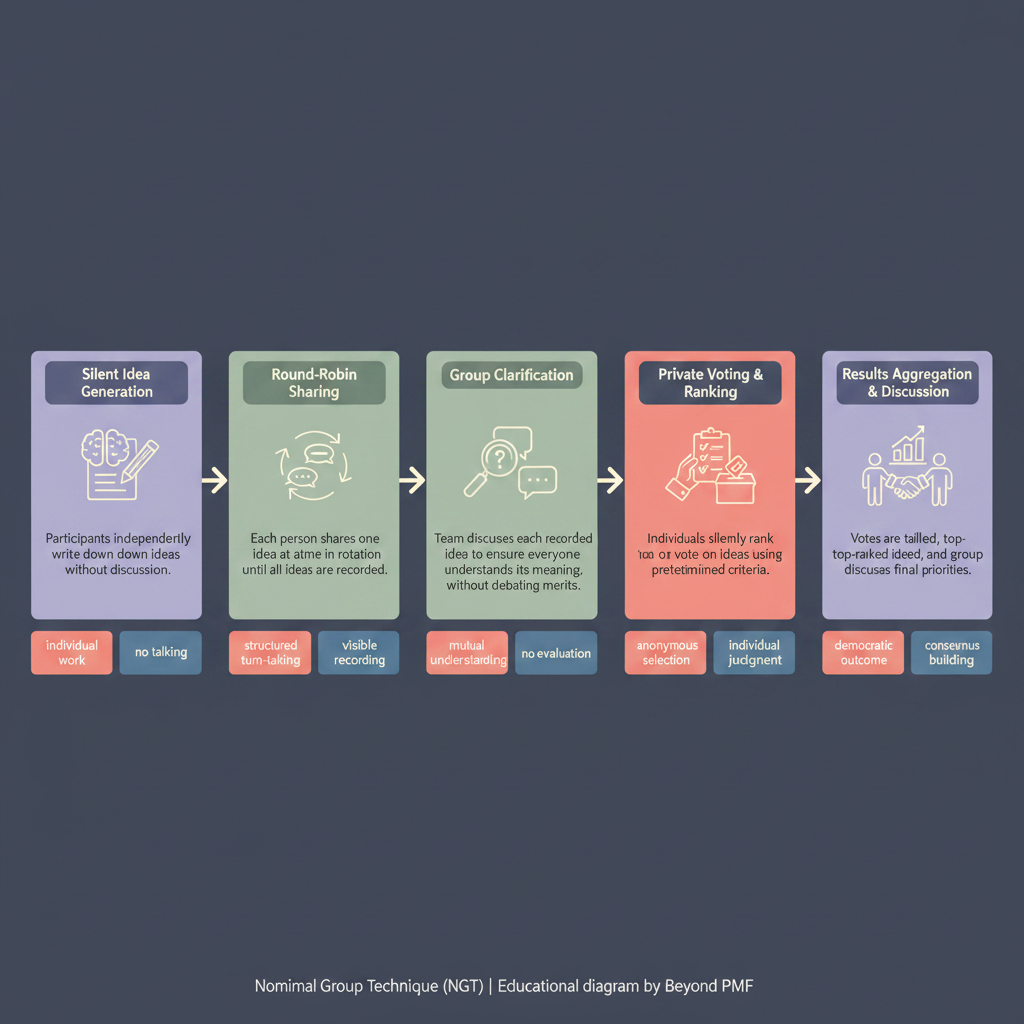
Nominal Group Technique (NGT)

https://ik.imagekit.io/beyondpmf/frameworks/nominal-group-technique-ngt.png
The Nominal Group Technique primarily addresses friction related to process and coordination within a group setting. It aims to improve workflows by providing a structured method for brainstorming and decision-making, ensuring that all participants contribute and that the process is efficient.

The Nominal Group Technique (NGT) is a collaborative decision-making process used to ensure equal participation from all members of a group. It is particularly effective in situations where some group members are much more vocal than others. The technique helps in gathering a wide range of ideas and achieving a consensus by prioritizing issues, making it highly beneficial for strategic planning and problem-solving.

Steps / Detailed Description

Introduction and presentation of the problem | Silent generation of ideas by each participant | Round-robin sharing of ideas | Group discussion for clarification and evaluation | Individual voting on ideas (usually through ranking or rating)

Best Practices

Ensure clear instructions are given | Keep the group size manageable | Use a skilled facilitator

Pros

Encourages equal participation from all group members | Reduces the influence of dominant individuals | Generates a diverse set of ideas

Cons

Can be time-consuming | May not be suitable for complex problems | Depends on the facilitator's skills

When to Use

When needing to generate a wide range of ideas | When group consensus is necessary

When Not to Use

When quick decisions are needed | In very large groups without adequate facilitation

Related Frameworks

Lifecycle

Scope

Scope not defined

Maturity Level

Maturity level not specified

Time to Implement

2–4 Weeks
3–6 Months
1–2 Weeks
3–6 Months
1–2 Months
3–6 Months
1–2 Weeks
Less Than 1 Day
1–2 Weeks
Longer Than 6 Months
1–2 Weeks
Longer Than 6 Months
1–2 Weeks
3–6 Months
1–2 Weeks
1–2 Weeks
1–2 Weeks
1–2 Weeks
1–2 Days
1–2 Weeks
1–2 Weeks
1–2 Weeks
1–2 Weeks
1–2 Weeks
1–2 Weeks
3–6 Months
1–2 Weeks
1–2 Weeks
1–2 Weeks
3–6 Months
1–2 Weeks
1–2 Weeks
2–4 Weeks
1–2 Weeks
1–2 Days
1–2 Weeks
Longer Than 6 Months
3–6 Months
Longer Than 6 Months
1–2 Weeks
Longer Than 6 Months
3–6 Months
Less Than 1 Day
3–6 Months
1–2 Months
3–6 Months
Longer Than 6 Months
3–6 Months
Less Than 1 Day
1–2 Weeks
3–6 Months
3–6 Months
1–2 Weeks
3–6 Months
1–2 Weeks
1–2 Weeks
1–2 Days
1–2 Weeks
1–2 Months
Longer Than 6 Months
1–2 Weeks
Longer Than 6 Months
1–2 Weeks
3–6 Months
1–2 Weeks
Less Than 1 Day
1–2 Weeks
3–6 Months
1–2 Weeks
3–6 Months
1–2 Weeks
1–2 Weeks
Longer Than 6 Months
Less Than 1 Day
3–6 Months
Longer Than 6 Months
1–2 Months
1–2 Weeks
Longer Than 6 Months
1–2 Weeks
3–6 Months
1–2 Weeks
1–2 Weeks
3–6 Months
Less Than 1 Day
1–2 Weeks
1–2 Weeks
3–6 Months
3–6 Months
Less Than 1 Day
1–2 Weeks
Longer Than 6 Months
1–2 Months
1–2 Weeks
1–2 Weeks
1–2 Weeks
Longer Than 6 Months

Copyright Information

Autor:
Public Domain
N/A
Publication:
Generic Business Tool