Lightning Decision Jam (LDJ)

https://ik.imagekit.io/beyondpmf/frameworks/lightning-decision-jam-ldj.png
The Lightning Decision Jam is designed to bypass lengthy discussions and generate actionable solutions, implying a focus on improving the speed and efficiency of problem-solving and implementation. This directly addresses friction in the execution phase, specifically the timely delivery of solutions.

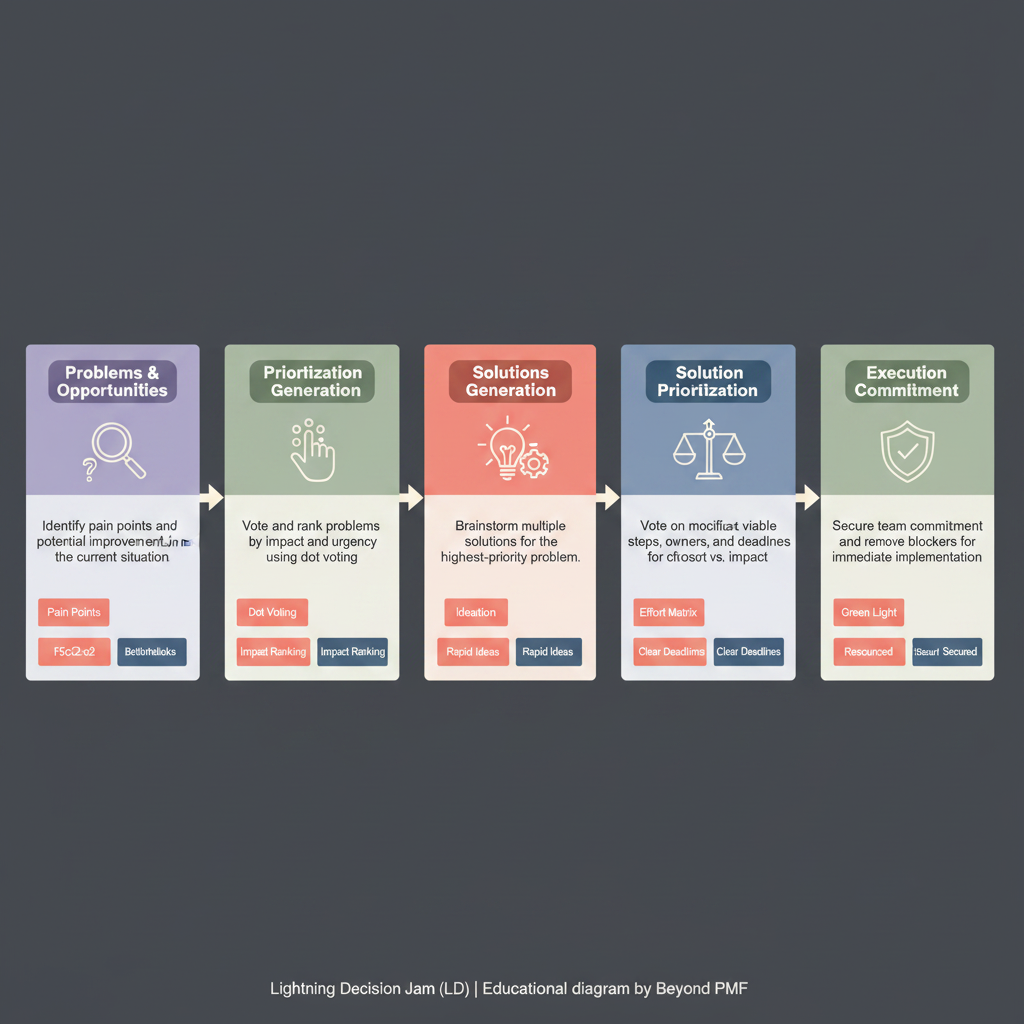
The Lightning Decision Jam (LDJ) is a facilitation technique used to address and solve complex problems quickly and efficiently. It replaces open-ended discussions with a clear, time-boxed process, helping teams to avoid common decision-making pitfalls like unstructured debates and decision fatigue. By using a series of structured exercises, LDJ helps teams to prioritize issues, generate solutions, and decide on action steps in a democratic and efficient manner. This approach not only accelerates the decision-making process but also enhances team alignment and collaboration.

Steps / Detailed Description

Problem Framing: Identify and articulate the main issues. | Solution Brainstorming: Each participant writes down potential solutions. | Dot Voting: Team members vote on the best ideas using dot stickers. | Action Planning: Develop action steps for the top-voted solutions. | Reflection: Reflect on the process and discuss improvements for future sessions.

Best Practices

Ensure clear understanding of the process among participants | Keep the session time-boxed to maintain focus | Follow up on action items to ensure implementation

Pros

Quickly generates actionable solutions | Enhances team alignment and collaboration | Reduces time spent in unproductive discussions

Cons

May overlook deeper issues due to time constraints | Not suitable for extremely complex or technical problems | Can be less effective without a skilled facilitator

When to Use

When needing to solve a problem quickly | When team alignment and buy-in are needed

When Not to Use

For deeply technical or specialized issues requiring expert input | When detailed analysis or extensive data gathering is necessary

Related Frameworks

Lifecycle

Scope

Scope not defined

Maturity Level

Maturity level not specified

Time to Implement

2–4 Weeks
3–6 Months
1–2 Weeks
3–6 Months
1–2 Months
3–6 Months
1–2 Weeks
Less Than 1 Day
1–2 Weeks
Longer Than 6 Months
1–2 Weeks
Longer Than 6 Months
1–2 Weeks
3–6 Months
1–2 Weeks
1–2 Weeks
1–2 Weeks
1–2 Weeks
1–2 Days
1–2 Weeks
1–2 Weeks
1–2 Weeks
1–2 Weeks
1–2 Weeks
1–2 Weeks
3–6 Months
1–2 Weeks
1–2 Weeks
1–2 Weeks
3–6 Months
1–2 Weeks
1–2 Weeks
2–4 Weeks
1–2 Weeks
1–2 Days
1–2 Weeks
Longer Than 6 Months
3–6 Months
Longer Than 6 Months
1–2 Weeks
Longer Than 6 Months
3–6 Months
Less Than 1 Day
3–6 Months
1–2 Months
3–6 Months
Longer Than 6 Months
3–6 Months
Less Than 1 Day
1–2 Weeks
3–6 Months
3–6 Months
1–2 Weeks
3–6 Months
1–2 Weeks
1–2 Weeks
1–2 Days
1–2 Weeks
1–2 Months
Longer Than 6 Months
1–2 Weeks
Longer Than 6 Months
1–2 Weeks
3–6 Months
1–2 Weeks
Less Than 1 Day
1–2 Weeks
3–6 Months
1–2 Weeks
3–6 Months
1–2 Weeks
1–2 Weeks
Longer Than 6 Months
Less Than 1 Day
3–6 Months
Longer Than 6 Months
1–2 Months
1–2 Weeks
Longer Than 6 Months
1–2 Weeks
3–6 Months
1–2 Weeks
1–2 Weeks
3–6 Months
Less Than 1 Day
1–2 Weeks
1–2 Weeks
3–6 Months
3–6 Months
Less Than 1 Day
1–2 Weeks
Longer Than 6 Months
1–2 Months
1–2 Weeks
1–2 Weeks
1–2 Weeks
Longer Than 6 Months

Copyright Information

Autor:
AJ&Smart
Unknown
Publication:
AJ&Smart