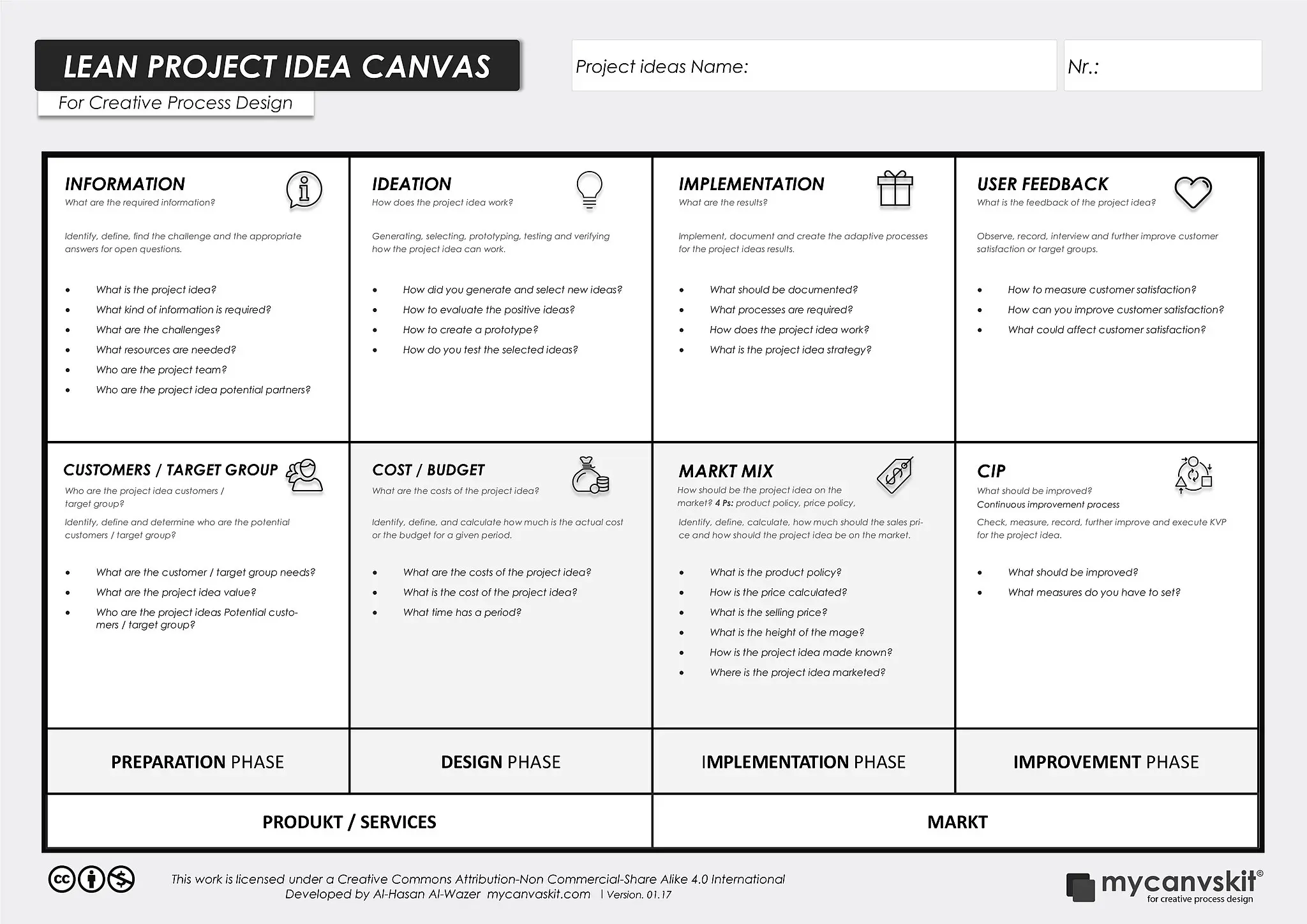
The Lean Canvas is a one-page business planning tool that helps founders deconstruct their idea into key assumptions. Developed by Ash Maurya, it is adapted from the Business Model Canvas by Alexander Osterwalder. This framework focuses on addressing startup risks and challenges, emphasizing problem-solving, customer segments, unique value propositions, and revenue streams. It's designed to be dynamic and easy to adjust, making it ideal for startups that need to pivot and adapt quickly.
Identify the problem your business intends to solve. | Define the customer segments that have these problems. | Outline the unique value proposition that differentiates your product. | List the solution for the problems identified. | Determine the channels to reach the customer segments. | Establish the revenue streams. | Detail the cost structure. | Identify key metrics that will measure the success of the business. | List the unfair advantage that cannot be easily copied or bought.
Regularly update the canvas as you learn more about your customers and market. | Use customer feedback to refine the canvas. | Keep the canvas clear and concise.
Quick to create and iterate | Focuses on problems and solutions | Ideal for startups and new products
May oversimplify complex business models | Less comprehensive than traditional business plans | Can be too rigid for more exploratory or innovative ventures
In the early stages of a startup | When pivoting or iterating on a business model
For established businesses with complex needs | When detailed planning and comprehensive strategy are required