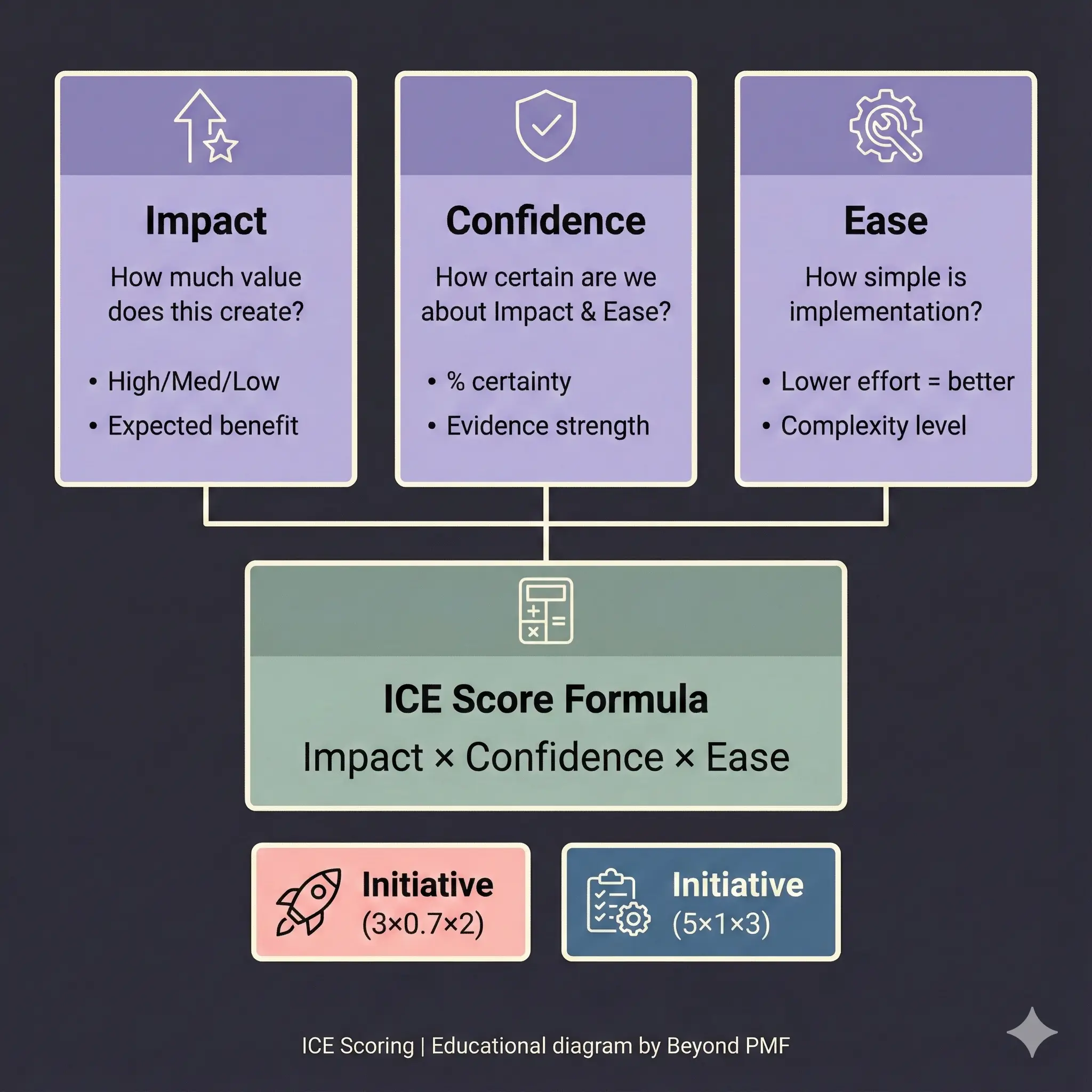
ICE Scoring is a framework designed to help teams prioritize features, projects, or ideas by scoring them on three criteria: Impact, Confidence, and Ease. Each criterion is rated, and the scores are then multiplied to give an overall ICE score. This method provides a quantitative way to compare different initiatives, helping teams to focus resources on the most valuable projects and ensure alignment with business objectives.
Identify the project or feature to be evaluated. | Rate the Impact: Assess how much the project will contribute to key business goals. | Rate the Confidence: Evaluate how sure you are about your impact assessment. | Rate the Ease: Determine how easy it will be to implement the project. | Calculate the ICE score: Multiply the scores of Impact, Confidence, and Ease. | Prioritize projects based on their ICE scores.
Ensure a diverse group is involved in the scoring to minimize bias. | Regularly review and adjust the scores as new information becomes available. | Combine ICE scoring with other frameworks for a more comprehensive analysis.
Simple and quick to apply | Helps in making data-driven decisions | Facilitates prioritization among a variety of options
Subjective scoring can lead to inconsistencies | May not account for interdependencies between projects | Overemphasis on ease of implementation may neglect long-term value
When prioritizing new features for development | When allocating resources among competing projects
When projects are legally or operationally mandatory | When there is a lack of data to accurately score one or more dimensions