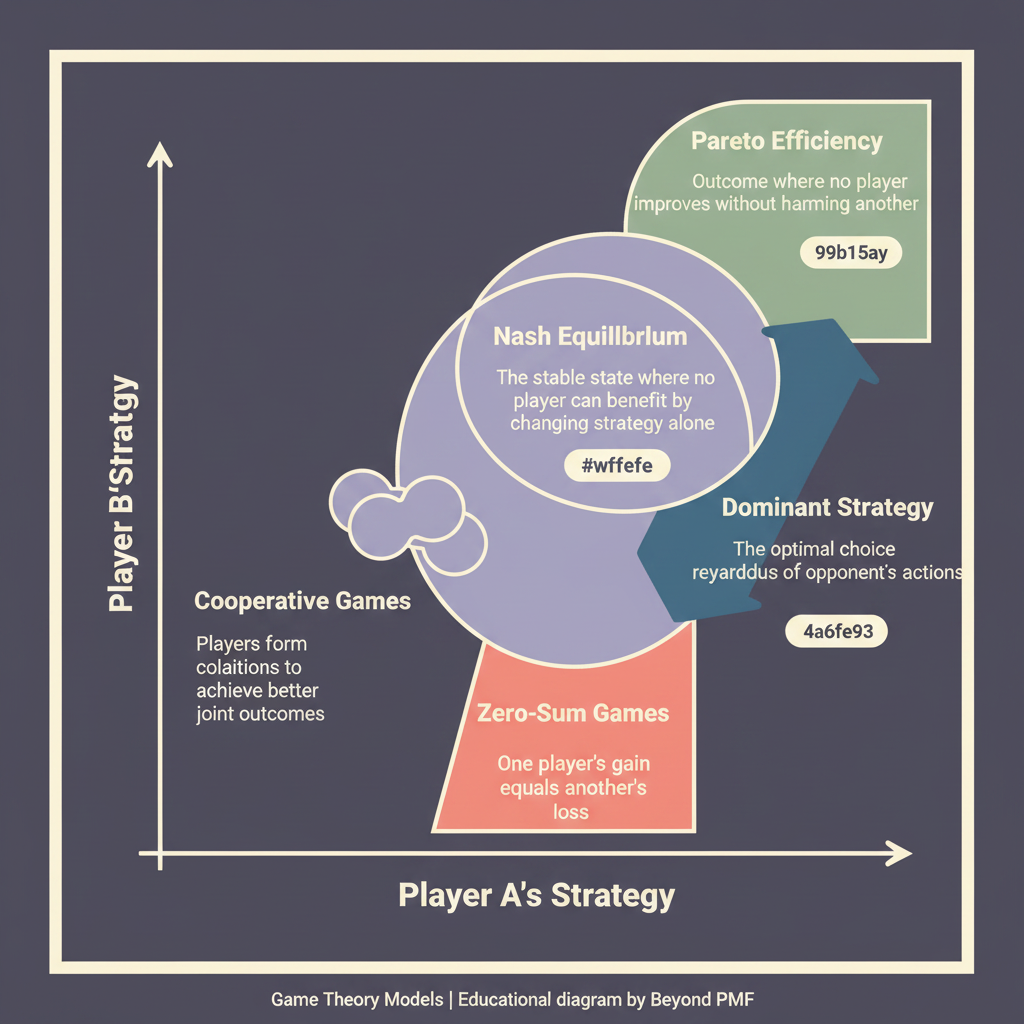
Game Theory Models

https://ik.imagekit.io/beyondpmf/frameworks/game-theory-models.png
Game Theory Models address the friction of unclear direction and conflicting priorities that arise in strategic interactions. They provide a framework for understanding how different players' actions and decisions influence the overall outcome, helping to develop a clearer vision and strategy.

Game Theory Models are a set of frameworks in economics and business that help analyze situations among competing players where the outcome for each participant is affected by the decisions of others. Primarily used in economics, political science, and psychology, these models help predict what decisions players will make in strategic situations. The benefits of using Game Theory include improved decision-making, strategic planning, and competitive analysis.

Steps / Detailed Description

Define the players: Identify all the participants in the game. | Determine the strategies: List all possible strategies available to the players. | Establish payoffs: Assign outcomes to every possible combination of strategies. | Analyze Nash Equilibria: Determine the set of strategies where no player can benefit by changing their strategy unilaterally. | Iterate and refine: Based on initial findings, refine strategies and outcomes to explore further strategic insights.

Best Practices

Clearly define all possible strategies and outcomes | Consider repeated games to account for strategy evolution over time | Use empirical data to inform and adjust theoretical models

Pros

Provides a structured way to analyze competitive interactions | Helps predict behaviors in strategic situations | Facilitates better strategic planning and decision making

Cons

Can be overly simplistic, ignoring real-world complexities | Assumes rational behavior, which is not always the case | Often requires extensive data and complex calculations

When to Use

In competitive market analysis | During negotiation strategy development

When Not to Use

When insufficient data is available | In highly unpredictable or irrational environments

Related Frameworks

Categories

Lifecycle

Not tied to a specific lifecycle stage

Scope

Scope not defined

Maturity Level

Maturity level not specified

Time to Implement

2–4 Weeks
3–6 Months
1–2 Weeks
3–6 Months
1–2 Months
3–6 Months
1–2 Weeks
Less Than 1 Day
1–2 Weeks
Longer Than 6 Months
1–2 Weeks
Longer Than 6 Months
1–2 Weeks
3–6 Months
1–2 Weeks
1–2 Weeks
1–2 Weeks
1–2 Weeks
1–2 Days
1–2 Weeks
1–2 Weeks
1–2 Weeks
1–2 Weeks
1–2 Weeks
1–2 Weeks
3–6 Months
1–2 Weeks
1–2 Weeks
1–2 Weeks
3–6 Months
1–2 Weeks
1–2 Weeks
2–4 Weeks
1–2 Weeks
1–2 Days
1–2 Weeks
Longer Than 6 Months
3–6 Months
Longer Than 6 Months
1–2 Weeks
Longer Than 6 Months
3–6 Months
Less Than 1 Day
3–6 Months
1–2 Months
3–6 Months
Longer Than 6 Months
3–6 Months
Less Than 1 Day
1–2 Weeks
3–6 Months
3–6 Months
1–2 Weeks
3–6 Months
1–2 Weeks
1–2 Weeks
1–2 Days
1–2 Weeks
1–2 Months
Longer Than 6 Months
1–2 Weeks
Longer Than 6 Months
1–2 Weeks
3–6 Months
1–2 Weeks
Less Than 1 Day
1–2 Weeks
3–6 Months
1–2 Weeks
3–6 Months
1–2 Weeks
1–2 Weeks
Longer Than 6 Months
Less Than 1 Day
3–6 Months
Longer Than 6 Months
1–2 Months
1–2 Weeks
Longer Than 6 Months
1–2 Weeks
3–6 Months
1–2 Weeks
1–2 Weeks
3–6 Months
Less Than 1 Day
1–2 Weeks
1–2 Weeks
3–6 Months
3–6 Months
Less Than 1 Day
1–2 Weeks
Longer Than 6 Months
1–2 Months
1–2 Weeks
1–2 Weeks
1–2 Weeks
Longer Than 6 Months

Copyright Information

Autor:
Public Domain
N/A
Publication:
Generic Business Tool