Five Forces Analysis

https://ik.imagekit.io/beyondpmf/frameworks/five-forces-analysis.png
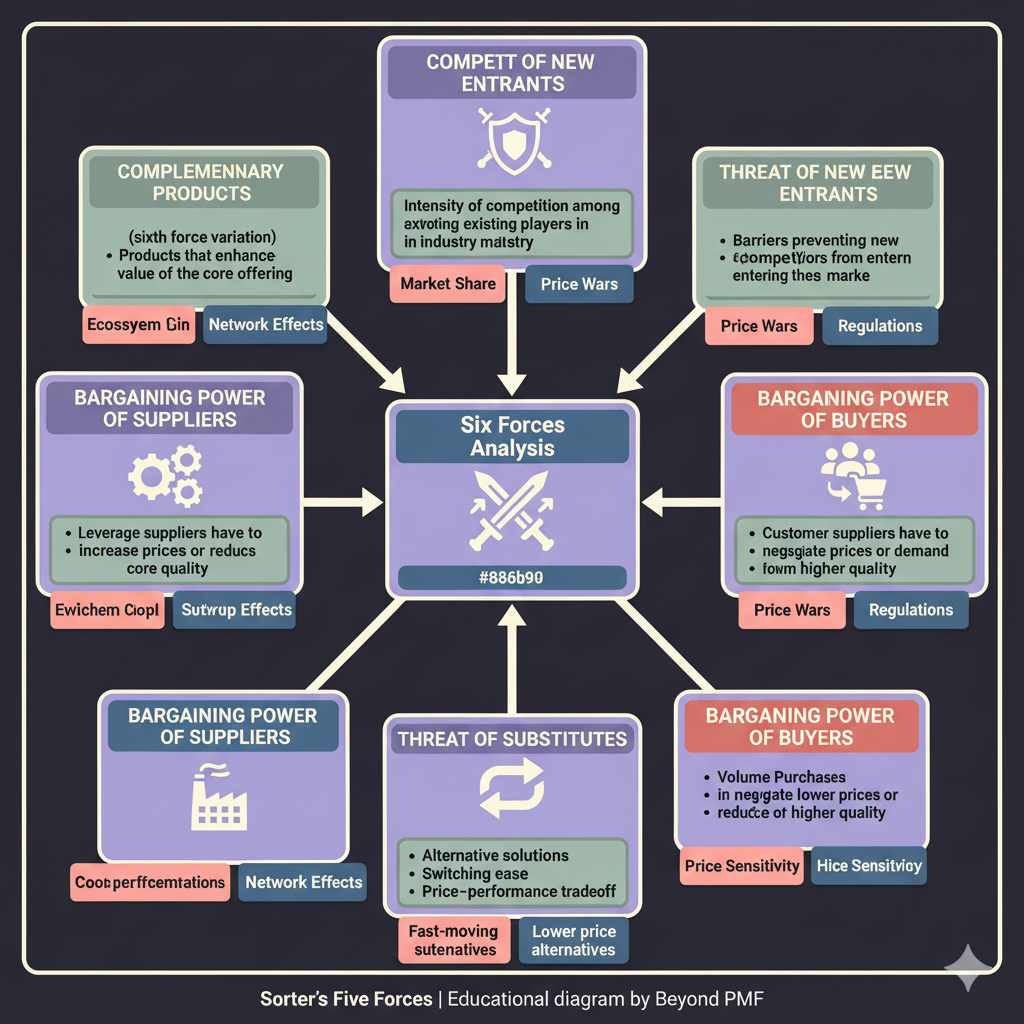
Five Forces Analysis helps businesses understand the competitive forces shaping their industry. This addresses strategic friction by providing insights into market attractiveness and the potential for profitability, enabling better strategic decisions regarding market positioning and business model.

Five Forces Analysis, developed by Michael Porter, is a framework for analyzing the competitive forces that shape every industry. It is used to assess the competitive intensity and therefore the attractiveness and profitability of an industry. The framework helps businesses identify the strengths and weaknesses in their industry environment, guiding strategic decision-making.

Steps / Detailed Description

Identify competitors: Analyze the current competitive rivalry within the industry. | Assess potential new entrants: Evaluate the threat posed by new companies entering the market. | Evaluate substitute products: Determine the threat of products or services that can replace existing offerings. | Analyze bargaining power of suppliers: Assess how much power suppliers to the industry hold. | Analyze bargaining power of customers: Determine the impact of customers' bargaining power on the industry.

Best Practices

Regularly update the analysis to reflect market changes | Combine with other strategic tools for comprehensive insights | Ensure accurate and current data for reliable analysis

Pros

Provides a thorough understanding of industry structure | Helps in strategic planning and market positioning | Facilitates the assessment of profitability in competitive environments

Cons

May oversimplify the complexities of some industries | Can be time-consuming to gather all necessary data | Relies heavily on the availability and accuracy of industry data

When to Use

When entering a new market | When considering new investments or business expansion

When Not to Use

In rapidly changing industries where data quickly becomes outdated | When insufficient industry data is available

Related Frameworks

Categories

Lifecycle

Not tied to a specific lifecycle stage

Scope

Scope not defined

Maturity Level

Maturity level not specified

Time to Implement

2–4 Weeks
3–6 Months
1–2 Weeks
3–6 Months
1–2 Months
3–6 Months
1–2 Weeks
Less Than 1 Day
1–2 Weeks
Longer Than 6 Months
1–2 Weeks
Longer Than 6 Months
1–2 Weeks
3–6 Months
1–2 Weeks
1–2 Weeks
1–2 Weeks
1–2 Weeks
1–2 Days
1–2 Weeks
1–2 Weeks
1–2 Weeks
1–2 Weeks
1–2 Weeks
1–2 Weeks
3–6 Months
1–2 Weeks
1–2 Weeks
1–2 Weeks
3–6 Months
1–2 Weeks
1–2 Weeks
2–4 Weeks
1–2 Weeks
1–2 Days
1–2 Weeks
Longer Than 6 Months
3–6 Months
Longer Than 6 Months
1–2 Weeks
Longer Than 6 Months
3–6 Months
Less Than 1 Day
3–6 Months
1–2 Months
3–6 Months
Longer Than 6 Months
3–6 Months
Less Than 1 Day
1–2 Weeks
3–6 Months
3–6 Months
1–2 Weeks
3–6 Months
1–2 Weeks
1–2 Weeks
1–2 Days
1–2 Weeks
1–2 Months
Longer Than 6 Months
1–2 Weeks
Longer Than 6 Months
1–2 Weeks
3–6 Months
1–2 Weeks
Less Than 1 Day
1–2 Weeks
3–6 Months
1–2 Weeks
3–6 Months
1–2 Weeks
1–2 Weeks
Longer Than 6 Months
Less Than 1 Day
3–6 Months
Longer Than 6 Months
1–2 Months
1–2 Weeks
Longer Than 6 Months
1–2 Weeks
3–6 Months
1–2 Weeks
1–2 Weeks
3–6 Months
Less Than 1 Day
1–2 Weeks
1–2 Weeks
3–6 Months
3–6 Months
Less Than 1 Day
1–2 Weeks
Longer Than 6 Months
1–2 Months
1–2 Weeks
1–2 Weeks
1–2 Weeks
Longer Than 6 Months

Copyright Information

Autor:
Michael Porter
1979
Publication:
Harvard Business Review