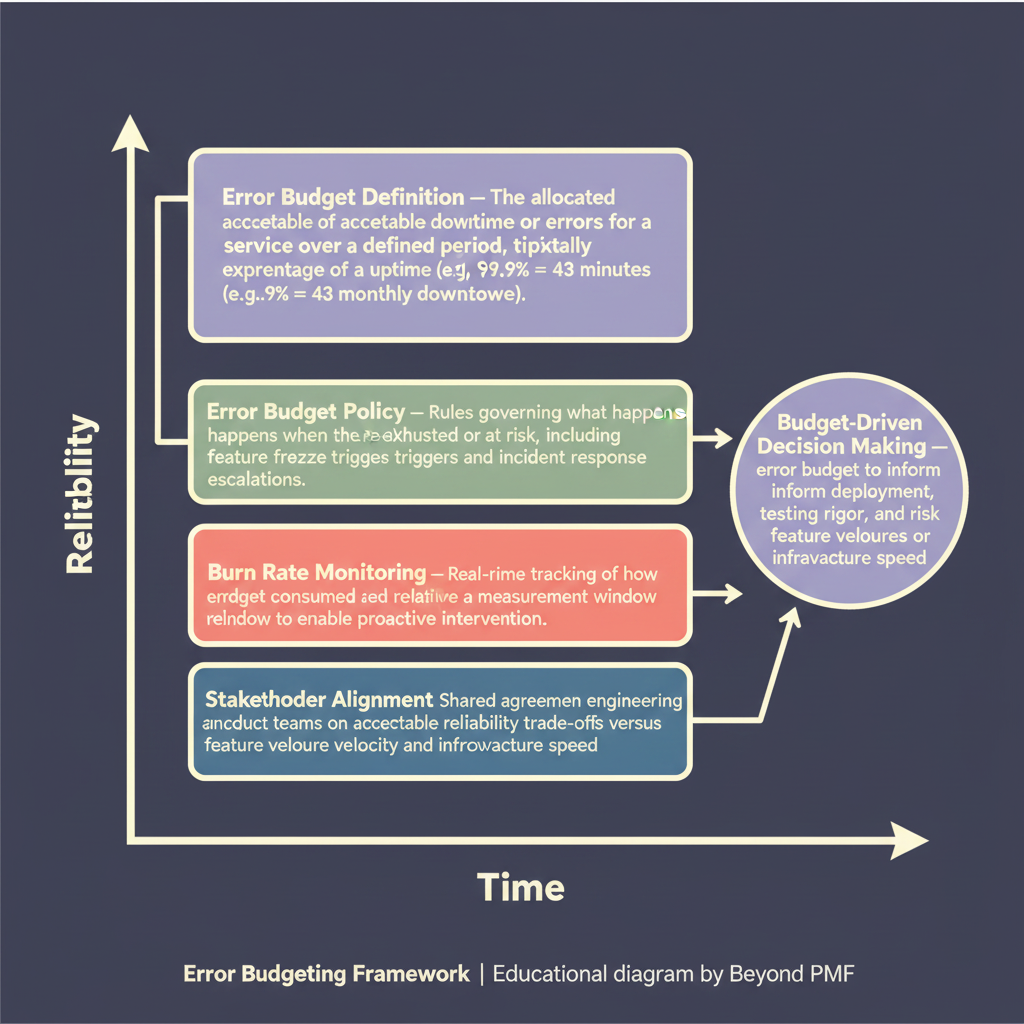
Error Budgeting Framework

https://ik.imagekit.io/beyondpmf/frameworks/error-budgeting-framework.png
The Error Budgeting Framework primarily addresses the friction of balancing rapid innovation with the delivery of a stable, high-quality service, which directly impacts customer experience. It helps manage the acceptable level of service failures, a crucial aspect of execution and delivery.

The Error Budgeting Framework is a strategic approach used primarily in site reliability engineering (SRE) to quantify the allowable amount of service downtime or errors in a given period. By setting a numerical limit on errors, teams can make informed decisions about the risks they can afford while pushing new features. This framework helps maintain a balance between reliability and the rapid deployment of new functionalities, ensuring customer satisfaction and system stability.

Steps / Detailed Description

Define service level objectives (SLOs) that align with business goals. | Calculate the error budget based on these SLOs. | Monitor system performance and track errors against the error budget. | Implement policies for what happens if the error budget is exhausted. | Adjust development pace or reliability measures based on error budget consumption.

Best Practices

Regularly review and adjust SLOs to reflect actual user expectations | Integrate error budget metrics into daily operations | Foster a culture of accountability and transparency around reliability

Pros

Promotes a balance between innovation and reliability | Provides a quantitative measure to guide decision-making | Helps prioritize engineering efforts on reliability when necessary

Cons

Requires accurate setting and understanding of SLOs | Can be challenging to implement without mature monitoring tools | May lead to reduced innovation speed if not managed properly

When to Use

In environments where reliability is critical to business operations | When introducing new features or services at a rapid pace

When Not to Use

In early-stage development where rapid iteration is more valuable than stability | When the service impact of downtime is minimal or negligible

Related Frameworks

Categories

Lifecycle

Not tied to a specific lifecycle stage

Scope

Scope not defined

Maturity Level

Maturity level not specified

Time to Implement

2–4 Weeks
3–6 Months
1–2 Weeks
3–6 Months
1–2 Months
3–6 Months
1–2 Weeks
Less Than 1 Day
1–2 Weeks
Longer Than 6 Months
1–2 Weeks
Longer Than 6 Months
1–2 Weeks
3–6 Months
1–2 Weeks
1–2 Weeks
1–2 Weeks
1–2 Weeks
1–2 Days
1–2 Weeks
1–2 Weeks
1–2 Weeks
1–2 Weeks
1–2 Weeks
1–2 Weeks
3–6 Months
1–2 Weeks
1–2 Weeks
1–2 Weeks
3–6 Months
1–2 Weeks
1–2 Weeks
2–4 Weeks
1–2 Weeks
1–2 Days
1–2 Weeks
Longer Than 6 Months
3–6 Months
Longer Than 6 Months
1–2 Weeks
Longer Than 6 Months
3–6 Months
Less Than 1 Day
3–6 Months
1–2 Months
3–6 Months
Longer Than 6 Months
3–6 Months
Less Than 1 Day
1–2 Weeks
3–6 Months
3–6 Months
1–2 Weeks
3–6 Months
1–2 Weeks
1–2 Weeks
1–2 Days
1–2 Weeks
1–2 Months
Longer Than 6 Months
1–2 Weeks
Longer Than 6 Months
1–2 Weeks
3–6 Months
1–2 Weeks
Less Than 1 Day
1–2 Weeks
3–6 Months
1–2 Weeks
3–6 Months
1–2 Weeks
1–2 Weeks
Longer Than 6 Months
Less Than 1 Day
3–6 Months
Longer Than 6 Months
1–2 Months
1–2 Weeks
Longer Than 6 Months
1–2 Weeks
3–6 Months
1–2 Weeks
1–2 Weeks
3–6 Months
Less Than 1 Day
1–2 Weeks
1–2 Weeks
3–6 Months
3–6 Months
Less Than 1 Day
1–2 Weeks
Longer Than 6 Months
1–2 Months
1–2 Weeks
1–2 Weeks
1–2 Weeks
Longer Than 6 Months

Copyright Information

Autor:
Unknown
N/A
Publication:
Unknown