
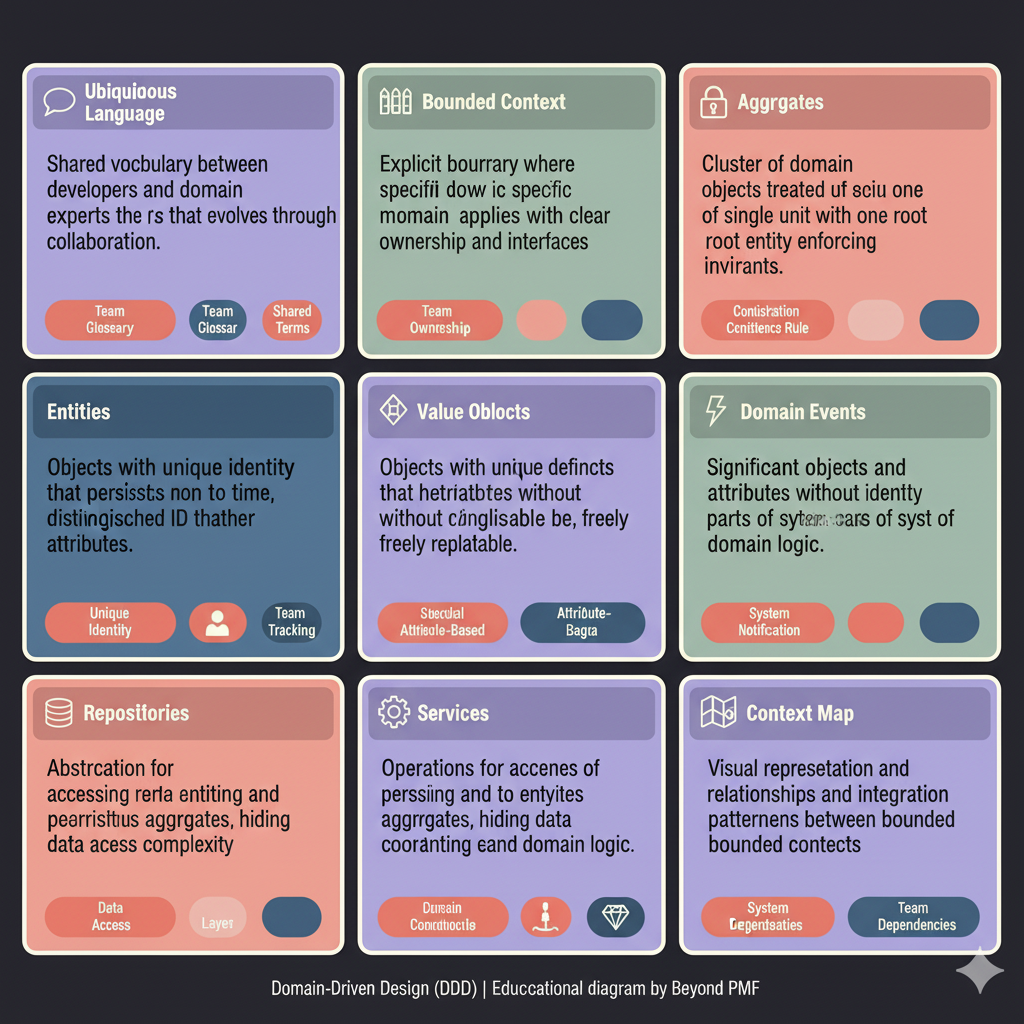
Domain-Driven Design (DDD) is a framework for designing and implementing software systems that focuses on creating a model based on the core business concepts. It emphasizes collaboration between technical and domain experts to improve system functionality and ensure the software accurately reflects business needs. DDD helps in tackling complexity by dividing the system into bounded contexts and defining ubiquitous language, making it easier to deal with large models and teams.
Identify the domain and subdomains: Understand the business domain and identify distinct areas within it. | Define a ubiquitous language: Establish a common language between developers and domain experts to ensure clear communication. | Model the domain: Create a model that reflects the domain complexities and priorities. | Isolate the domain: Use bounded contexts to divide the system into manageable components. | Integrate bounded contexts: Define explicit interfaces for interaction between different parts of the system.
Engage domain experts throughout the project | Regularly refine and update the domain model | Keep the bounded contexts well-defined and integrated
Improves communication between developers and business experts | Facilitates a deep understanding of the domain | Enhances flexibility and scalability of the software system
Can be overly complex for simple applications | Requires significant upfront investment in domain understanding | Potential for over-engineering if not carefully managed
Complex business domains requiring deep understanding | Large systems with evolving business rules
Small-scale projects with limited domain complexity | Projects with tight deadlines and limited resources for domain modeling